


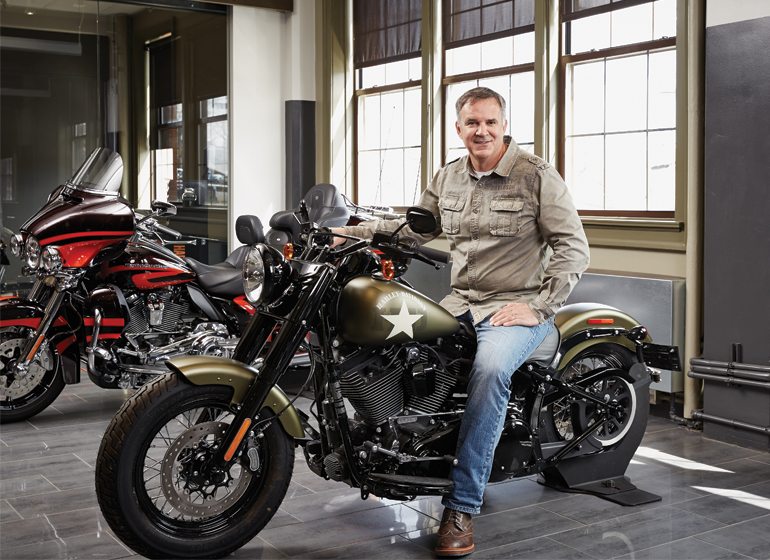

Matt Levatich has stepped down as president and chief executive officer of Harley-Davidson Inc. after 26 years with the company and nearly five years leading the company.
“The board and Matt mutually agreed that now is the time for new leadership at Harley-Davidson,” said Jochen Zeitz, a Harley board member who will serve as acting president and CEO. “Matt was instrumental in defining the More Roads to Harley-Davidson accelerated plan for growth, and we will look to new leadership to recharge our business.”
Zeitz has been on Harley’s board since 2007. He was chairman and CEO of Puma from 1993 to 2011.
Levatich will assist with the transition through the end of March. Harley’s board plans to form a committee and use an external search firm to find a new CEO.
Levatich said he is proud of what the company achieved during his time as CEO, which he described as “one of the most challenging periods in our history.”
“I am very fortunate to have spent many years with a company as revered as Harley-Davidson,” he said. “The grit and determination of the employees and dealers and their passion for bringing our brand of freedom to people around the world has always been inspiring.”
Levatich became president and CEO of Harley in 2015. Prior to that, he was president and chief operating officer of Harley-Davidson Motor Co. from 2009 to 2015. He first joined the company in 1994.
During Levatich’s time as CEO, Harley has been faced with a number of challenges. Retail sales of new Harley motorcycles dropped from 264,627 in 2015 to 218,273 in 2019, a 17.5% decline. The U.S. market accounted for most of that drop, going from 168,240 motorcycles to 125,960.
The company saw many of its core baby boomer riders begin to age out of the sport of motorcycling, leading to a surplus of used bikes on the market. At the same time, the company also faced increased competition from the relaunched Indian Motorcycle brand along with foreign competitors.
Compounding those challenges, Harley has been at the center of a number of trade disputes as President Donald Trump has ratcheted up his confrontation with other countries.
Harley was a target of retaliatory tariffs from the European Union, prompting Levatich and the company to opt to move final assembly of European bikes overseas. The decision drew the ire of Trump, who accused the company of waving the white flag and pledged to work with Harley competitors.
To counteract the mounting challenges, Harley launched a 10-year strategic plan in 2017 that called for growing the number of riders in the United States and launching 100 high-impact models. Levatich often described a shift in the company’s focus from building motorcycles to building riders.
Harley announced an accelerated approach to that plan in 2019 that called for additional investments and laid out a timeline for Harley to move into new motorcycle segments.
Over the course of the last 3 years, the company has spent an additional $66.4 million on research and development and $39 million more on advertising, compared to 2016 spending levels.
Also during Levatich’s tenure, Harley made several changes to production of its motorcycles. The company first moved production of some touring models from York, Pennsylvania to Kansas City. A year later, however, Harley launched a manufacturing optimization plan that called for the closure of the Kansas City plant with all work moving to York.
Despite the efforts, Harley has seen its business steadily decline in recent years. In 2015, the company reported $5.31 billion in motorcycle related revenue and $752 million in net income. Those metrics declined every year except 2018, which saw slight increases. By 2019, the company had $4.57 billion in motorcycle related revenue and $423 million in net income.

