Research Snappy
  • Market Research Forum
  • Investment Research
  • Consumer Research
  • More
    • Advertising Research
    • Healthcare Research
    • Data Analysis
    • Top Companies
    • Latest News
No Result
View All Result
Research Snappy
No Result
View All Result

Association of Reductions in PSA Screening Across States with Increased Metastatic Prostate Cancer in the United States

researchsnappy by researchsnappy
February 14, 2021
in Healthcare Research
0
Association of Reductions in PSA Screening Across States with Increased Metastatic Prostate Cancer in the United States
399
SHARES
2.3k
VIEWS
Share on FacebookShare on Twitter

(UroToday.com) Prostate cancer screening using prostate-specific antigen (PSA) testing has been controversial since shortly after its introduction in large part due to concerns of over-diagnosis and over-treatment, with the associated morbidity. Thus, despite improvements in prostate cancer-related metastasis and mortality demonstrated in the European Randomized Study of Screening for Prostate Cancer (ERSPC) randomized trial from Europe, PSA screening has remained contentious. In both 2008 and 2012, the US Preventive Services Task Force (USPSTF) did not recommend PSA screening. Some have attributed increased rates of metastatic prostate cancer in the US to reductions in PSA screening as a result of these recommendations from the USPSTF. To test this hypothesis, in the Poster Highlights: Prostate Cancer – Localized Disease Session at the 2021 American Society of Clinical Oncology (ASCO) Genitourinary (GU) Cancers Symposium, Dr. Vidit Sharma and colleagues assessed longitudinal variations in PSA screening across individual states with the incidence of de novo metastatic prostate cancer.

To do so, the authors used the North American Association of Central Cancer Registries to determine age-adjusted incidences of metastatic prostate cancer at diagnosis per 100,000 men between 2002 – 2016 for each state. The authors then used the Behavioral Risk Factor Surveillance System, which collects this information for men at least 40 years of age every 2 years from 2002 onward, to determine state-level survey-weighted estimates of PSA screening. PSA screening and metastasis data were collated as a multi-panel time series and then analyzed using a random-effects linear regression model with random effects at the state level.

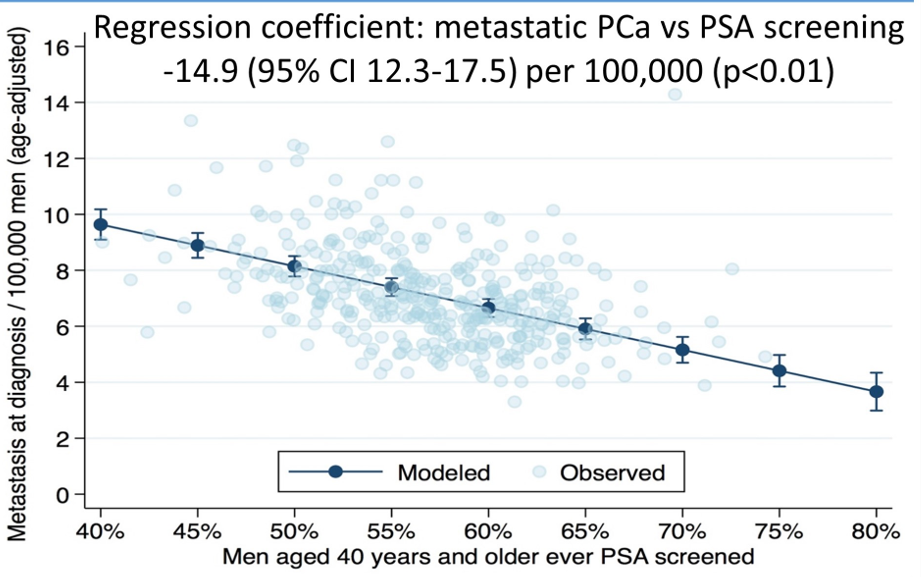
Dr. Sharma and colleagues identified significant variation between states in the percent of men age >40 years who reported ever receiving PSA screening (range 40.1% to 70.3%) and in the age-adjusted incidence of metastatic prostate cancer at diagnosis (range 3.3 to 14.3 per 100,000). Between 2008 and 2016, across all states, the mean percentage of men undergoing PSA screening decreased (61.8% to 50.5%) whereas the mean incidence of metastatic prostate cancer at diagnosis increased (6.4 to 9.0 per 100,000; Bonferroni adjusted p < 0.001 for both).

Using a random-effects linear regression model, the authors found that longitudinal reductions in PSA screening across states were associated with increased rates of de novo metastatic prostate cancer (regression coefficient per 100,000 men: 14.9, 95% confidence interval [CI] 12.3 – 17.5, p < 0.001), suggesting that states with larger declines in PSA screening had larger increases in the incidence of metastatic prostate cancer at diagnosis.

regression coefficient metastatic pca vs psa screening

Just over a quarter (27%) of longitudinal variation in rates of metastatic prostate cancer at diagnosis within states could be explained by variation in PSA screening.

The authors, therefore, conclude that reductions in PSA screening are likely to explain some of the observed increase in metastatic prostate cancer.

Presented by: Vidit Sharma, MD, Resident of Urology, Mayo Clinic, Rochester, Minnesota

Written by: Christopher J.D. Wallis, MD, PhD, Urologic Oncology Fellow, Vanderbilt University Medical Center, Nashville, Tennessee, Twitter: @WallisCJD during the 2021 ASCO Genitourinary Cancers Symposium (ASCO GU), February 11th to 13th, 2021

Previous Post

What It Takes For Amazon To Go To The Moon – Seeking Alpha

Next Post

In-vitro Toxicology Market Currently Growing at a CAGR of 15.4 Percent, Says Beroe Inc

Next Post
Global Sea Food Market Currently Estimated at $147.04 Billion, Says Beroe Inc

In-vitro Toxicology Market Currently Growing at a CAGR of 15.4 Percent, Says Beroe Inc

Research Snappy

Category

  • Advertising Research
  • Consumer Research
  • Data Analysis
  • Healthcare Research
  • Investment Research
  • News
  • Top Company News

HPIN International Financial Platform Becomes a New Benchmark for India’s Digital Economy

Top 10 Market Research Companies in the world

3 Best Market Research Certifications in High Demand

  • Privacy Policy
  • Terms of Use
  • Antispam
  • DMCA
  • Contact Us

© 2025 researchsnappy.com

No Result
View All Result
  • Market Research Forum
  • Investment Research
  • Consumer Research
  • More
    • Advertising Research
    • Healthcare Research
    • Data Analysis
    • Top Companies
    • Latest News

© 2025 researchsnappy.com