


Observations
Ambient air measurements of CFCs were obtained by two independent global networks, the NOAA and the AGAGE, at a total of thirteen unique surface sites throughout the globe using multiple techniques1,3,27,28 (Extended Data Table 1). Multiple approaches are taken to reduce any local emissive influences on estimates of background atmospheric CFC mole fractions and their change over time. These approaches include considering monthly medians instead of means for on-site results at remote NOAA sites, a statistical filter to derive pollution-free monthly means30, visual inspection, consideration of back-trajectories, and only using flask results obtained when air was from a pre-specified clean air sector. Variability (1 s.d.) since 2010 in measured monthly mean mole fractions averaged 0.2−0.5 ppt for NOAA GCMS flask analysis and 0.2−0.4 ppt for AGAGE in situ electron capture detection measurements, depending on site.
Hemispheric mole fraction differences
Hemispheric concentration differences reflect hemispheric asymmetries in emission magnitudes and loss, and these asymmetries are modulated by interhemispheric transport. For long-lived trace gases with only anthropogenic sources, such as the CFCs, hemispheric concentration differences are primarily determined by emission magnitudes31. For example, ENSO can affect CFC-11 mole fraction gradients across the Equator in the tropics. After removing the long-term trend (using a quadratic polynomial fit), seasonal cycle and quasi-biennial oscillation cycle in this gradient measured at Barbados (13° N) and American Samoa (14° S) (AGAGE data), the correlation between the residuals and the MEI.v2 ENSO index is strong (Pearson’s correlation coefficient r = 0.41 for 1995−2020 and 0.51 for 2010−2020), and the range of the residuals is ±0.5 ppt. ENSO influences on hemispheric differences are reduced, by comparison, when hemispheric mean concentrations are considered, and they were not removed from results presented in Fig. 2.
MLO sensitivity to east Asian emissions
The NAME, a Lagrangian atmospheric transport model developed by the UK Met Office19, was used to estimate the surface sensitivity of concentrations measured in flasks collected at MLO to emissions from different regions in eastern Asia (Extended Data Fig. 3). NAME is driven by meteorology from the UK Met Office’s operational weather forecasting model (horizontal resolution in longitude 0.141° and in latitude 0.094°, with 60 vertical levels in the lowest 30 km of the atmosphere). NAME was run backwards in time, releasing 1 g h–1 of material distributed over 100,000 air parcels at 3,433 m above sea level. These were followed for a maximum of 30 days or until they left a domain covering 90° E to 255° E longitude and –10° to 69° latitude. A 30-day time-integrated air concentration (g s m–3) was output from NAME at a resolution of 0.352° longitude by 0.234° latitude within 2 km of the ground.
Observationally derived global emissions
Global CFC emissions were estimated with 3-box and 12-box models to yield tropospheric mole fractions consistent with surface data using established methodologies1,3 with some modifications to enable the consideration of NOAA and AGAGE data together (see below). The loss rate constant in the 3-box-modelled stratosphere was adjusted to provide a steady-state lifetime matching the mean CFC-11 lifetime diagnosed in the 3D models (56 yr for WACCM and 54 yr for TOMCAT). Additional estimates were made with lifetimes of 50 yr and 60 yr based on the 1 s.d. range of lifetimes diagnosed in two-dimensional and 3D models for recent years29. The 12-box model consists of three vertical levels, separated at 500 hPa and 200 hPa, and four equal mass latitudinal bands, with divisions at the Equator and 30° North and South. The loss rate in the stratospheric boxes was adjusted until the global CFC-11 lifetime was equal to 52 yr (for NOAA- and AGAGE-specific results appearing in Extended Data Fig. 4a, b; ref. 29).
Uncertainties on annual mole fractions and emissions were estimated with a bootstrap technique using replacement32 and represent the influences of measurement repeatability, atmospheric variability, calibration differences between NOAA and AGAGE, and representation errors associated with the finite number of sampling locations within each semi-hemisphere (Extended Data Table 1). This analysis was performed on NOAA and AGAGE data considered separately (Extended Data Fig. 4) or together (as in Fig. 4). Start-of-year mole fractions were derived from 480 representations of semi-hemispheric means as measured by either NOAA, AGAGE or a combination of results from both networks that were averaged to a global mean. Semi-hemispheric monthly means derived from NOAA data were derived from a random selection of sites within each semi-hemisphere. In each network representation, random noise was added to monthly site means by an amount equivalent to the measured monthly standard deviation. For data from the American Samoa station (SMO) (0°−30° S), however, measured monthly standard deviations were multiplied by a factor of 2 to account for this semi-hemisphere being characterized with results from only one site. With this procedure, uncertainties on annual mean mole fractions centred on 1 January of each year were derived, thereby enabling an estimate of uncertainty on calendar year emissions (as 1 s.d.). The first uncertainty quoted (1 s.d.) on all bias-corrected emissions includes an additional term related to uncertainty in the bias correction (Extended Data Fig. 6). Emissions and bias corrections on emissions were also derived for annual mean mole fractions centred on other months of the year, and these appear as the smoothly varying lines in Fig. 4 and Extended Data Figs. 4, 6.
The second uncertainty listed on annual or multi-year emission estimates is a total uncertainty that includes uncertainty in the global lifetime of CFC-11 (see Fig. 4; ref. 29). Note that changes in emissions are not quoted with a second uncertainty because they are insensitive to lifetime when derived over periods that are short relative to the CFC-11 lifetime.
Estimating dynamical influences
Three-dimensional model simulations were used to estimate the influence of dynamics-induced variability on CFC-11 mole fractions and derived emissions. CFC-11 mole fraction histories were calculated in forward simulations in the WACCM33,34 and the offline chemical transport model TOMCAT35,36. In both 3D models, global mole fractions and distributions of CFC-11 were initialized in the year 1980. The WACCM model was run with interactive chemistry in the specified dynamics configuration at a resolution of 1.9° latitude × 2.5° longitude horizontal with 88 vertical levels from Earth’s surface to 6 × 10⁻⁶ hPa. Horizontal winds and temperatures were nudged to specified dynamics derived from the Modern Era Retrospective-analysis for Research and Applications (MERRA2)33,34. The TOMCAT simulation parameterized the atmospheric loss of CFC-11 tracers using calculated photolysis rates and a repeating year of archived monthly zonal mean distributions of electronically excited oxygen atoms (O(1D)) from a previous full chemistry simulation8. The model was run at a resolution of 2.8° × 2.8° with 60 levels from the surface to 0.1 hPa and was forced using the ERA-5 reanalyses (horizontal winds, temperatures)37 from the European Centre for Medium-Range Weather Forecasts (ECMWF). In TOMCAT, the large-scale vertical transport was diagnosed from the divergence of the horizontal winds.
The method for deriving dynamics-induced emission biases was performed in a manner similar to Ray et al.20 in which a smoothly varying emission history was used as input to forward runs of the 3D models. Our analysis, however, includes all simulated variability, not just related to the quasi-biennial oscillation as in ref. 20. The smoothed input global emissions were derived from the 3-box model analysis of surface measurements (a smoothed version of black lines in Fig. 4) and were distributed as follows: 0% from 90° N to 60° N, 5% from 60° N−50° N, 80% from 50° N−25° N, 12% from 25° N−10° S, 3% from 10° S−40° S, 0% from 40° S−90° S (equivalent to 90% of emission north of 10° N). Mole fractions simulated from the 3D model runs were extracted from the grid cells corresponding to the NOAA and AGAGE measurement locations and were used to derive hemispheric and global mean mole fractions.
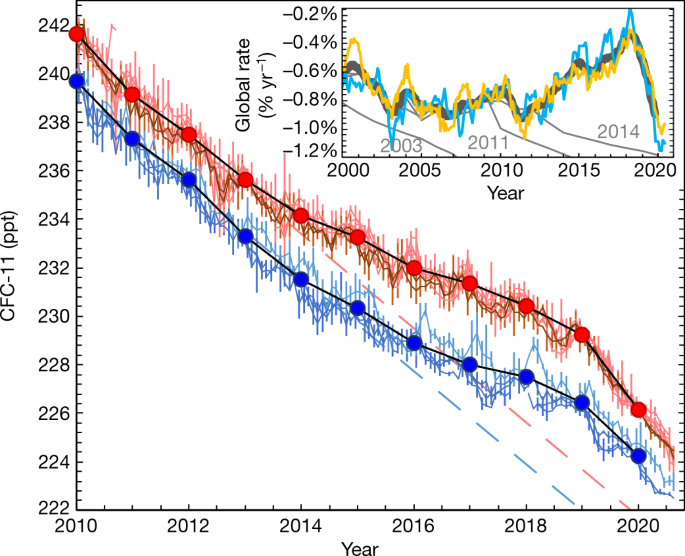
Surface mole fractions simulated in the 3D model have an added variability that arises from dynamics that is of order of ±0.2% yr–1 in annual rates of change on a 1 to 3-yr timeframe (Extended Data Fig. 5). Despite using different models and different representations of meteorology, the main features of the simulated variability in mole fraction rates are apparent in both model results and, notably, are also present in measured hemispheric means, particularly the peaks in early 2015 and 2018.
The mole fractions simulated in the 3D forward runs were used to derive a second global emission history using the 3-box model and the same methodologies applied to measurement data. Differences between the smoothed input and second emission histories were taken to represent emission biases arising from the influence of dynamical variability on CFC-11 atmospheric mole fractions (Extended Data Fig. 6). These biases (calculated on a monthly basis) were subtracted from the 3-box model emission history derived directly from observations to provide a best-estimate emission history for CFC-11 (Fig. 4 and Extended Data Fig. 4).
Expected emissions after 2012
Without post 2010 production, CFC-11 emissions were expected to slowly decline thereafter as reservoirs of CFC-11 (banks), primarily in foam, but also in industrial process refrigeration and comfort cooling for commercial buildings (chillers), diminished from the CFC-11 escaping to the atmosphere4,15,16,17,22,23. To better quantify the effect of renewed CFC-11 production on future ozone depletion, we examined differences between observed emissions and those expected in the absence of renewed production (‘excess emission’).
We considered multiple methods for estimating expected global CFC-11 emissions in the absence of renewed unreported production. Emission expectations were derived for 2013−2019 from a linear fit to the observationally derived bias-corrected emissions during 2002 to 2012 (orange-dotted line, Fig. 4). This approach projects a global emission in 2019 of 42 ± 3 Gg yr–1 (WACCM/MERRA2 dynamical corrections) or 48 ± 4 Gg yr–1 (TOMCAT/ECMWF dynamical corrections) and bank release fractions during 2010−2019 that remain constant at about 3% yr–1. The consistency in results for fits over different ranges of years (2002−2012, 2003−2012, and so on, through 2008−2012) suggests no appreciable influence of small amounts of CFC-11 production reported during 2002−2010 (110 Gg) (ref. 1).
We also consider expected CFC-11 emissions derived through 2016 with a Bayesian probabilistic model in the absence of post-2010 production15. The model includes a wide range of observation-based and inventory-based information to derive posterior estimates of banks magnitudes and emissions through 2016 (Fig. 4). In part because this analysis is constrained by observations, it yields similar emissions and emission trends to those suggested by observations during 2002−2012; it also suggests post-2012 emissions that are similar to those derived from the observation-based extrapolated fit and only small changes in bank release fractions in recent years (median estimate drops from 3.0% yr–1 in 2006 to 2.7% yr–1 by 2016).
Expected emissions are taken from the Montreal Protocol’s Technology and Environmental Assessment (TEAP) inventory model4, which provides a CFC-11 emission history starting in the 1930s based on reported production data, breakdown of use in multiple applications such as chillers, foam manufacturing, as an aerosol propellant, and as a solvent and more than 20 parameters representing the lifetime of products, and time-dependent emission rates associated with manufacturing, installation, use, decommissioning (transfer to landfill), and at end of life. Values for these parameters are based on existing literature, historical data, and input from industry experts associated with TEAP and its reports. The original TEAP model considered different values for some parameters in four different scenarios, thus providing a range of expected emissions that decrease substantially from 2010 to 2020 (Fig. 4, blue-shaded region). Here, we limit our attention to the ‘most likely’ scenario originally developed4 by TEAP, which falls within the range of the other scenarios in most years, as it was developed with parameter values considered to be the most likely. This scenario results in a substantial drop in fractional bank losses (3.6−1.4% yr–1) and, therefore, total emissions during 2010−2020 owing to end-of-life assumptions made for CFC-11-containing products and the fate of that CFC-11 as those products are retired. In this scenario, enhanced emissions related to production, active use, and the transition of chillers to landfill become negligible shortly after 2010 and overall emissions in subsequent years are sustained only by the small release rates from foams in situ and foams in a landfill (both are ≤1.5% yr–1), or related to transitioning foam-containing products to a landfill (for example, building decommissioning, during which only a small fraction of the CFC escapes4). As a result, the 2010−2020 emission decline in the ‘most likely’ TEAP scenario depends in large part on the accuracy of assumptions of end-of-life treatment and mean in-use lifetime of chillers, parameters whose values were not explicitly explored in the TEAP report4.
As a result of this sensitivity, we considered an alternative scenario (TEAP*) that enabled continued emissions from chillers past 2012, since CFC-11 containing chillers continue to be used throughout the world4. Whereas there are many factors affecting emissions from chillers (for example, recapture or venting of refrigerant during recharge and at end of life that probably vary), the lack of historical detailed information on these practices prevents their explicit modelling. Instead, we allowed for sustained emissions from chillers by assuming a longer in-use lifetime for CFC chillers (35 yr versus 25 yr) and a 10% increase in pre-2010 reported production for all applications (as explored elsewhere4,15) (TEAP*; Fig. 4). Longer mean chiller lifetimes may be likely especially now, since commercial chillers are currently professionally serviced and maintained through well established service contracts. The high cost of replacement can lead to slow decommissioning rates, potentially only after a catastrophic failure. Furthermore, chiller lifetimes in Brazil are estimated to be 30 years and, in India, 40 years38. In addition, the World Bank has forecast that “the demand for recycled CFCs for servicing large capacity chillers will continue till 2027” (ref. 38), which is more than a decade after the year (2012) implied by a 25-yr chiller lifetime. The effect of this simple adjustment to TEAP’s ‘most likely’ model produces an overall bank release fraction that remains close to 3% yr–1 from 2000 to 2020, and it provides emission expectations after 2010 that are similar to those derived by Lickley et al.15 and projected from the extrapolated linear fit to observationally derived emissions, given a CFC-11 lifetime of 55−60 yr.
Estimating excess global emissions
Excess global emissions (emissions above expectations considering only reported production) were derived as the difference between observationally based estimates and expected emissions estimated using methods discussed above. Excess emissions declined notably from 2018 to 2019, but suggest that emissions in 2019 may remain elevated above expectations (Extended Data Fig. 7) by different amounts. Relative to the extrapolation of derived emissions during 2002−2012, the estimated excess emission in 2019 is 7 ± 6 Gg yr–1 and is insensitive to the CFC-11 lifetime, and the average over 2014−2018 is 21 ± 3 Gg yr–1. Relative to TEAP* expectations, excess emissions in 2019 are 5−24 Gg yr–1, and the average during 2014−2018 is 18−37 Gg yr–1. Based on the consistency among excess emissions derived from these expectations, which are also consistent with those derived from Lickley et al.15 during overlapping years, we estimate excess CFC-11 emission in 2019 of 2−24 Gg yr–1. Larger excess emissions (24−46 Gg yr–1) are suggested for 2019 and earlier years from TEAP’s ‘most likely’ scenario and CFC-11 lifetimes at the shorter end of the range explored here (50−60 yr), but we consider these magnitudes less likely given evidence suggesting that chiller emissions are probably continuing and that most atmospheric models suggest a mean CFC-11 lifetime of between 55 and 60 yr (ref. 29). Such large increases also seem unlikely because they would have to come from regions other than those dominating past CFC use (the USA and the European Union), given the observational evidence suggesting no recent increases from these regions1,3 and a near complete decline by 2019 in excess CFC-11 emissions from eastern China25 (Extended Data Fig. 7).
Continued unexpected emissions for CFC-11 in 2019 could represent ongoing production and use of CFC-11, albeit at reduced levels compared to the previous few years, but also probably reflect contributions from foam banks created with new production since 2010 (ref. 4; Extended Data Fig. 8).
Estimating enhanced production and banks
While atmospheric observations provide a straightforward way to derive global emissions, an estimate of production magnitudes and additions to banks that accounts for the emission enhancement requires additional information that was recently reassessed4. That TEAP study concluded that unreported production after 2010 was most probably used to manufacture closed-cell foams. Production magnitudes associated with the multiple estimates of emission enhancements (Extended Data Figs. 7, 8) were derived by estimating the unreported production required to match excess emissions after 2012 given ranges for emissive losses during CFC production (4–10%) and the installation of closed-cell foams (17–35%) (ref. 4), although here we consider an upper limit of 50% for installation losses to capture the possibility of poor industry practices for formulating and producing foams. These values nominally suggest initial multiples for new production vs enhanced emission of 1.7 to 4. For the emission enhancements derived relative to the linear fit to 2002−2012 emissions or TEAP*, mean unreported production during 2013−2018 is in the range 25−100 Gg yr–1, which encompasses the 40−70 Gg yr–1 of unreported production estimated previously4 (Extended Data Fig. 8). The ‘most likely’ TEAP scenario suggests unreported production in excess of 100 Gg yr–1, which, if true, would represent substantially more CFC production than was reported by A5 countries during their peak reporting year of 1997 (47 Gg yr–1; ref. 4).
Additions to banks were derived as the cumulative sum of production enhancements minus emissions. We estimate additions to CFC-11 banks from unreported production of between 90 Gg and 725 Gg CFC-11 by the end of 2019 for the emission scenarios that were consistent with observationally derived emissions before 2010. The lower end of this range is associated with high levels of emissions during production and installation of the newly produced CFC-11 and small emission enhancements above expectations, whereas the high end of this range is implied by small emission losses associated with new production and larger emission enhancements. While certain combinations of parameter values in the TEAP inventory model, together with a CFC-11 lifetime at its lower limit could suggest larger additions to CFC-11 banks by 2020 (for example, >900 Gg; Extended Data Fig. 8), we estimate that they are less likely, given the reasons discussed above. Furthermore, based on a range of considerations and very different observational constraints, an increase in the CFC-11 bank in eastern China of up to 112 Gg CFC-11 has been estimated through to 2019 (ref. 25), which is more consistent with the lower range of global bank increases, considering that this region accounts for about half of global excess emissions since 2013 (refs. 1,3,25).

