


Nicolai Tangen
made his name picking stocks in the cloistered world of hedge funds. Now he is sparring over an active approach to running the world’s largest sovereign-wealth fund—historically a bastion of passive investing.
Mr. Tangen—three months in as chief executive of Norges Bank Investment Management, the arm of the Norwegian central bank that operates the fund—says active management boosts investment returns and lays the groundwork for interacting with companies. Purists say stock picking is a waste of money and returns at the 10.838 trillion Norwegian kroner fund, equivalent to $1.265 trillion, would hold up fine without it.
Established in the 1990s to invest revenues from oil discoveries, the oil fund, as it is known, is now worth three times the country’s annual gross domestic product and safeguards wealth for the future.
“Norwegians really feel it’s their money, and they really care who runs it,” Mr. Tangen said in an interview.
Now the years-old debate has bubbled up again, with Mr. Tangen himself weighing in. The core of the dispute: how integral active asset management should be to the strategy of the sovereign-wealth fund.
Espen Henriksen,
a finance professor at BI Norwegian School of Business, says it is puzzling that a hedge-fund manager was chosen to run the engine room of a de facto index fund.
That discussion was part of a wide-ranging furor over Mr. Tangen’s appointment, which attracted the most public attention in the fund’s history, said
Camilla Bakken Øvald,
an economist who has written a book on the fund.
Problems first arose when it emerged Mr. Tangen, 54, had offered his predecessor,
Yngve Slyngstad,
a plane ride home from a glitzy seminar Mr. Tangen hosted in November 2019. Mr. Tangen had invited Mr. Slyngstad to the event, which featured a
Sting
performance, a year and a half before the job came open, but questions were raised over the pair’s interactions. Mr. Slyngstad later apologized for accepting the ride. The central bank said Mr. Slyngstad had no part in hiring Mr. Tangen.

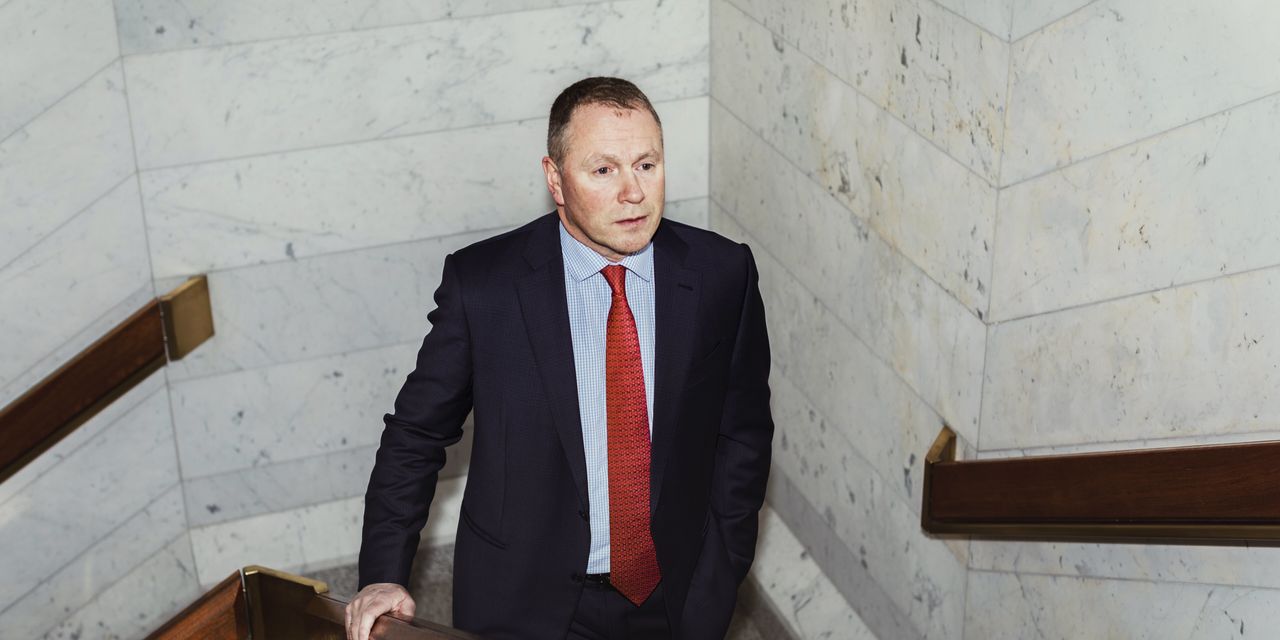
Norwegians “really care who runs it,” Mr. Tangen said of Norway’s sovereign-wealth fund.
Photo:
Andrea Gjestvang for The Wall Street Journal
Then there was the central bank’s willingness to let Mr. Tangen keep his 43% stake in AKO Capital LLP, the investment firm he founded. An outcry over potential conflicts of interest and the hedge-fund industry’s use of tax havens forced him to transfer the stake to his charitable foundation and liquidate his personal fund investments. Mr. Tangen has an estimated net worth of £550 million, equivalent to $744.2 million, according to The Sunday Times Rich List.
Mr. Tangen said he aims to make the fund as much money as he can within a mandate given by the Ministry of Finance. Portfolio managers can make small tweaks to holdings in 800 of the more than 9,000 listed companies in which the fund invests. The rest are governed by an index. The fund can’t invest in most private companies.
“Active management has given the fund considerable extra return and is a prerequisite for engagement with companies,” Mr. Tangen said.
In recent days he has exchanged words in the Norwegian press with critics who say the costs are excessive.
“You could eliminate stock picking and reduce costs and you wouldn’t have a return that would be any worse,” said
Halvor Hoddevik,
who runs a financial-advisory firm in Oslo.
Mr. Tangen on Friday wrote that since 2014, active management has earned an extra 66 billion kroner for the Norwegian people.
The fund has returned an annualized 5.8% since 1998 and exceeded its benchmark by roughly 0.25 percentage point. Anything over the benchmark constitutes an active return.
The fund will further divest from companies on environmental, social and governance grounds, Mr. Tangen said, offering an example of active management. It will also increase its use of external asset managers.
Active management has paid off for the fund in the past. Portfolio managers last year discovered irregularities at German payments company
Wirecard AG
, which, coupled with Financial Times coverage, caused them to sell holdings. When Wirecard in June said cash had gone missing, the fund minimized its losses by unloading remaining shares before their value plunged.
Diego López,
managing director of consulting firm Global SWF, said Mr. Tangen’s hedge-fund background could signal a more agile and less risk-averse strategy.
That means using more of the tracking error, fund-watchers say, which refers to the deviation from the benchmark portfolio return. Others expect Mr. Tangen to ramp up stock picking and limit bets based on macroeconomic environments or tied to factors like growth.
People who know Mr. Tangen from his time at AKO Capital, the $21 billion firm named after his children, say he is process-oriented and rigorous. He studied interrogation in an elite Russian-language program in the Norwegian intelligence service.
“Nicolai is willing to pay up for quality,” said
Lawrence Cunningham,
who wrote a book on investing with AKO Capital portfolio managers. The firm has returned an annualized 11% since 2005 in its flagship strategy.
SHARE YOUR THOUGHTS
Do you think active management is a good path for the Norwegian sovereign-wealth fund? Join the conversation below.
Chats with 140 oil fund employees before he started (“one of the great characteristics of Scandinavians—they tell you the truth,” he said) have prompted Mr. Tangen to initially focus on the fund’s performance, communication and talent development.
The fund has benefited from its 70% allocation to stocks during the year’s swerving markets, despite a 3.4% loss in the first half. Its second-quarter performance was its best ever, boosted by equities added during the spring selloff. It was up 4.3% in the third quarter.
Mr. Tangen is acclimating to the public realm. Newly prolific on LinkedIn, he revealed last month he had contracted, and then recovered from, Covid-19. He also offered to buy Cokes for successful job applicants. The fund wants to hire from all religious backgrounds, so drinks need to be nonalcoholic, he wrote. Despite the internal emphasis on diversity, Mr. Tangen says the fund won’t divest from companies on that basis.
—Jem Bartholomew contributed to this article.
Write to Julie Steinberg at [email protected]
Copyright ©2020 Dow Jones & Company, Inc. All Rights Reserved. 87990cbe856818d5eddac44c7b1cdeb8

