


For homeowners, sod producers and turf industry professionals, keeping pests from feeding on valuable turfgrass has been both challenging and costly due to limited monitoring and management techniques.
Now, thanks to a two-year, $199,922 grant from the U.S. Department of Agriculture’s National Institute for Food and Agriculture, a team of Cornell scientists will use acoustic technology to develop efficient and affordable ways to manage soil-dwelling pests — and prevent damage from the predators they attract.

Kyle Wickings, associate professor of entomology in the College of Agriculture and Life Sciences, is lead investigator of “Using Acoustics to Enhance the Monitoring and Management of Belowground Pests and Their Aboveground Predators.”
Wickings’ lab will collaborate on the project with Paul Curtis, professor and wildlife extension specialist in the Department of Natural Resources and the Environment.
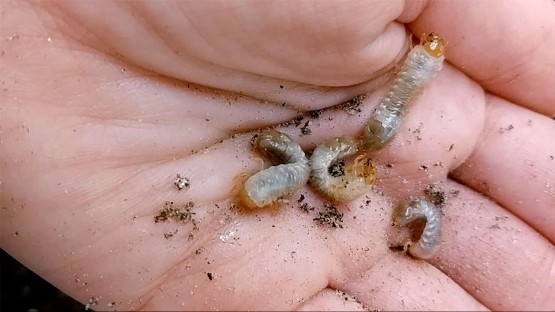
White grubs are the most widespread and damaging pest in the lawn and sport turfgrass industries. The immature larva of specific species of scarab beetles, the inch-long grubs make a distinct popping and cracking sound when feasting on turfgrass roots. This attracts larger mammals, such as raccoons and skunks, which then dig up the turfgrass to feed on the grubs.
The damage caused by both white grubs and their predators compromises the quality and safety of turfgrasses. It destabilizes the surface, leaving it hazardous for athletes and other users, and it can also compromise soil health by stimulating rapid decomposition and limiting the capacity for carbon sequestration.
“One thing we know going into this project is that many vertebrates use sound among other sensory cues to locate their prey,” Wickings said. “If they are attracted to the sounds white grubs make, acoustic technology may offer some viable management solutions.”
The new project will take place over 18 months in Green-Wood Cemetery in Brooklyn, which has been one of Cornell’s long-standing partners for sustainable turfgrass research. The historic cemetery is one of New York City’s largest urban grasslands and home to both seasonal white grub infestations and a large population of raccoons.
Wickings’ team will place soil activity sensors in 40 plots around the cemetery with varying levels of soil disturbance, grass management and background noise – both near known white grub hot spots and in pest-free control soils. After gathering recordings, they will transport soil samples back to their laboratory at Cornell AgriTech, in Geneva, New York, to see how the two sets of data correspond.
“Acoustic monitoring has the potential to help turfgrass managers spray less by allowing them to more accurately distinguish areas where white grubs and other pests are actually present,” said Louise Roberts, a postdoctoral associate in Wickings’ lab. “The technology may also help identify the sounds vertebrates are responding to.”
Using the soil activity recordings from Wickings’ lab, plus Green-Wood video surveillance, Curtis will explore how raccoons are responding to acoustic cues that indicate white grub activity. This knowledge will help him assess new wildlife management strategies that could use acoustic recordings to manipulate mammals’ foraging behavior and limit damage to turfgrass.
Currently, the industry relies on nuisance trapping through wildlife management services; for managing white grubs, they maintain strict calendar-based pesticide applications. While effective, the practice is often unnecessary and can have negative impacts on beneficial invertebrates and the processes they drive.
“Our approach has the potential to give turfgrass managers greater knowledge and decision-making power about pest distributions and how to mitigate vertebrate foraging,” Wickings said. “Ultimately, acoustic technologies could fit well into a turfgrass integrated pest management framework, given its non-invasive nature and ability to make management efforts both more effective and sustainable.”
Erin Rodger is the senior manager of marketing and communications for Cornell AgriTech.

