


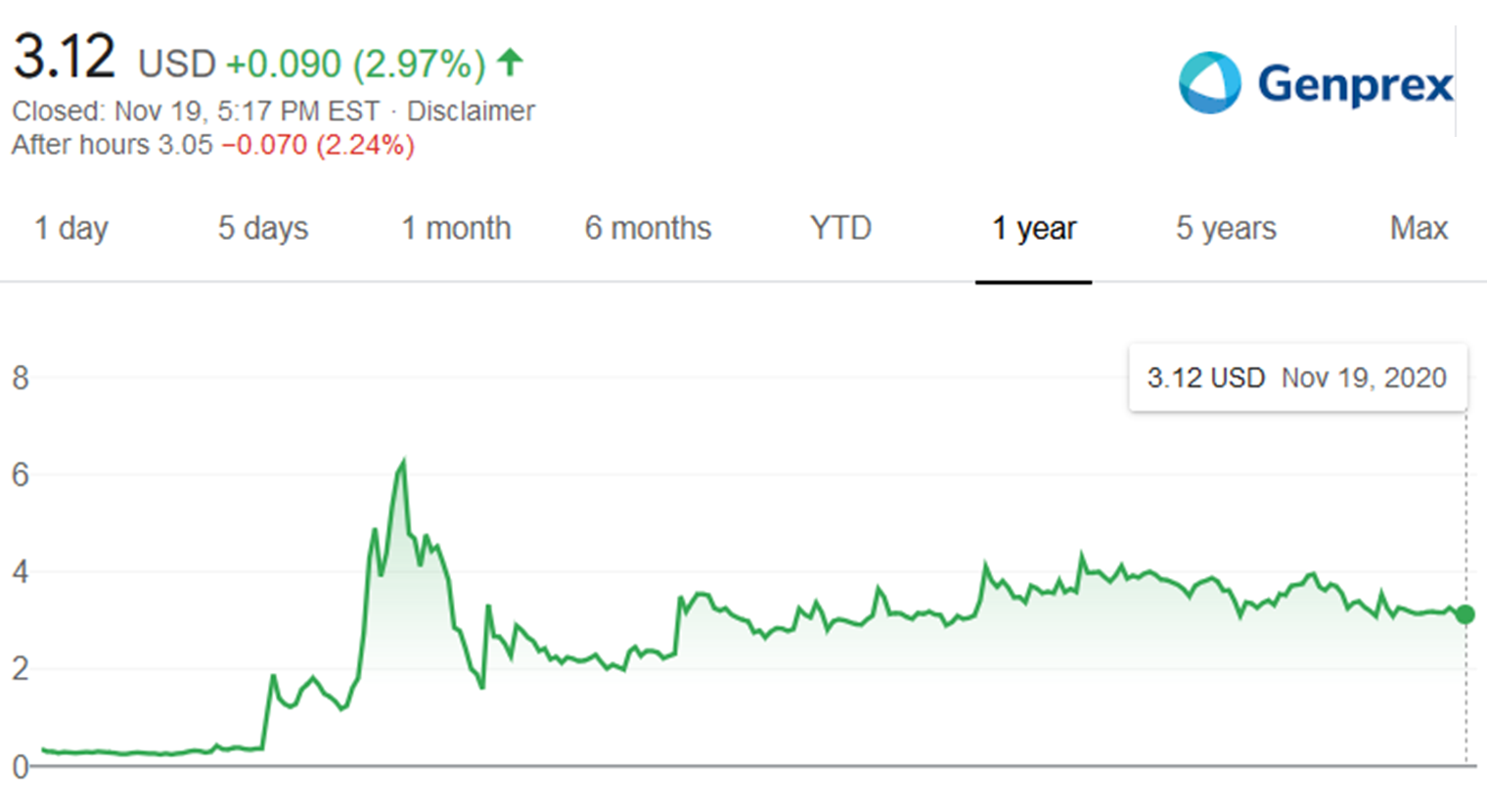
Price Target & Rating Revision: Genprex (NASDAQ: GNPX)
Stock Rating: BUY from prior Hold
Price Target: $8.27 from prior $2.86 (+190% upside
12-months)
Market Price: $3.12
Research Publication Date: 11/19/20
Genprex (GNPX) is currently our best idea in our biotech coverage as we upgrade Genprex from Hold to BUY. We have followed this stock closely since its IPO, we believe our undervalued thesis has transitioned into momentum as the company has toppled many of our initial expectations, which is what warrants a significant revision to our price target from $2.86 to $8.27
Brief background: Genprex is an early-stage
gene therapy company developing treatments for NSCLC (non-small cell lung
cancer) and diabetes. The company’s primary drug candidate is REQORSA (which
was recently rebranded from Oncoprex as of October 29th, 2020. REQORSA
is a TUSC2
plasmid DNA, the tumor suppressor gene missing or reduced in more than 80 percent
of lung cancers. TUSC2 is the active ingredient in REQORSA. Genprex also
initiated programs with additional contract manufacturing organizations to
manufacture the lipid nanoparticle (the lipid nanoparticle is a small sphere
that acts as a delivery vessel for the plasmid containing the TUSC2 gene).
The company has de-risked the situation via a number of events over the course of 2020, which is inclusive of two private placements early this year, raising a combined $25.5M in cash, which was followed by a couple smaller offerings in the mid/end of the year, which totaled to $29M in cash raised via secondary offerings in 2020. This keeps the company funded until Q1’22 before we anticipate a substantial uptick in dilution from follow-on cap raises to sustain funding of the drug pipeline. We factored the added dilution from these private placements into our revised financial model where total dil. share outstanding has increased from 19M shares to 39.05M outstanding shares in 2020.
The recent weakness in equities from the COVID-19 epidemic does
not alter our investment thesis on Genprex by much, but we anticipate that some
of the upside tied to January/February news was mitigated by the pandemic crash.
As such, we think investors are given another opportunity leading into next
year to buy the stock in anticipation of strengthening clinical pipeline data,
and diminished solvency risk (which is the greatest risk in early-stage
biotech).
We revised our prior FY’20 dil. EPS estimates from -$0.62 to -$0.53. We’ve also revised our Dil. EPS estimate for FY’21 lower from $-$0.76 to -$0.57 per share, which was driven by the dilutive impact from the issuance of additional shares and OpEx impact from the expansion of clinical trials for REQORSA + Osimertinib and minor financial impact from the licensing agreement with the University of Pittsburgh tied to diabetes treatment.
Figure 1. Financial Estimate Snapshot

Source: Cho Research
We’ve also revised our net loss estimate upwards from
$-12.03M to -$20.79M to reflect the added impact from financing cost tied to
the two separate private placements, and the expansion of the drug pipeline,
which increased costs tied to R&D, which we will discuss in the financial
model overview section.
We increased our price target from $2.86 to $8.27 to
reflect the expanded market opportunity that gets addressed from the REQORSA +
Osimertinib clinical trial, where we anticipate the fast-track FDA designation
to translate into a five-year timeframe between IND to NDA, which expands the
market opportunity considerably, and thus improves the forecasted revenue in
our financial model.
We’ve raised our prior rating from HOLD to BUY.
What changed the investment narrative so quickly?
- Risk/Reward improves considerably with the expansion
of drug combination pipeline with Osimertinib (which received fast track
designation). REQORSA is also undergoing clinical trials in combination with Erlotinib
and Pembrolizumab. This differs from our affordable scenario which we had
outlined in our (prior
research) due to the entrance of Mylan with a generic Tarceva, i.e.
erlotinib, thus making the combination with REQORSA more affordable for cost
sensitive cancer patients. - Q1’20 capital raise of $25.5M de-risks scenario
and expands possibilities with pre-existing drug pipeline, while also
addressing the needed funding for the launch of multiple clinical trials
concurrently, so it can meet FDA requirements for the treatment of NSCLC
(non-small cell lung cancer) with three of the most common therapeutic
treatment methods. - Genprex also made an announcement where they
will license a patented gene therapy for the treatment of diabetes from the
University of Pittsburgh, which is a large addressable market opportunity where
30.3 million patients are affected by either Type 1 or Type 2 diabetes. This
market is dominated by insulin manufacturers such as Eli Lilly, Novo Nordisk,
and Sanofi which was a market valued at $26.64 billion in FY’16 and is
projected to grow to a $57.4 billion market by 2025. - Genprex announced
an expanded licensing agreement with MD Anderson on May 5th,
2020 where the license will also combination treatment to include nivolumab
(Opdivo) and ipilimumab (Yervoy) both of which are marketed by Bristol-Myers
Squibb. The licensing agreement was further expanded to cover the combination
of chemotherapies with REQORSA, and also claims patent protection for
combination use in all types of cancers (breast, glioblastoma, head/neck
cancers and so forth). - The expansion of the licensing agreement is
pertinent as recent third-party
studies from Nature have demonstrated that REQORSA TUSC2 gene, i.e. REQORSA
prevented tumor growth in triple negative breast cancer (TNBC). Therefore, the
expanded license agreement most immediately addresses the cell mutation
miR-138. We anticipate that expansion of the clinical program could be
inclusive of TNBC, which is a more progressed form of breast cancer that has a
low survival rate with limited treatment options on the market.
Figure 2. Time to Buy on Year End Momentum?

Source: Cho Research
Our 12-month price target suggests a path to $8.27, which is
driven by an adjustment to the risk model of the pipeline, dilutive impact from
secondaries, and improved forecasted market penetration. The stock was
undervalued as investors were discounting the long-term intrinsic value of the
drug pipeline given the limited news on the company, and concerns tied to
solvency.
What changed from our prior research coverage on Genprex?
We are upgrading our GNPX rating from Hold to Buy, as the
management team has responded to the concerns outlined in our prior
equity research report. Our concerns were 1) lack of meaningful news tied
to the development pipeline 2) on-going accumulated losses of shareholder equity
without an updated timeline for a cap raise 3) outlook from management
unchanged with the same pitch made at a number of recent investor conferences.
4) lack of progression either in mid-point, or phase transition for the current
clinical program over the course of 9-months. 5) revision to our financial model
lower to reflect heightened risks of pricing/penetration in a FY’23 launch
scenario with erlotinib/tarceva due to declining revenue/market share of the 1st-gen
TKI-Inhibitor.
Recent events tied to Genprex have addressed the bulk of
those concerns, as Genprex provided meaningful updates to its drug pipeline and
clinical progress. Company solvency was immediately addressed earlier this
year. Communication from management more upbeat with more meaningful news when
compared to prior year. Additional upside from the expansion of drug pipeline
changes the investment narrative altogether and diminishes the risks tied
exclusively to an REQORSA + Erlotinib combination.
With the stock now hovering at $3.12 which conforms with our
prior price target of $2.86, we felt it was necessary to update our 12-month
price target to reflect some of the more recent developments, and how we
anticipate those developments will impact the stock over the next 12-months.
Our dil. EPS ramp takes into consideration the dilution from recent cap raises
and addresses some added dilution from follow-on cap raises.
The Strategic Value of Osimertinib Fast Track
Designation?
Osimertinib is a blockbuster cancer therapy, as AstraZeneca
(AZN) reported $3.189B FY’19 revenue from Osimertinib/Tagrisso. The drug is one
of the fastest growing treatment options for Oncologists in the NSCLC
(non-small cell lung cancer) therapy segment given the promising data from its
Phase 3 clinical trials where PFS (progression free survival) was 10.1 months
when compared to 4.4 months for Doublet Chemotherapy.
Figure 3. TAGRISSO Clinical Study Data Points

The improvement is quite noticeable, as it addresses the
T790M mutation-positive NSCLC, which is a secondary mutation that’s caused by
Erlotinib (TARCEVA) or Gefitinib (IRESSA). Over 50% of NSCLC patients with
EGFR-TKI resistance have what’s known as the “EGFR T790M,”as it develops a
resistance to exon-19 deletion or exon 21 L858R point mutation targeted
therapies such as Tarceva and IRESSA, which is why the REQORSA + Osimertinib
combination therapy would soon follow the REQORSA + Erlotinib treatment
assuming the cancer cells mutate into T790M (which is likely to occur in over
50% of cases).
Thus, this marks a substantial improvement in the drug
pipeline, as REQORSA would address the first stage and second stage cell
mutations that tends to happen in 40% of NSCLC patients assuming FDA approval for
REQORSA + Erlotinib and REQORSA + Osimertinib.
Figure 4. Genprex Clinical Pipeline

Source: Genprex
What’s even more strategically important about the REQORSA +
Osimertinib combination therapy is the timing of its NDA (new drug application
or FDA Approval). We anticipate that based on the current timeline/pipeline
that REQORSA + Erlotinib will reach the market in FY’23, i.e. 4 years from now,
and the Fast-Track FDA designation for REQORSA + Osimertinib would reach the
market in FY’25, i.e. 6 years from now. Typically, Fast Track designation
shortens the timeline from Pre-Clinical to NDA from 10 years to perhaps 5-6
years, which is why our revenue ramp scenario improves considerably from FY’25
onwards, as we anticipate that the secondary mutation therapy will address a
greater patient population thus improving our market penetration scenario from
2.5% in FY’25 to 4.5% thus increasing our long-term estimates on revenue and
dil. EPS contribution.
Furthermore, we anticipate that TAGRISSO revenue will
continue to grow over the foreseeable 5-year timeframe, as AstraZeneca reported
that Q4’19 sales grew by 50% for this treatment. We anticipate that the T790M
mutation will become more common, but then this begs the questions, what comes
next?
The C797S mutation is the resistance mechanism that has
developed in response to Osimertinib. EGFR C797S results in the blocking of the
Osimertinib drug binding. In 6 out of 15 cases (40% cases), cell mutations
resulted in what’s known as the Amino Acid mutation C797S, according to Harun
Patel in the European
Journal of Medicinal Chemistry. Hence, AstraZeneca is pursuing the ORCHARD
clinical study, which is in Phase 2 Clinical Trials. However, the ORCHARD
Clinical Study design doesn’t constitute a 4th generation EGFR
Inhibitor, instead AstraZeneca is attempting to study treatment combinations on
patients who have progressed on first-line Osimertinib therapy, which is why the
ORCHARD Clinical Study examines multiple combination therapies, i.e.
Osimertinib + Savolitinb, Osimertinib + Gefitinib, Osimertinib + Necitumumab.
Furthermore, we looked into AstraZeneca’s current
pre-clinical pipeline to see if they have developed a drug compound that
directly addresses the C797S mutation, and we have yet to identify any
announcements pertaining to a specific targeted therapy thus far. So, what has
occurred is the exploration of combination treatments in the interim to help
address the additional resistance mechanisms (the other 60% of cases that have
not expressed the C797S mutation), and hopeful clinical benefit rate from
combining 1st and 2nd gen TKI-Inhibitors with Osimertinib
to address the C797S mutation.
What makes Genprex so interesting is the alternative
treatment mechanism of TUSC2, i.e. REQORSA, which isn’t a part of the ORCHARD
Clinical Trial, but was given a Fast-Track designation by the FDA. However, in
stark contrast the ORCHARD Clinical Trial was not given a fast-track designation,
which implies that REQORSA + Osimertinib could be a treatment for some of the
additional resistance mechanisms that cannot be addressed by the ORCHARD Trial.
What is important to recognize is the differentiation of REQORSA and how it
might address the absence of the TUSC2 gene, which is reduced or absent in lung
cancer. Whereas REQORSA with earlier-generation TKIs has demonstrated an 11.11%
complete response rate vs. erlotinib (standalone) at 5% complete response rate,
therefore the combination translated into a doubling in complete response rate.
As such, we think that upon Genprex release of clinical study datapoints in
combination with Osimertinib investors will be more justified in their
optimism. The osimertinib + REQORSA combination could translate into an
improvement in complete response rate (full cancer remission), and progression
free survival could also improve. However, the key caveat is that the complete
response rate of 18% for osimertinib in isolation would require that the complete
response rate in combination with REQORSA would need to be in excess of 18%+ to
demonstrate a clinical benefit ratio in excess of the standalone treatment.
Hence, investors in Genprex would consider the data readouts from Phase 2
Clinical Trials to be successful if the complete response rate were to range
from 22%-30%, which would demonstrate a meaningful improvement in treatment
outcomes until 4th gen EGFR inhibitors come onto the market (which
could take a decade or longer based on the absence of new investigative drug
compounds for even more advanced cancer mutations such as C797S).
Financial Model Upwards Revision Based Upon Osimertinib
Impact
We anticipate more meaningful market saturation assuming the
approval of REQORSA + Osimertinib, which is why we forecast that revenue growth
will accelerate meaningfully from FY’25 onwards. We anticipate that market
share gains will improve as modest inclusion of REQORSA in combination with
Osimertinib would translate to $405M FY’25 and $615M FY’26 revenue. We anticipate
that Osimertinib drug sales will grow from $3.2B FY’19 to $5.8B by FY’25. This
implies that only a very modest percentage of patients on Osimertinib would need
to transition to the combination therapy of REQORSA. As such, we anticipate meaningful
revenue contribution, but we keep our expectations conservative so we don’t
price-in too much implied upside.
Figure 5. Revenue Model

Source: Cho Research
Therefore, we revise our revenue estimate upward from $202M
and $225M in FY’25 and FY’26 to $405M and $615M revenue in FY’25 and FY’26.
This upward revision to revenue implies an added +$203M and +$390M revenue
impact from osimertinib combination therapy. The remaining revenue contribution
ties to our prior estimates pertaining to Erlotinib + REQORSA. We maintain the
conservative timing of REQORSA + Erlotinib in a FY’23 timeframe and anticipate
that the release of REQORSA + Osimertinib would address some added patient
cases and would increase our market penetration scenario upwards from 2.75% to
7.5%.
This drives our revenue/EPS estimates higher, as we
anticipate that the expansion of the clinical program will address more
patients with differing EGFR-types. Furthermore, we limit our expectations on
drug pricing to $80K per patient to keep our financial upside scenario as conservative
as possible.
Figure 6. Full Financial Model

Source: Cho research
We anticipate that cash burn will result in added dilution
in the near-term but can be offset with the successful commercialization of REQORSA
from FY’23 onwards. We anticipate that added impact from Osimertinib to have a
positive impact in FY’25 to FY’26. Therefore, we have revised our FY’25 and
FY’26 dil. EPS estimates from $3.42 and $3.61 to $2.62 and $4.07.
Valuation Methodology
We value the stock based on an end of period discount on forward earnings. We have revised our earnings estimates higher to reflect some of the impact from the expansion of the clinical pipeline while maintaining the same discount rate of 60% to reflect the risks of investing into early clinical stage drugs.
Figure 7: Risk Model Based on Clinical Trial

Source: J.A. Dimasi Journal of
Medicine (New Estimates of R&D Cost)
We establish the discount rate by the probability of
entering phase % from the above table. We believe that this captures the risk
of clinical trial phase in our long-term steady revenue/earnings state model.
Furthermore, we apply a 34x forward earnings multiple to our FY’26 estimate of
$4.07 dil. EPS, and apply a 60% discount over 6-years to arrive at out PT. In
our revised model, we capture the recent dilution impact, and additional
dilution, so we can arrive at our 12-month price target of $4.07.
Conclusion
We believe the risk/reward is compelling in this
environment, as we are exiting the worse phases of the COVID-19 impact on U.S.
equities next year, which should create a stronger environment for equities from
2H’21 onwards. Furthermore, we anticipate that enough time has passed to
anticipate further progress on GNPX’s clinical trial programs with clinical
data updates likely in 21’ and 22’, which should de-risk the associated risk of
failure during clinical trials, as we anticipate a relatively high probability
of progressing to phase-3 trials with erlotinib, and beginning of phase 2
trials for Osimertinib by FY’22 at the absolute latest.
As such, we’ve revised our HOLD rating to BUY and adjust our prior PT from $2.84 to $8.27. We think investors can capitalize on an emerging therapeutics program tied to Oncology by investing earlier into the development cycle of a drug. This is given the unique positioning of REQORSA, and the number of programs in combination with a high efficacy treatment suggests a high conditional likelihood of some drug combinations with REQORSA getting approved by the FDA at some point in the future. Therefore, the stock is definitely a buy as we anticipate that investors are in for a significant stock price surge over the next 12-months with our updated model suggesting an additional +190% upside.
Disclosure: Cho Research was compensated to publish “Genprex (GNPX) Upgrading from Hold to Buy and Raising Price Target to $8.27.” The to-date compensation terms were $15,000 cash and 15,000 shares via options over a 7-year contract duration as of January 2019. Though Cho Research does use the research dollars it
generates from other clients of our research service to fund market research
reports such as this. This document is not produced in conjunction with a
security offering and is not an offering to purchase securities. This report
does not consider individual circumstances and does not take into consideration
individual investor preferences. Recipients of this report should consult
professionals around their personal situation, including taxation. Statements
within this report may constitute forward-looking statements, these statements
involve many risk factors and general uncertainties around the business,
industry, and macroeconomic environment. Investors need to be aware of the high
degree of risk in micro capitalization equities, cryptocurrencies, crypto assets.
Independent equity research isn’t regulated by the SECand operates separately from more conventional sell-side equity research. Thepublication of independent equity research is unregulated and rules pertainingto published independent equity research are covered under “freedom of thepress” with legal case precedent taken all the way to theN.Y. Supreme Court to guard against libel based claims or claims of lossrelating to the publication of a report on a company. Any copyright claimrelating to infringement is covered under fair use of copyrighted materials. Sincethe use of material was derived into a separate form of analysis without anysubstantial content derived from any third-party no copyright claim can bepursued under common law. To discuss investment risk or to consider the riskspertaining to any securities it is recommended to consult a registeredfinancial advisor. To understand independent research it’s encouraged to readthis published article on independent equityresearch to become more familiar with industry standard practices and therelative value of independent equity research versus brokerage research andnews media.Cho Research, its subsidiaries, and employees may open along/short equity position at future date from the data of publication of thereport. The price per share and trading volume of subject company and companiesreferenced in this report may fluctuate and Cho Research is not liable forthese inherent market fluctuations. The past performance of this investment isnot indicative of the future performance, no returns are guaranteed, and a lossof capital may occur. Certain transactions, such as those involving futures,options, and other derivatives, can result in substantial risk and are notsuitable for all investors.

