


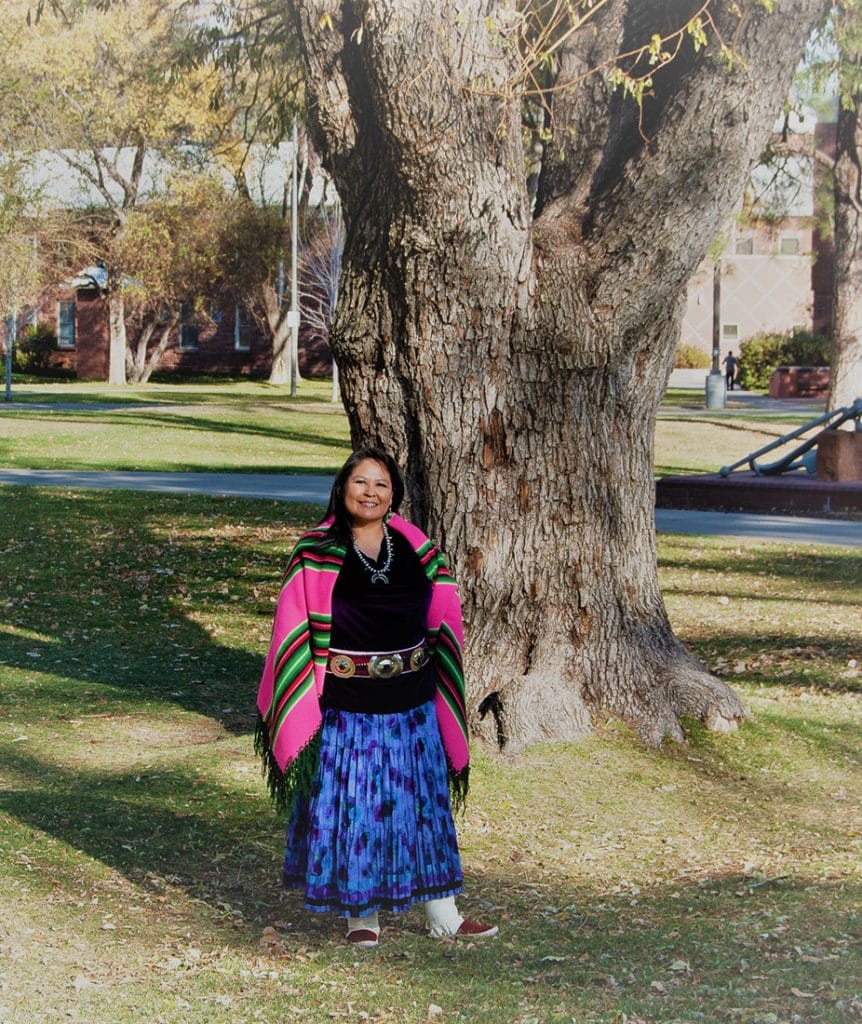
When she was in fourth grade, Esther Cadman’s teacher asked her a question that changed her life: “What do you want to be when you grow up?”
It’s a simple question every elementary school student has been asked, but for Cadman, this question opened the door to future possibilities, which was an idea she never had before: that she could be whatever she wanted. For that 10-year-old in Albuquerque, New Mexico, living in a home with alcoholism and domestic violence, that meant earning a doctorate.
Spoiler: She defended her dissertation a few weeks ago and on Nov. 22, she will graduate, being the first in her family to earn a Ph.D.
Cadman’s journey has been complicated. After earning bachelor’s and master’s degrees in school psychology, a supervisor suggested she look into NAU’s doctoral program; her mentors through the Gates Millennium Scholars also encouraged it. So in 2006, she left New Mexico for Flagstaff and started her doctoral degree in educational psychology.
While in Flagstaff, Cadman, who is Navajo, engaged with the Navajo, Hopi and Havasupai tribes, including hiking into Havasupai Canyon to spend the weekend with the children there. She traveled throughout the western Navajo Nation to provide psychological and psychoeducational evaluations for Diné children and their families.
After finishing her coursework, Cadman returned to New Mexico, got a job at the Rio Rancho Public School District and planned to finish her dissertation remotely. Real life, however, got in the way. An abusive relationship derailed her plans, and after years of enduring domestic violence, parenting three children and dealing with the stress and depression that accompanied her relationship, her education became a thing of the past—temporarily.
“Throughout much of these hard times, I kept God in my heart, which kept me hopeful that I would come out of my times of hitting rock bottom and traumatic experiences with strength and resilience,” Cadman said. “I prayed every night for God to help me return to NAU to complete my dissertation, and in 2018 my prayer was answered. I got reaccepted into the program after being away for many years and was able to complete my dissertation, and now here I am today as Dr. Cadman, weeks away from graduating.”
When Cadman righted her life, she reached back to NAU and found she still had a place. She picked up where she left off, applying the lessons she’d learned to her research and practical experiences here.
Her experiences included working with the Institute for Human Development’s Navajo Head Start. She enjoys working with preschool-age children because they are so eager to learn and are creative and imaginative. She vividly remembered how her imagination helped her through dark points in her childhood.
“As a preschooler myself, I endured the traumatic effects of two violently alcoholic parents and had to escape my frightening reality using my imagination while fantasizing about a peaceful future for myself,” she said. “I vowed to myself to break the cycle of alcoholism and violence in my family.”
 Cadman also worked with the NAU Center for Health Equity Research (CHER) as a graduate research assistant supporting the Missing and Murdered Diné Relations team. She assisted with efforts to initiate the grassroots organizational development through multiple forums that discussed the importance of searching for the missing Diné relatives and investigating unsolved murders of the Navajo people. Her experience as a Diné woman motivated her to join this project.
“My interest in joining these efforts was encouraged by the adverse childhood experiences I had and my knowledge with psychology, which helped me to relate to the possible reasons that could have potentially led our missing relatives to fall victim to such tragedies,” she said. “In some but not all cases, there is most likely a psychological underpinning that may relate to how our Diné relatives become vulnerable to these unfortunate circumstances. My interest in the search for this understanding encouraged me to assist in the efforts to help with the emergence of this grassroots initiative.”
Cadman’s doctoral research was in the area of data literacy. Working with professor Kathy Bohan, she became interested in examining graph literacy knowledge and skills among pre-service teachers. Most of the available research looked at in-service teachers but recommended further research with pre-service teacher populations. Cadman developed a study that used a quasi-experimental research design to investigate the impact of an intervention on pre-service teachers’ graph literacy knowledge, skills, self-efficacy and anxiety.
She found in a pre-test that the control group had greater knowledge and skills than the experimental group, but a post-test showed no difference between the groups’ skills. In addition, the experimental group showed higher self-efficacy and lower anxiety compared to the control group, when the pre-test returned similar results from each group. These results add to the literature showing pre-service teachers can benefit from course training on graph literacy practices.
After graduating, Cadman will continue her work as a school psychologist and is looking into academia as well as possibly starting her own evaluation and consulting business.

Heidi Toth | NAU Communications
(928) 523-8737 | [email protected]

