


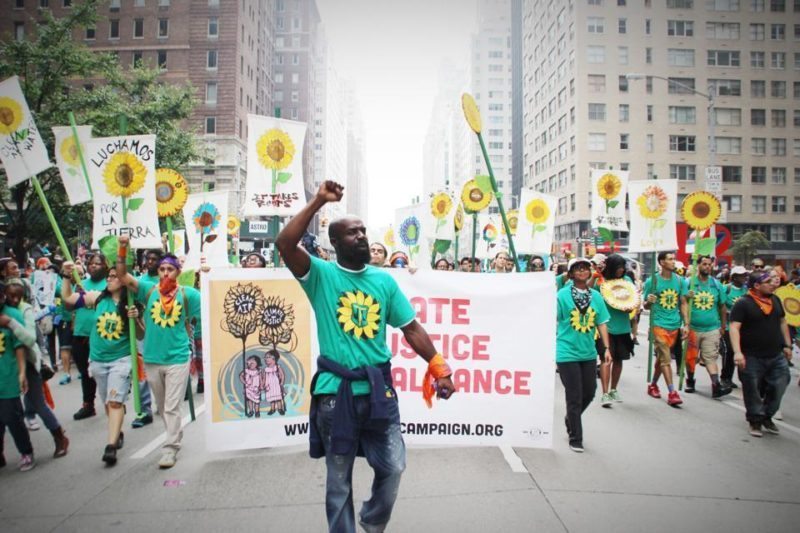

It’s not only been a summer season (now autumn) of a deadly pandemic,
toxic politics, and social unrest, but the nation has been rocked by a
nonstop series of environmental calamities triggered by the
human-pressed climate crisis. Hurricane Sally was a destructive
slow-moving mix of high winds and epic flooding battering the Gulf
Coast and other parts of the South. That was after Hurricane Laura and
ahead of an unprecedented number of cyclones forming in the Atlantic for
what’s building up into one of the most active—if not the most active—hurricane season on record.
The entire West Coast is either, literally, on fire or under a blanket of choking smoke from said fire. This summer was the fourth hottest on record, with nights no longer cooler and city neighborhoods burning up because of little shade, too little tree canopy, and still lots of pollution. Meanwhile, glaciers the size of whole states are rapidly melting in the global poles, raising sea levels and destabilizing weather patterns.
When these climate catastrophes strike in the United States, the
nation’s Black people are hit the hardest—while lacking the resources
and social mobility to confront them. More than a quarter of the Black
population in the U.S. live in the Gulf Coast states constantly hit by
hurricanes, not to mention the large concentrations of Black communities
in other East Coast states hit by massive flooding. They’re also living
in “urban heat island” spaces that are up to 20 degrees warmer than
normal, making them twice as likely to die from heat than Whites.
Exposure to bad air and water quality are rampant in Black
communities that are daily punished by environmental injustice by ZIP
code. We’ll become more aware of this as fires throughout places such as
California and Oregon, for example, reveal high rates of permanent
respiratory illnesses among Black people, especially those who do not
have the economic means to move away from those areas.
This is all aggravated by an unmitigated blend of systematically
racist designs and generations of redlined public policy. The
coronavirus pandemic, which has disproportionately affected and killed
so many Black people in the U.S., is one monstrous byproduct of the
racist geographic burdens placed on Black communities. As researchers
J.T. Roane and Justin Hosbey noted in their study Mapping Black Ecologies,
“ … the ongoing reality [is] that Black communities… in the African
diaspora are most susceptible to the effects of climate change,
including rising sea levels, subsidence, sinking land, as well as the
ongoing effects of toxic stewardship.”
Black voters could in many ways be the decisive eco-voters of the most high stakes election in American history.
With Black people clearly on the front lines of climate crisis and
environmental disaster (as victims and forced resistance fighters), it
would seem natural for Black voters in the 2020 election to view the
environment as a top issue. Indeed, Black voters could in many ways be
the decisive eco-voters of the most high stakes election in
American history—particularly as we consider the current Trump
administration’s zealous hostility to and aggressive dismantling of
environmental protections.
This election will decide the fate of the planet and human
civilization because the outcome will decide the direction of policy to
fix the damage done to our collective home. Environmental issues, in
fact, seem to permeate as key context throughout every major racial
injustice highlighted this past summer: The diabolical gentrification
plans of real estate companies ended up murdering Breonna Taylor in
Louisville, Kentucky, because police were being used to methodically
push out low income Black residents for a redevelopment scheme.
And the redlining legacies in Minneapolis, and Kenosha, Wisconsin,
eventually led to the death of George Floyd and the paralyzing of Jacob
Blake. Behind every headlining viral act of open racism is an
intersection of environmental injustice. Will Black voters be making
those connections as they mail ballots or show up at polling places?
It’s not clear at the moment. A recent Economist/YouGov
survey found 33% of Black voters (by far the highest of other groups
polled) were not sure whether “the world is becoming warmer as a result
of human activity,” but a higher percentage (47%) believed that the
severity of recent hurricanes and wildfire is increasing. Yet, Black
voters were also the most likely to say (75%)—out of all
demographics—that climate change and the environment were either “very”
or “somewhat important.” Interestingly enough, an August 2019 poll from
Quinnipiac found Black voters split on whether it was an emergency, with
44% saying it was not. But, in the recent YouGov poll, that issue ranked 5th among Black voters (at 8%) out of the 10 most important issues, with health care at the top (35%).
With polling of Black potential or eligible voters notoriously
incomplete (since political polling firms are overwhelmingly led by
White men), it’s hard to determine the size of the Black eco-electorate:
or rather, that portion of the Black voting community that is mobilized
by environmental issues, including climate change and pollution. What
we do know is that Black people, generally speaking (and based on the
polling data we have to work with), have an enormous amount of
situational awareness on these subjects. Of course, it bothers them: as a
Yale Program on Climate Communication found
“… Hispanics/Latinos (69%) and African Americans (57%) are more likely
to be Alarmed or Concerned about global warming than are Whites (49%).
In contrast, Whites are more likely to be Doubtful or Dismissive (27%)
than are Hispanics/Latinos (11%) or African Americans (12%).”
Research suggests that people of color may be more concerned than Whites about climate change.
The issue, however, is around mobilization. Is this a key issue
prompting outrage and a related rush to the polls among Black voters?
Are large segments of the Black electorate moved by issues around the
climate crisis, toxic air, and water, or demanding dramatic policy
changes such as clean energy infrastructure and the expansion of a
“green economy” that creates jobs and Black startups? The recent Yale
survey shows 36% of Black respondents willing to “join a campaign” to address climate change (versus 37% of Latinos and just 22% of Whites).
When asked whether these issues would significantly influence their
decision in the 2020 election, 60% of Black voters surveyed ranked “environmental protection” as their 11th top issue out of 29 top issues listed and 53% ranked “global warming” as their 16th top issue. That’s impressive compared to just 44% and 35% of Whites, respectively, on the same issues.
“Research suggests that people of color may be more concerned than Whites about climate change because they are often more exposed and vulnerable to environmental hazards
and extreme weather events,” reported the study. “One particularly
important example is that people of color are more likely than Whites to
be exposed to air pollution.
Inequitable exposure to environmental problems such as this may also
explain, at least in part, why Hispanics/Latinos and African Americans
report greater intentions to engage in climate activism.”
What we’re seeing in the Yale survey (which was conducted in 2019
before the pandemic hit) is that Black voters are, potentially, more
activable on environmental health and climate crisis than White voters.
Yet, the mainstream news, discourse, and protest around eco-issues is
steadily focused on White concerns and White conversation. Even during
the early months of the pandemic—as necessary stay-at-home lockdowns
placed major burdens on vulnerable Black families and households
confined to smaller spaces and densely populated locations that
increased risks of infection—mainstream local news and cable coverage
too often focused on the comparably minor inconveniences faced by White
middle class families. We typically hear little, if at all, about Black
household or neighborhood burdens when climate disasters such as
hurricanes at the Gulf Coast and wildfires consuming the West Coast take
place.
Yet, Black people do understand that they are prime targets of zoning and redlining decisions that push them into pollution zones, and they know their families are suffering from high rates of chronic illnesses such as asthma and cancers that are directly correlated to pollution and climate change impacts. They also understand, such as the case with Hurricane Katrina in 2005, that they frequently find themselves the least unprepared for and most economically displaced by climatic disasters.
Black communities also, instinctively, realize that as the climate
crisis intensifies, the racism of scarce resources and space will get
worse. But, as a July focus group survey by Third Way of Black
communities in Detroit, Philadelphia, and Greensboro correctly noted
“…. even though they’re concerned about the environment worsening
around them, Black Americans aren’t necessarily counting climate change
among their top priorities—and they’re not hearing people speak to them
on the issue in a manner that resonates.” Environmental advocacy
movements often express frustration over the public’s inability to put
electoral pressure on policymakers about issues such as climate change.
Maybe it’s because they’re not really talking to Black voters about it …
or investing the time and money it takes to do just that.
This story originally appeared in ecoWURD and
is republished here as part of Covering Climate Now, a global
journalism collaboration strengthening coverage of the climate story.

