


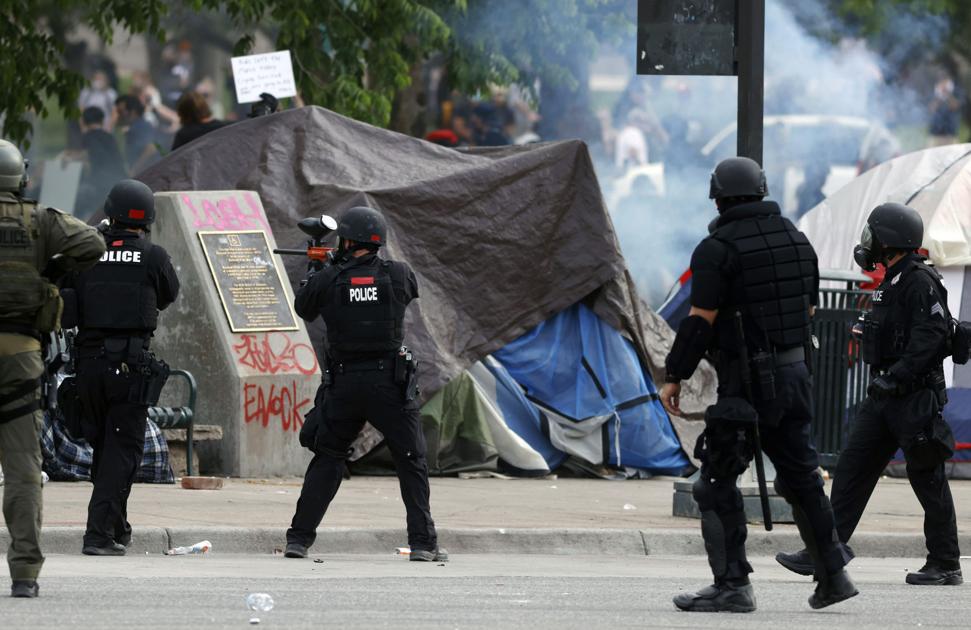
A draft of Denver’s budget for the next year, arguably the city’s “moral document,” reflects investments in alternatives to policing, but as calls to defund the police persist following the death of George Floyd, some elected officials argue it doesn’t go nearly far enough.
In Denver City Council budget hearings around Denver Police Department funding on Friday, Mayor Michael Hancock, Public Safety Director Murphy Robinson and Denver Police Chief Paul Pazen said despite departmental budget cuts elsewhere, they would be funneling $1 million into the city’s Support Team Assisted Response program, which diverts low-level 911 calls to health professionals. The pilot program is currently funded with grants from the Caring for Denver Foundation, but the plan is to leverage permanent city funding to expand the program.
“This is our effort, during a fiscal crisis, to put a high-dollar amount to show our values of this program and the diversification of alternative response,” Robinson told council members.
Nearly everywhere else in DPD’s budget are slashes, however.
DPD’s budget this year totaled $254.2 million, but next year, due to a $190 million budget shortfall caused by the coronavirus pandemic, the agency is proposing a 9.7% reduction. This, as Denver is on course to have its deadliest year in more than a decade and many residents are calling for more police to combat the crime wave.


The police department is also scaling back the hiring of new recruits and onboarding 70 fewer officers in 2021, which is estimated to save the city $3.5 million, according to the budget. DPD also plans to place a temporary freeze on 25 non-uniform positions, a cutback of about $1.9 million.
In the small number of recruits the agency does plan to pursue, the goal is to hire more diverse candidates, particularly women.
“There is research out there that if a female officer is on scene, that there’s less likelihood that the use-of-force incidences would escalate,” Pazen said.
Still, Councilwoman At-Large Robin Kniech said she wants to see the budget for Denver’s STAR program quadrupled to at least $4 million, and District 10 Councilman Chris Hinds echoed her. Kniech also argued that the program should not live within the police department under its 911 call center but rather be moved to the Denver Department of Public Health and Environment.
“I believe that clinical programs should be supervised by those who have the qualifications to be evaluating them, giving them the support they need,” she said.
Robinson said he would work with the Hancock administration to consider it, but also said it is “a big deal” the mayor found a million dollars to put towards the program in a fiscal crisis, which he said kept them up nights trying to find those dollars.
Meanwhile, the Hancock administration is negotiating a new contract with the Denver police union that was voted down earlier this week by the city council because it gives officers a raise in 2022. Council members felt it was unfair to city employees, who have not only been forced to take furlough days this year — a hardship not felt by law enforcement — but also have not been promised a forthcoming pay boost.
The contract has since been sent back to the negotiation table.
The Denver City Council will continue to hold budget hearings through Sept. 24. Council members will haggle with the Hancock administration for changes they want before the budget must be adopted in November.

