


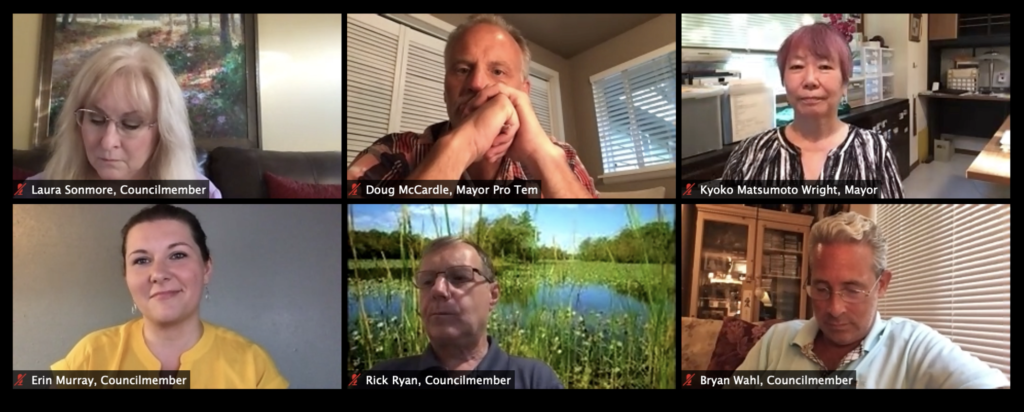
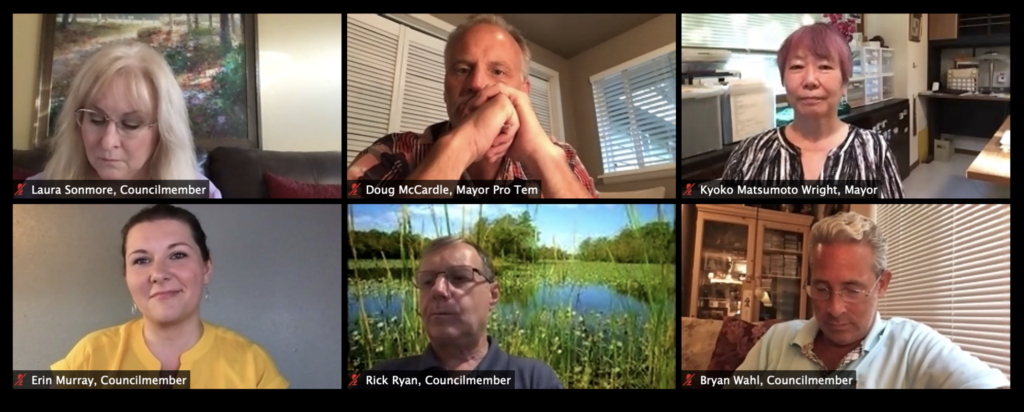
The Mountlake Terrace City Council at its Aug. 13 work/study session discussed a resolution that would extend the city’s emergency proclamation that allows local businesses to temporarily expand their outdoor seating capacity during the coronavirus outbreak. Restaurants are currently limited, under health measures issued by Gov. Jay Inslee, to using only 50 percent of their seating capacity for in-person dining in order to maintain social distancing. The state issued new guidelines last month outlining how restaurants and similar businesses could expand their seating outside and serve customers while still maintaining appropriate distance between patrons.
Some businesses in Mountlake Terrace have sought approval to expand seating areas outside into parking areas and possibly even public sidewalks. The city’s community and economic development department has developed a “Temporary Outdoor Use Permit,” which includes an application and review process of each business’ proposed outdoor operations.
The temporary permit is intended for those businesses that may be able to expand their capacity for seating or servicing customers during a modified Phase 1, Phase 2 or Phase 3 of Inslee’s Safe Start Washington Order. All uses authorized under the permit are intended to be temporary, moveable and no permanent structures will be allowed. Outdoor areas used may include a combination of sidewalk space and private parking, provided that safe pedestrian and vehicle access is maintained.
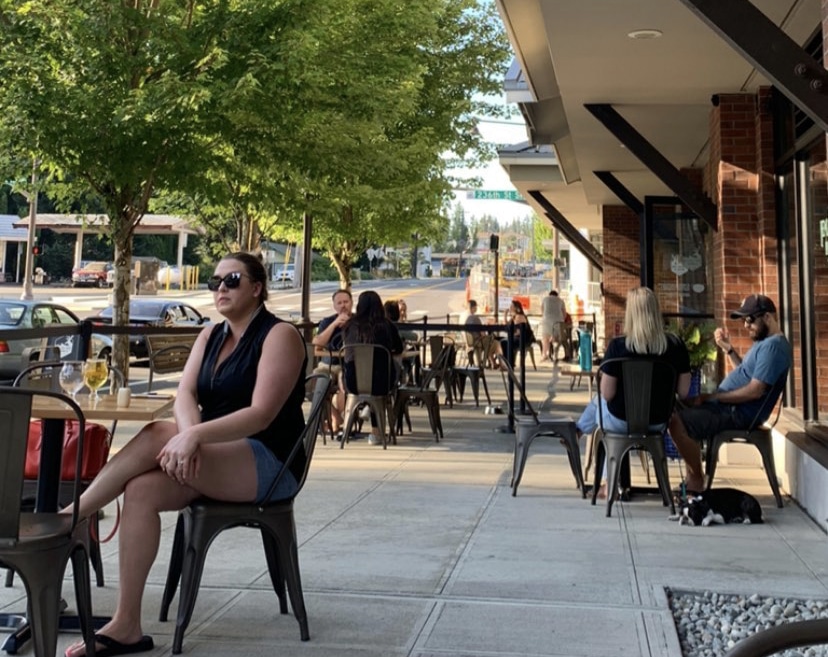
The program was already put into place with an emergency proclamation issued by City Manager Scott Hugill, and the council will vote at its Aug. 17 meeting whether to continue the measure. Hugill informed councilmembers that since the emergency implementation, two casinos had set up tents for card rooms in adjacent parking lots along with gas-powered generators, which have resulted in noise complaints from nearby residents. The city has notified the casinos that the generators must be shut down by 10 p.m. under the municipal code.
Councilmember Laura Sonmore said she had recently checked out the set-ups and outdoor picnic tables used by a couple of restaurants in the city’s downtown area and expressed support for the program. “When I go into these businesses and I see those workers working really hard, it’s nice to be able to give them that option so they are allowed to make more money as best as they can,” she said.
Councilmember Bryan Wahl said he is “really excited” for the program and believes that it is a win-win situation for restaurants and the city under current health and economic conditions due to COVID-19. He added he hopes to see the continued development, after the pandemic, of “more outdoor seating available long-term, year-round,” and thinks that the temporary program can help to provide experience and guidance for permanent rules going forward.
In another business, Hugill informed the council that the city’s request for proposals from nonprofit organizations to help provide specific coronavirus-related relief services to residents had received two such submissions. The council had previously identified in June assistance for people unable to pay essential bills and also make food delivery or additional grab-and-go meal programs available to those who are either homebound or at higher risk to travel as priorities to address, with funding supplied by the federal CARES (Coronavirus Aid, Relief, and Economic Security) Act. Under the program, money is available to the city on a reimbursement basis from the State of Washington as long as the expenses are directly connected to the COVID-19 pandemic.
One of the proposals received was from Washington Kids in Transition, which said it would distribute funds to residents in need to cover their unmet bills. It includes a 12% administrative fee for supplies and personnel costs. Hugill said the proposal did not identify a specific dollar amount requested for the services to be provided and any potential funding total received would be determined in further discussions between the city and organization.
The other proposal involves a three-way partnership of organizations that includes the Foundation for Edmonds School District, the Mountlake Terrace Community Foundation and Calvary Fellowship. This partnership of nonprofits is seeking a total of $40,000. It would provide food delivery and meal programs through the Foundation for Edmonds School District as well as financial assistance from all three nonprofit entities for residents’ unpaid bills. Under the proposal, the school district foundation would receive $20,000 to provide services, with each of the other two organizations getting $10,000 apiece.
Some on the council had questions concerning what the administrative costs associated with the three organizations in the partnership would be. Councilmember Erin Murray determined that the figures provided in their proposal allowed for $4,800 towards such expenses and were “right in line” as a percentage of the total amount requested, she said.
Councilmembers said they wanted to make sure that any relief programs approved would also provide for adequate communications outreach and be well publicized within the local community. Hugill thought that while the organizations are positioned to reach out to people they already serve, the city may also help with marketing those services. “It’s going to take all of us to talk about the programs and the availability and get the word out,” he said.
Councilmember Steve Woodard agreed and brought up the possibility of the city sending out postcards to residents informing them about the available funds. City Clerk Virginia Olsen also mentioned developing similar signs or flyers that could be posted around town and said she would further explore all of those options.
Hugill recommended contracting with both groups “so that we can get as much service out there to those who are in need.” He said any funds the organizations received that were not spent on the proposed relief programs would be returned to the city as required by contract.
Councilmembers noted the urgency for implementing and distributing the help throughout the local community. City policy allows the city manager to sign contracts, and Hugill proposed expediting the process to develop the contracts and get them signed, rather than waiting two more weeks for approval at the council’s Aug. 31 meeting. This was supported by the council, with Mayor Kyoko Matsumoto Wright stating, “We need to get the money in use as soon as possible.”
Civic construction and improvement efforts were also discussed at Thursday’s work/study session.
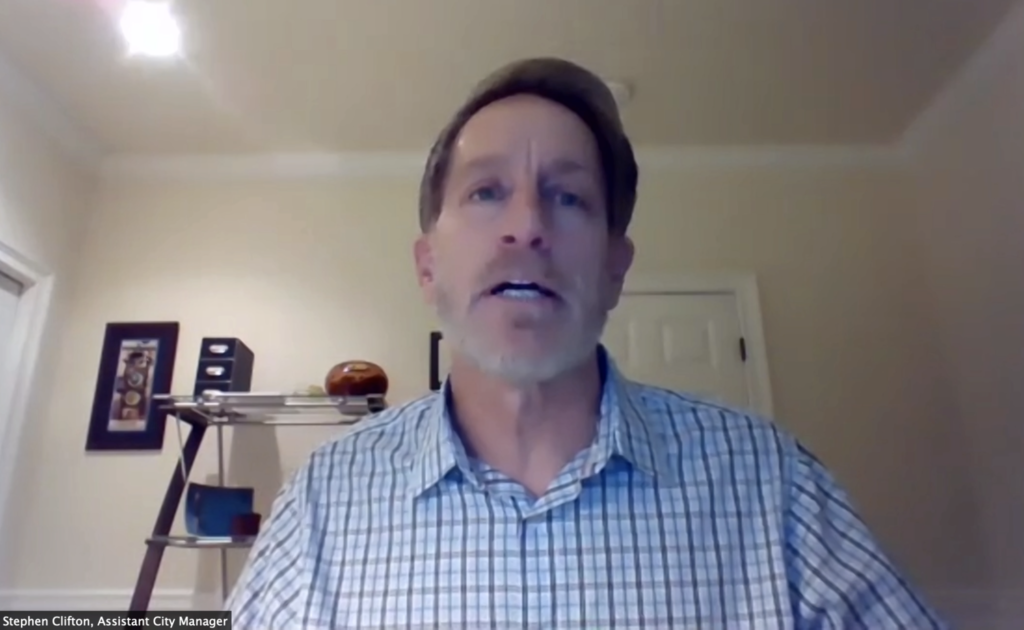
Assistant City Manager Stephen Clifton informed the council of a request for approval of an additional $100,000 in contingency funds for the Civic Campus project. It would bring the overall contingency at this point to $600,000, which he said remains within the project’s anticipated contingency of $900,000.
The contingency funds address the costs of city-approved change orders and unanticipated expenditures in connection with construction. The December 2019 project budget had originally included a contingency of over $900,000, but when construction bids came in higher than estimated, more of the contingency had to be used up front to cover the costs of the base construction contract with Allied Construction Associates Inc. This resulted in a remaining contingency of only $190,000 at the time the contract was awarded.
Council had previously approved an increase of $310,00 in the contingency amount in May.
Clifton said that a big portion of cost increases have been related to the excavation process and electrical upgrades, including underground wiring necessary at the Civic Campus. He told councilmembers that if the increase were to be approved, the contingency funds as a percentage of the total overall cost of the project would just over five percent, which would still be lower than the 10 percent that he said is typically standard for such developments.
City staff is recommending that the council approves the request at the council’s next meeting Monday night, Aug. 17.
Finally, Traffic Engineer Marc Seferian updated the council on the city’s self-assessment and transition plan under the Americans with Disabilities Act (ADA). He said it shows the city’s commitment to provide equal access and mobility for residents while focusing on pedestrian access routes, which includes sidewalks, curb ramps, pedestrian pushbuttons, crosswalks and bus stops.
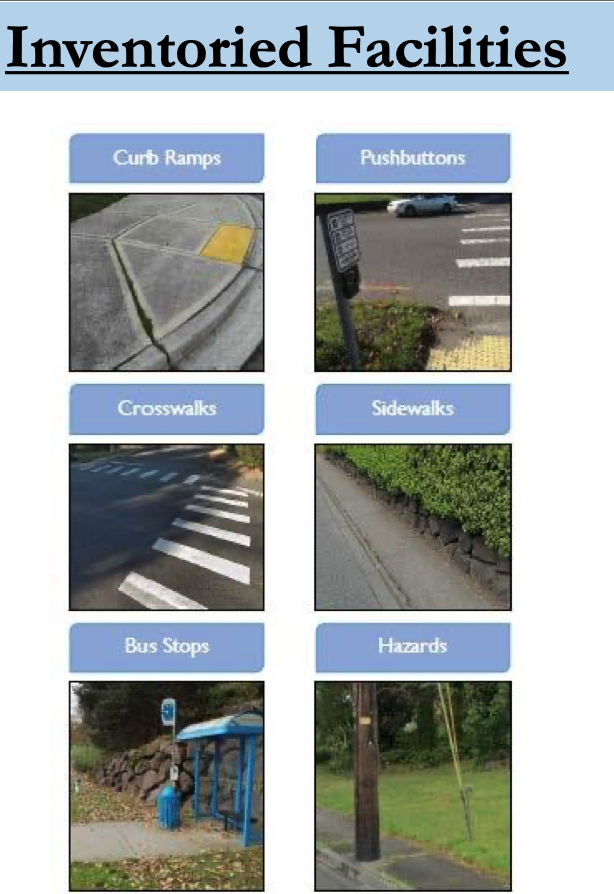 The city is conducting an inventory of barriers to pedestrian access in stages due to funding constraints, and Seferian said that those efforts have been currently completed for approximately one-third of the city. They have also utilized public outreach measures including an open house, survey and focus group.
Seferian said that so far data collection efforts and measurements have identified over 3,400 accessibility deficiencies throughout the city. Removal of any accessibility barriers is the primary purpose of ADA transition plans and in order to prioritize facilities that pose the largest barriers a scoring system was used based on current accessibility and proximity to significant community destinations such as schools, churches and bus stops.
He said that it is not uncommon for cities to have such a large number of accessibility barriers and to target removal of the highest priority barriers within the inventoried areas, a 50-year plan is anticipated. The “very high” and “high” priorities account for approximately 53 percent of the existing barriers within the area already inventoried and are estimated to cost a total of almost $19-million to address. The report estimates that based on the current annual funding available to remove the barriers, the “very high,” ‘high,” and 90% of “medium”-priority barriers could be prioritized for removal throughout the city over the next 50 years.
Some councilmembers expressed an interest in hearing what the timelines of comparably-sized cities are for such efforts. Seferian said that he would bring the results of that research to his next meeting with the council.
Seferian recommended the council provide any further questions or comments about the plan before its final review at its next work/study session on Sept. 3. The next proposed step would then be a public hearing and potential adoption of the plan at the council’s Sept. 21 meeting.
— By Nathan Blackwell

