


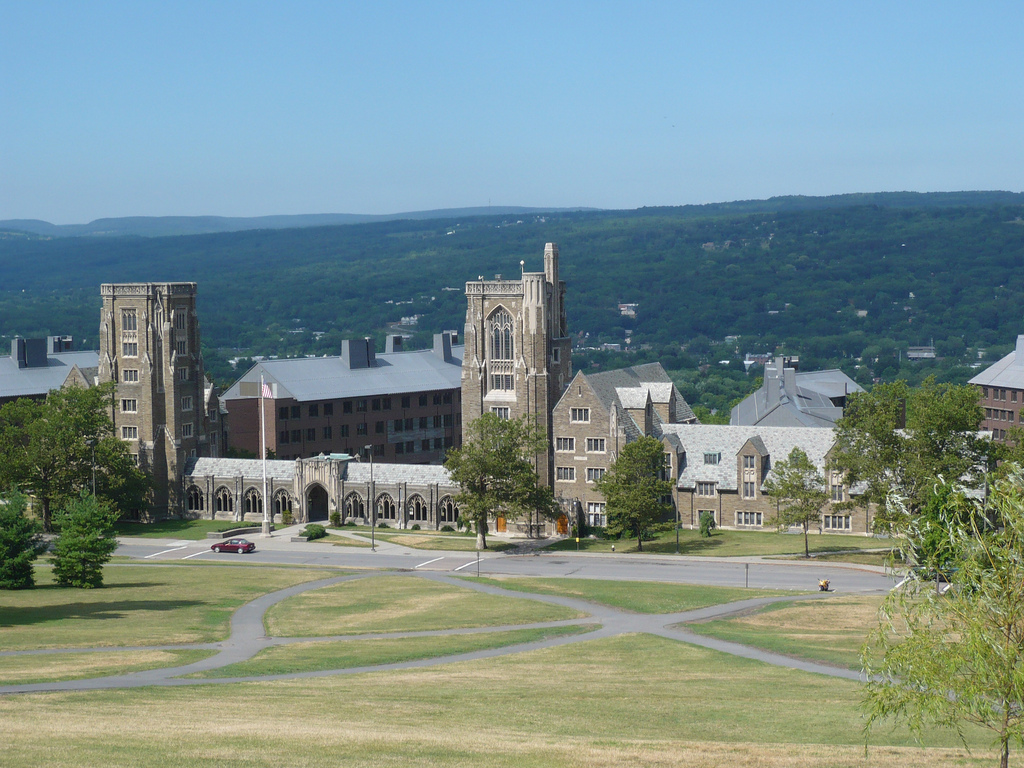
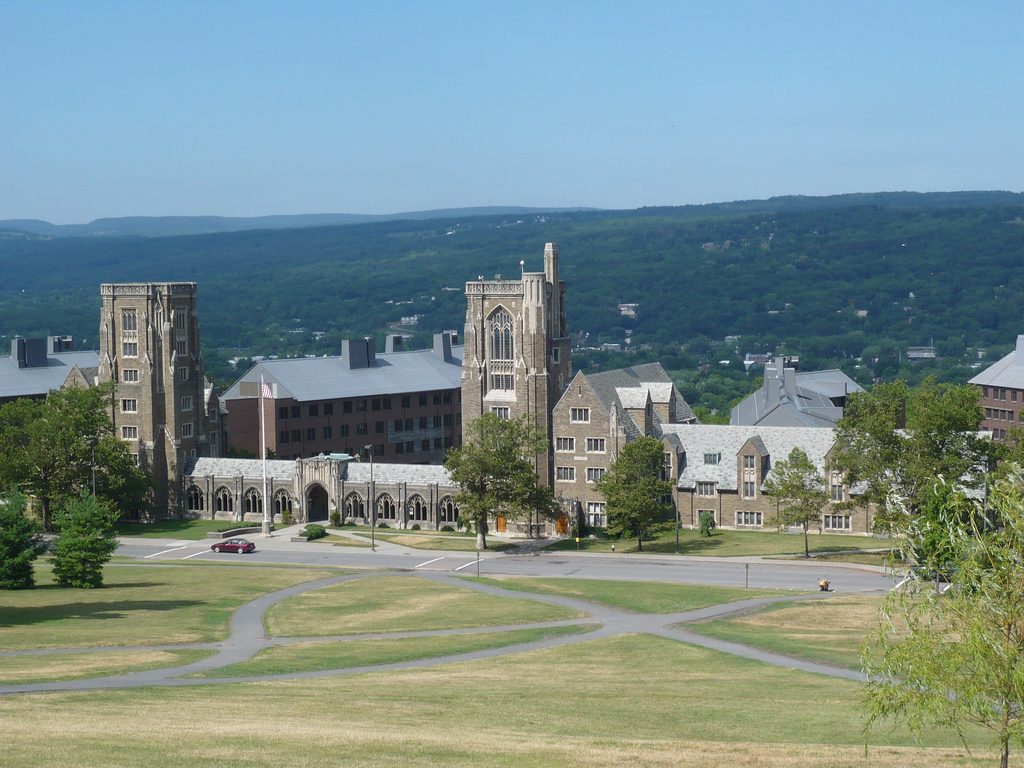
Cornell University (source: flickr/ Lina Rodriguez, creative commons)
Cornell University has won a grant of up to $7.2 million for its Earth Source Heat project that plans to tap into geothermal energy for heating parts of the campus of the school.
Announced last week, the U.S. Department of Energy has awarded funding of around $28 million to 5 projects on various elements of geothermal development and technology. As part of that funding, Cornell University has secured a grant expected to total about $7.2 million, which will fund exploratory research – in the form of a 2-mile-deep borehole (around 3,500 meters) – to help verify the feasibility of using a novel geothermal energy system to heat its campus buildings.
The grant, announced July 29, is among funding for several projects around the country that the DOE said will promote the advancement of next-generation geothermal energy technologies.
“Geothermal energy is an important part of the Trump administration’s diverse, all-of-the-above energy strategy,” Undersecretary of Energy Mark W. Menezes said in a statement. “These projects will help bring the massive promise of clean and reliable, geothermal energy, for both power production and direct use, closer to reality for all Americans.”
Earth Source Heat (ESH) has been part of Cornell’s Climate Action Plan since 2009 as a potential means of moving toward carbon neutrality on campus by eliminating fossil fuels for campus heating. ESH is an ambitious proposal to heat most buildings on the Ithaca campus using a deep geothermal system that would draw thermal energy stored deep within the Earth.
The project would help eliminate Cornell’s carbon footprint while demonstrating a geothermal technology that may be applicable in much of the northern United States.
Cornell has since published several studies highlighting the technical and economic feasibility of ESH, including research revealing promising geological conditions deep under campus. The borehole will provide detailed and conclusive data on those conditions, including natural fracture patterns in rock, zones of fluid flow and their hydraulic capacity, and thermal properties of rock, among others.
The research borehole, to be 4 inches in diameter in its deepest section and located on Cornell-owned property, will complete the testing necessary to verify those conditions, according to Jefferson Tester, the David Croll Sesquicentennial Fellow and Professor in the Smith School of Chemical and Biomolecular Engineering, chief ESH scientist and principal investigator for the research borehole.
“The DOE’s support puts us on path to demonstrate geothermal’s potential as a major, sustainable source of clean, decarbonized energy that the region and much of the country urgently need in order to transform the way we heat our communities and cities,” Tester said. “The Earth Source Heat project will also demonstrate the feasibility of seasonal thermal storage to increase the performance and lifetime of geothermal reservoirs.”
The project will be subject to an environmental review and a permitting process.
Its start date is to be determined, but Tester and other project leaders estimate that it will take up to a year to establish detailed drilling plans and permitting. The actual drilling and sample extraction will take about three months; laboratory and computational analyses of materials and data will take another 18 months.
Scientists will install equipment that will allow the borehole to become a long-term observation well, to monitor natural phenomena and reservoir performance during future testing of a geothermal production system.
The project has already drawn interest from geologists, seismologists and other scientists. In January, Cornell hosted 35 researchers from around the world to design experiments that could be incorporated into the borehole. Some of these studies and experiments exceed the scope of the just-announced DOE project, and they could underpin future research collaborations and funding.
“The international geothermal research community and the national geosciences community were eager collaborators in imagining novel experiments, and they generously lent their expertise to transform those ideas into a practical drilling and science plan,” said Teresa Jordan, the J. Preston Levis Professor of Engineering and co-PI for the research borehole. “The borehole offers the chance to simultaneously achieve practical and scientific goals by focusing on learning the complex relationships between pore pressure, stress and strain in heterogeneous rock, across conditions that span from natural to human perturbations, and short to long time scales.”
Co-PI Patrick Fulton, assistant professor of earth and atmospheric sciences, and a Croll Sesquicentennial Fellow, has studied fluid flow, thermal responses and geomechanics in deep boreholes in the floor of the Pacific Ocean as well as in California.
Senior partners for this project include Cornell facilities engineers Ole Gustafson and Steve Beyers, whose activities will include analyzing the value of further engineering innovations, such as the incorporation of bi-directional heat transfer into the ESH system.
The National Renewable Energy Laboratory will be working with Cornell on technical and economic modelling for the project.
Source: Cornell release

