


New legislation in the U.S. that could enable a fresh wave of sanctions against China may have international banks operating in the city on edge, but experts expect lenders to wait to see the full extent of the tensions between the two superpowers before deciding how to respond.
Tensions mounted when President Donald Trump on July 14 approved the Hong Kong Autonomy Act, a move made in response to China’s new national security law for the city.
The act paves the way for sanctions against Chinese individuals and entities the U.S. deems to threaten the autonomy of the special administrative region as well as financial institutions that conduct business with those individuals and entities. China vowed to take strong counter-measures against the U.S. and the Hong Kong government said it would support any steps Beijing takes.
Some of the world’s largest banks have significant client bases in Hong Kong, and the latest U.S.-China tensions may have the potential to put regional strategies to the test.
Two international banks with a notable presence in Hong Kong are HSBC Holdings PLC and Standard Chartered PLC, ranked 6th and 43rd in the world by assets in the latest annual ranking from S&P Global Market Intelligence. With headquarters in the U.K. both institutions have Hong Kong business segments that account for 30.15% and 27.76%, respectively, of their total loans and leases, according to S&P Global Market Intelligence data.
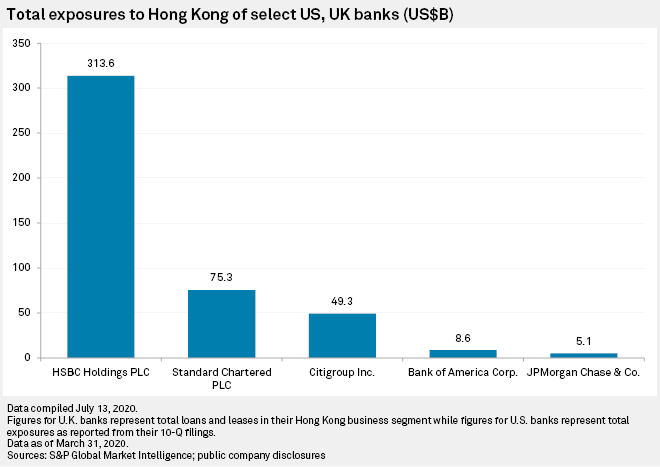
“It’s too early for banks to say what the consequences are, but there would definitely be reasons to revisit that client list to look at risk exposures” from a ‘know your customer’ perspective, said Benjamin Quinlan, CEO of Hong Kong-based management consulting firm Quinlan & Associates. “There is probably a little bit more of a wait-and-see approach from banks when responding to the new sanctions.”
Banks will need to assess the risks and evaluate the effect on their earnings and reputation before planning their next steps, he said. However, when it comes to cutting off sanctioned individuals, the process may not be as straightforward for the banks.
“Some clients may not want to move their money or conduct their banking activities in another offshore market [even] if advised to do so by their bank,” Quinlan said, adding that others may move to different banks. “Ultimately, the extent of this will be based on the risk appetite of the various banks operating in the city, including the risk exposures they are willing to accept with regards to these new laws.”
‘Make or break’
The challenge for banks is that they will need to find a way to satisfy both U.S. and Chinese authorities, said Anna Bradshaw, a partner and sanctions specialist at Peters & Peters, a London law firm.
“The banks are caught between two hugely powerful nations and this situation is necessarily going to be unresolved in the short term because that is part of the bargaining position involved – this is part of the process that gives sanctions their force,” Bradshaw said.
Some banks have been vocal about their support for the national security law. HSBC, which derives most of its overall profits in Hong Kong and mainland China, has been supportive of the Chinese legislation for Hong Kong, even at the cost of tarnishing its reputation among certain customers. Standard Chartered also has endorsed the change.
Yet Bradshaw describes U.S. sanctions as “make or break.” Large international banks have no choice but to comply with U.S. sanctions, she said, “These are the penalties that hurt. Sanctions, in this case, can be unforgiving because for a global bank like HSBC being penalized for doing business in your key market is a significant problem.”
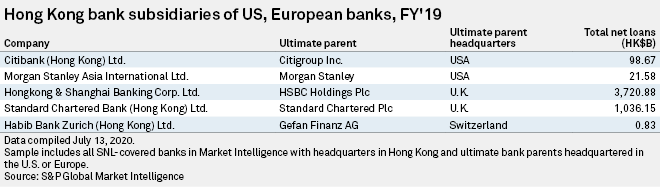
Banks may seek to work with the U.S. government to see how they can minimize the impact of the sanctions on their businesses. “The only course of action they have is to engage with the U.S. authorities, go to the U.S. authorities in the first instance and try to work out some way that allows them to continue their operations,” she said. “But the banks are at their mercy.”
Fahed Kunwar, an analyst at London-based equity research firm Redburn, added that sanctioning could leave certain international banks in a weakened position, with the threat of sanctions reverberating across other parts of their business, not just those that are directly related to Hong Kong.
For example, he said, the U.S. Department of Justice has gone from considering sanctions when U.S. dollars have been used to trade with America to looking at whether a bank uses U.S. dollars at all in its operations, he said. If a bank carries on doing what the U.S. does not want it to do, its dollar clearing license can be revoked. “And, for a global bank, that makes it extremely difficult to continue,” he said.
Even so, banks’ commitment to doing business in Hong Kong does not appear to be waning. During a July 14 earnings call, Citigroup Inc. CEO Michael Corbat said the bank is looking to obey local laws and found both the Hong Kong and Chinese governments to be supportive of its business. According to a regulatory filing, Hong Kong accounts for 2.9% of business for the U.S. bank, the 13th largest in the world by assets.
“Our goal really is to be there to support our clients and that we’re fairly used to operating in charge for complex environments,” Corbat said.

