


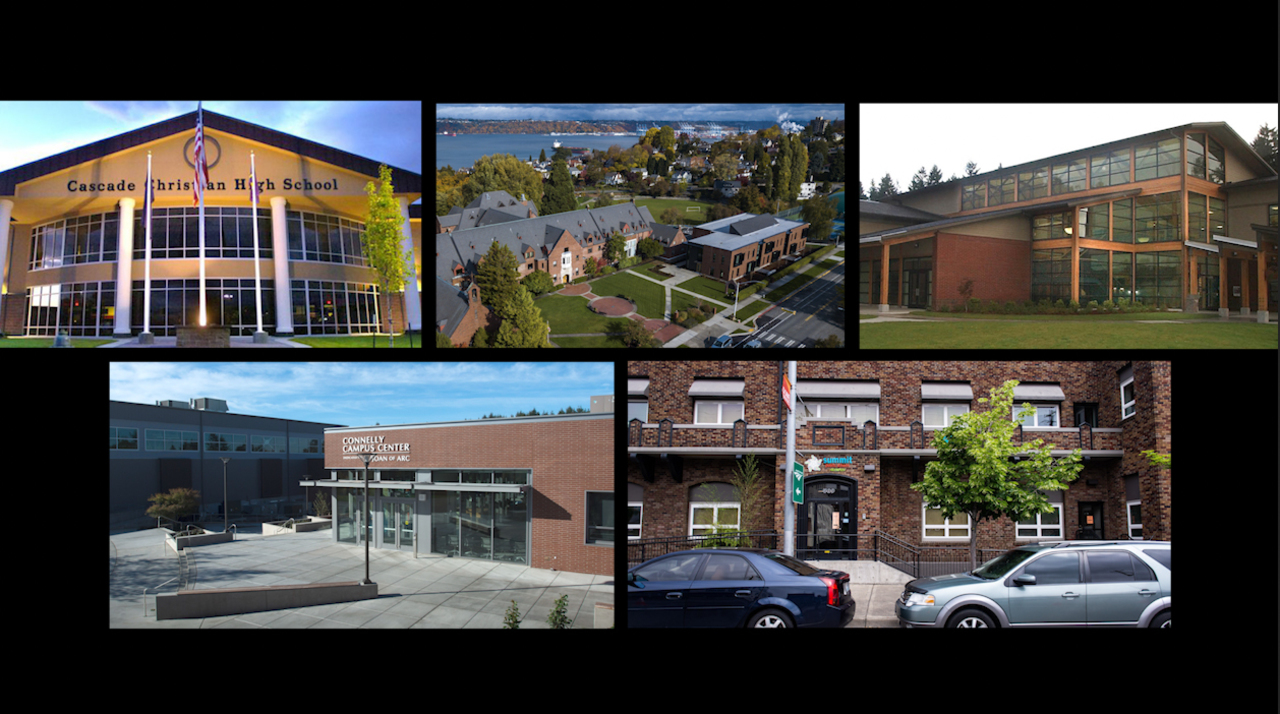
Private and charter schools in Pierce County were some of the largest local recipients in federal Paycheck Protection Program funding.
Some say the schools were justified in accepting the loans, while others called it an example of the federal government helping private schools more than public ones.
These schools were awarded at least $10 million in federal aid, according to the federal database of PPP funding.
Neil Campbell with the Center for American Progress is concerned that the higher-tuition private schools were awarded more, because they tend to have more expensive payrolls. The need for funding is inverted from the amount awarded.
“It wasn’t designed for education,” Campbell said.
Private schools are seeing a drop in enrollment for next school year, and University of Washington-Tacoma’s Margo Bergman said a business is a business.
“If they were seeing withdraws, then they would have to lay people off,” she said. “We need people to continue to pay into the system to ensure that we can come out of it on the other side somewhat where we were.”
Congress allotted $719 billion into the Paycheck Protection Program to help businesses stay afloat and keep employees at work during the pandemic. Additional funds were added to the program in April.
Recipients receive low-interest loans that can become grants if the business follows guidelines such as retaining or quickly rehiring employees. The program is intended to encourage businesses to keep employees on the payroll.
The award amount is determined by average monthly payroll costs, minus employees who make more than $100,000, according to the application.
Campbell is the Center for American Progress’ Director of Innovation for K-12 Education. He understands the frustration some have voiced on social media over the fact that private and charter schools received public loans.
About 70 education groups, including Campbell’s, advocated for the federal government to provide public education $250 billion. Washington state public schools were allocated $195 million of CARES funding that will be divided between 294 school districts. Campbell said that’s not enough.
“We are of the belief that public money should be for public schools,” he said.
But, he added that the pandemic has been brutal for all schools. Private schools rely almost entirely on tuition, making their revenue more volatile and susceptible to the whims of the economy.
“The need is there and what makes me upset is that there hasn’t been that responsibility to public schools,” Campbell said.
He is considerably worried about the quality of education all students are receiving due to the coronavirus pandemic, calling it “four-dimensional chess.” Schools have to decide how to educate with face masks, social distancing and continual cleaning, all of which are costly additions.
Bergman is a senior lecturer at the Milgard School of Business with a background in economics and public health. She said that, from an economical standpoint, the PPP loans are meant to help people stay employed, regardless of the job.
“Fairness, or unfairness, they are employing people. It is in our general interest to ensure that people still get paid,” she said.
Wright Schools
The head of Annie Wright Schools, Jake Guadnola, said they were awarded $2.1 million in the Paycheck Protection Program. The school serves more than 600 students from preschool to 12th grade. The school employs 180 staff, all of which kept their jobs, and Guadnola credits the federal aid.
“We are happy to say that through the PPP, we were able to keep them on through the school year,” he said.
The $2.1 million might not be enough to cover the hit to revenues for the private school.
Some of the boarding school’s families were affected, and called to ask for financial relief. A traditional school year for the Upper School costs $29,920.
Enrollment for next year has decreased, and uncertainty surrounding international students’ return could cause continued losses for the school, Guadnola said.
“The financial impact of this is significant and even with the PPP loan, we anticipate running a deficit for the coming school year,” he said.
Charles Wright Academy, an independent private school serving roughly 550 students, was awarded just over $2 million in PPP funding.
Of the $2 million, $26,000 was used for utilities, while the rest was used for salaries.
“We use the PPP to essentially pick up our payroll during that time,” said Susan Rice, head of school at Charles Wright since June. “We also had a large percentage of our workforce that we would have laid off otherwise.”
Staff from the transportation, facilities and maintenance, janitorial, food service and administrative assistance departments could stay on board, Rice said.
Due to COVID-19, two of the school’s major funding sources have taken a hit, including fund-raising and enrollment, Rice said. Enrollment heading into the fall has decreased, with some families struggling to pay tuition due to job loss or wage cuts.
The cost of tuition for Charles Wright students range from $19,000 to $28,000, depending on age.
About $200,000 of the $2 million PPP funding awarded is left over, and Charles Wright plans to return it, Rice said.
Faith-based schools
The Trump administration opened the federal COVID-19 loans to religious entities, stating that it was discriminatory not to include them.
The United States Conference of Catholic Bishops released a statement July 10 saying that the loans will help the church provide essential services during the pandemic.
“The Paycheck Protection Program was designed to protect the jobs of Americans from all walks of life, regardless of whether they work for for-profit or non-profit employers, faith-based or secular,” the statement said.
Pierce County Catholic schools affiliated with the Archdiocese of Seattle also received funding from the government, up to $2.35 million. Communications Director Helen McClenahan spoke on behalf of the three Pierce County Catholic schools — St. Charles Borromeo, St. Patricks, and Holy Rosary.
The schools and churches entirely depend on tuition and donations. McClenahan said the funding has helped keep staff employed and pay mortgages, utilities and groceries.
“While we have seen an impact alread,y we have no idea how deep and long it will be — but clearly longer than the eight-week period of the PPP,” she said in an email.
Cascade Christian Schools received about $1.4 million, Superintendent Ken Friesen said. With tuition accounting for about 92 percent of the school’s income, there was a significant impact as families affected by COVID-19 withdrew students.
Between 95% to 97 % of jobs were saved due to the federal aid.
“Having the benefit of PPP funds kept us from having to lay-off many employees,” he said in an email. “The funds were used as intended to cover two-months of payroll expenses, as well as some expenses related to utilities and facility leases.”
Michael J. Adams, president of Faith International University in Tacoma, said the school received $275,000 in PPP funding to help with payroll and utilities.
“We have offered online education along with resident and hybrid study for many years, but our enrollment was still down about 20% last spring due to the coronavirus,” Adams told The News Tribune through email. “The PPP funds allowed us to retain all 23 jobs — timely and very helpful, indeed.”
Lighthouse Christian School’s head of school, Stephen Roddy, did not elaborate on the precise amount awarded, but confirmed the school received between $350,000 and $1 million. The funds were used for staff, utilities and mortgage payments, he said in an email.
Charter
Pierce County has one charter school in Tacoma.
Charter schools are publicly funded but privately operated by nonprofit organizations and became legal in Washington in 2012. They are free and open to all students and they receive funding based on student enrollment, like traditional public schools.
Summit Public Schools, which serves three schools in Washington state, including Summit Olympus High School in Tacoma, received $1.5 million in PPP funds.
The organization did not respond to requests on how much the Tacoma school received.
“In March, when school buildings had to close, we were able to pivot quickly to virtual school, ensuring students did not miss a single day of learning,” Summit Public Schools spokesperson Heather Vega said in an email. “And, in accordance with the current federal guidelines, the money was used to pay wages and rent during the months of March through July. In short, we were able to keep everyone employed while students continued to learn.”
Being operated by nonprofits also qualified them for PPP funding. In Summit Public Schools’ case, the Washington state board of directors discussed the implications of participating in the PPP program and then voted to do so on May 5.
Charter schools accepting PPP funding stirred controversy across the country as many small businesses struggled to gain access to the program to stay afloat.
“Charter schools, just like other public schools, were continuing to get their education funding from the state … but then charters were also tapping into this source that was meant for private businesses,” said Clare Crawford, senior researcher for In the Public Interest, a national nonprofit research and policy organization that studies public goods and services.
Private schools don’t have the same access to state funding that charter schools do, but Crawford said it’s important to ask whether or not they are seeing an impact to their major funding streams, like fund-raising and enrollment.
The News Tribune reached out to the following schools for comment, but they did not respond: Tacoma Christian Academy, Seabury School, Harbor Montessori, Pacific Northwest Lutheran High School Association, Bellarmine Preparatory School, Alphabet Preschool, South Sound Christian Schools, Northwest Christian Schools and Our School of Gig Harbor.

Josephine Peterson covers Pierce County and Puyallup for The News Tribune and The Puyallup Herald. She previously worked at The News Journal in Delaware as the crime reporter and interned at The Washington Post.

Allison Needles covers city and education news for The News Tribune in Tacoma. She was born and raised in the Pacific Northwest.

