


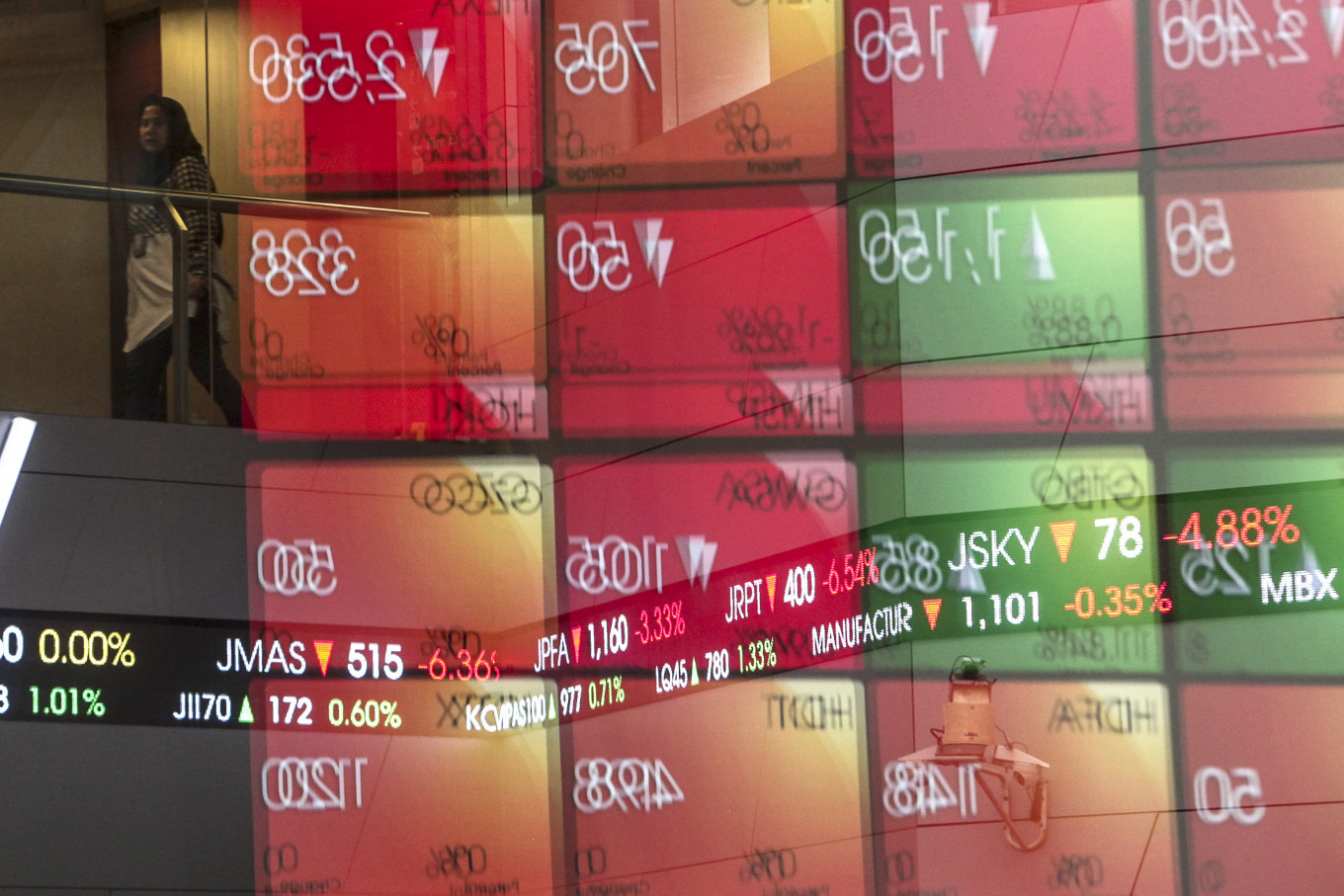
According to market players’ projections, the benchmark Jakarta Composite Index (JCI) will likely end the year at between 5,000 and 5,500, a wide range that shows how difficult it has been to predict market movements as pandemic-related risks will likely continue to create volatility.
Schroders Indonesia investment director Irwanti said stock price growth in both global and domestic markets would rely on the reopening of economies and development of vaccines. Meanwhile, the number of COVID-19 cases have recently been ignored by the market, she added.
“It is very difficult to forecast anything at the moment,” Irwanti said during The Jakarta Post’s webinar Jakpost Up Close: Investing in Stocks: Best Strategies in Volatile Times.
“Things are very fluid right now.”
Irwanti, whose firm manages Rp 61.1 trillion (US$4.37 billion) in assets in Indonesia, estimates that in the best-case scenario, the JCI would drop 15 percent this year based on projections on earnings per share (EPS) growth coupled with government policy support.
This compares with Mandiri Sekuritas’ forecast of a 12 percent JCI drop to 5,540 at the end of the year, said head of equity research Adrian Joezer during a Mandiri Economic Outlook online forum.
“With the gradual easing of large-scale social restrictions [PSBB] starting this month, we expect the JCI to reach our forecast as it will help publicly listed companies recover from the impact of the pandemic,” Adrian said.
The brokerage firm, however, could also further revise its projection depending on how market players would respond to government policies and the latest development of COVID-19 in Indonesia, including on how the economy would recover.
The JCI has lost 21.5 percent of its value so far this year following a global stock market crash in March caused by investors’ concern over the pandemic’s impacts on the global economy. The current level is already recovering from the year’s low of 3,937, a 37 percent drop from the end of last year.
Batavia Prosperindo Aset Manajemen (BPAM), which manages Rp 44.8 trillion in funds, projects the JCI to close the year at between 5,000 and 5,300, representing a fall of 15 to 20 percent from last year’s end point of 6,299.
“We are going to see continuous volatility, so expect that, get used to that. Volatility is not something you should be fearful of. It should be seen as an opportunity especially for individual investors to do dollar cost averaging,” BPAM president director Lilis Setiadi said in the Post’s webinar.
Dollar-cost averaging refers to an investment strategy in which investors try to reduce the impact of market volatility by dividing their investments into multiple smaller purchases, with regular intervals in between each purchase.
Prudential Indonesia chief investment officer Novi Imelda said in a separate livestreamed press conference that short-term stocks’ volatility would be inevitable, but they would rebound accordingly as the economy recovered.
“As long as the economy grows, our index will grow,” Eastspring Investments Indonesia chief investment officer Ari Pitojo said at the press conference.
Ari refrained from making a projection of when a rebound to normal levels would occur but noted that market consensus said it would take one and a half to two years’ time.
The government had projected a baseline economic growth of 2.3 percent this year and a 0.4 percent contraction under a worst-case scenario due to the pandemic.
Looking at the JCI historical chart, Bank Commonwealth head of wealth management and premier banking Ivan Jaya said in a separate webinar that in the several past bear markets, it took the JCI 11 to 18 months to recover to its previous highest level.
Mirae Asset Sekuritas head of research Hariyanto Wijaya projected the Indonesia Stock Exchange’s main gauge to reach 5,180 by the end of 2020 in its best-case scenario. Even in the best-case scenario, under which vaccines could be produced for the mass market this year and crude palm oil prices (CPO) rise, the index could reach 5,830 at the end of the year, still reflecting a 7.4 percent drop from last year.
Mirae’s worst or bear-case scenario for the JCI is a fall to 4,160 by the end of the year, reflecting a wide range of predictions that gives room for price volatility.
“This could happen if a second wave of the coronavirus outbreak occurs, the United States enters a recession in 2020 and CPO prices collapse,” he said during the Post’s webinar.

