


SINGAPORE (ICIS)–Asian demand for chemical raw
materials that go into protective barriers used
to prevent coronavirus transmissions is
expected to remain buoyant as more economies in
the region reopen.
The uptick in demand for polymethyl
methacrylate (PMMA) into acrylic sheets for
transparent barriers is increasing in Asia as
economies slowly reopen, with indications that
this will continue for some time amid the
ongoing pandemic.
Sheet makers are now seeing increased demand
from within southeast Asia including Singapore,
Thailand and Indonesia, as lockdown
restrictions are being lifted.
Thailand started the last stage of its lockdown
on 1 June with the aim to fully re-open its
economy on 1 July, while Indonesia’s
“large-scale social curbs” ended on 4 June.
Singapore will also enter the next phase of its
economic reopening from 19 June.
In the week ended 4 June, PMMA prices were
assessed at an average of $1,500/tonne CFR
(cost & freight) China, up by $35/tonne
from the previous week, according to ICIS data.
Key feedstock acetone CFR CMP (China Main
Ports) prices have risen by more than twofold
since early April to an average of $1,050/tonne
in the week ended 12 June.
China domestic MMA prices have surged by 83%
since early April to CNY 13,000/tonne extank
east China in the week ended 12 June.
Transparent sheets are now being installed in
shops, restaurants, offices, hospitals and
other public spaces to prevent coronavirus
transmissions.
Cast acrylic sheet, made directly from the
monomer, and also extruded acrylic sheet, made
from PMMA resins, are commonly used to make
these barriers.
According to an Asia-based PMMA producer,
demand for protective sheets is still firm in
US, Europe and Middle East.
The producer, who sells PMMA resins to
extrusion sheet makers in the these regions,
said that it is receiving spot enquiries and
expects demand to remain supportive for the
rest of the year.
However, demand for protective barriers alone
is insufficient to lift overall demand for MMA
as other downstream sectors remain weak, with
major industries such as automotive and
construction still heavily impacted by
disruptions caused by the coronavirus.
This may result in weaker overall demand growth
for these products in the months ahead compared
with the sharp shikes seen so far this year.
Global exports of MMA to-date this year now
stands at 343,638 tonnes, according to ICIS
data.
Global shipments totalled 1.31m tonnes for the
whole of 2019.
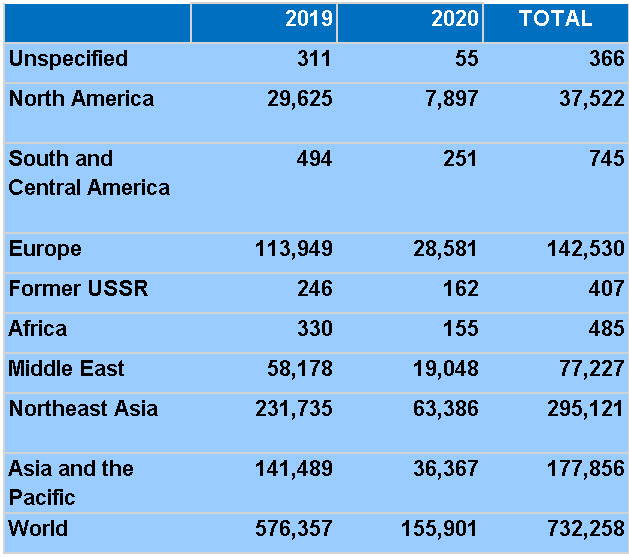
Global exports of PMMA meanwhile are at 155,901
tonnes while global shipments of PMMA totalled
576,357 tonnes last year.
Global PMMA Exports
Source:
ICIS
DEMAND FOR PERSONAL PROTECTIVE
EQUIPMENT SUPPORTING PP
With the
coronavirus pandemic, growing demand for face
masks, disposable syringes, and other medical
protective equipment is expected to boost the
supply of transparent polypropylene (TPP) grade
and polypropylene (PP) fibre grade, according
to US based analysis firm Beroe.
Demand for PP from the medical sector in China
remains supportive, especially for the
production of face masks, according to ICIS
senior analyst Joey Zhou.
Masks are made of two fibrous layers which use
PP fibre as the raw material, and a melt blown
fabric layer for antivirus protection which
needs to use high melting index PP (melting
1500).
“China is the largest producer for face masks
and both domestic and export demand remains
strong,” Zhou said.
The production of face masks remain the key
drive for fibre-grade PP in the short term.
However, demand has since waned since its peak
in April when face masks were in shorter supply
and will not be able to push PP prices much
higher, she said.
There are also government-led moves to tighten
regulations on illegal factories producing face
masks.
Furthermore, the higher production of face
masks has lowered their prices back to normal
levels, according to Zhou.
In southeast Asia, demand for PP non-woven,
fibre grades previously saw a surge in the
demand earlier in the year, which led to some
producers focusing production of these
grades, owing to increased demand and
attractive premiums.
However, demand for non-woven grades has
tapered down in recent weeks, amid the
slowing spread of the coronavirus in
southeast Asia.
Premiums have also been eroded as a result.
Offers for non-woven major supplier in
southeast Asia were at around $980/tonne CFR
(cost and freight) southeast (SE) Asia for
June shipments.
Offers were previously above the $1,000/tonne
mark.
In longer term, demand for fibre-grade PP can
support overall demand but will not be the key
driver. Demand from medical section takes over
less than 5% of China’s total PP demand,
according to Zhou.
With additional reporting by Li Li Chng and
Leanne Tan
Focus article by Nurluqman
Suratman

