


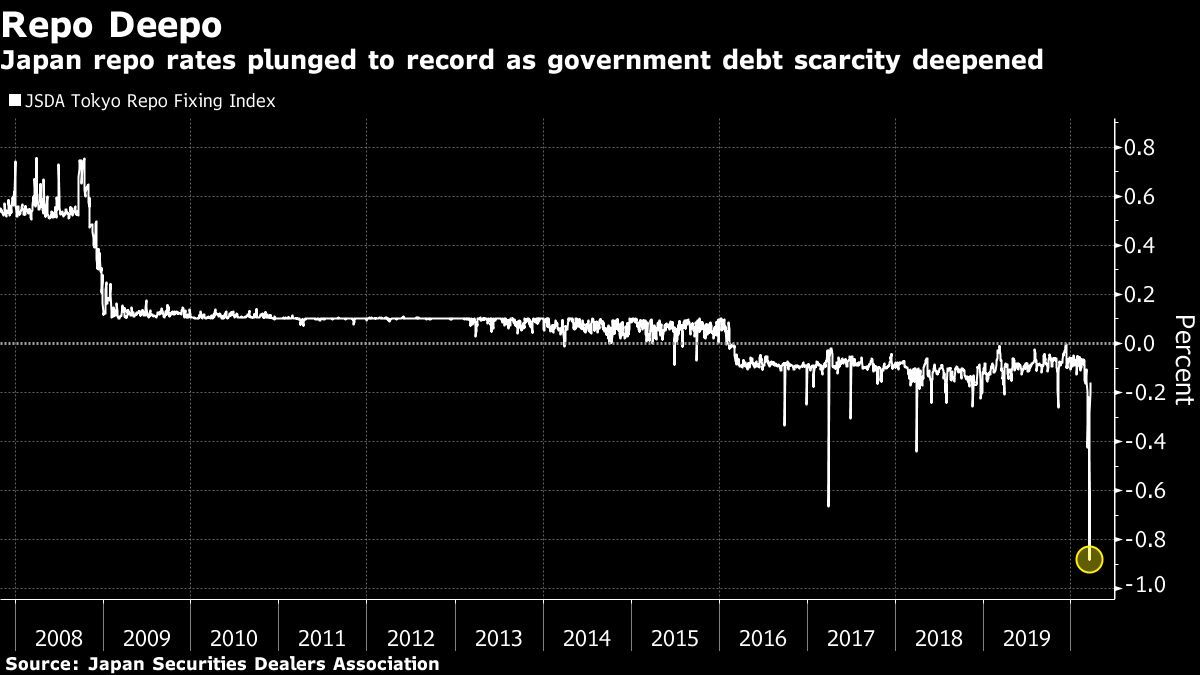
(Bloomberg) — The Bank of Japan went to such lengths to ensure local banks had enough dollars to weather a global liquidity crunch that it may have inadvertently contributed to a surge in repo-market rates to a record.
The BOJ offered Japanese banks cheap access to dollars, and encouraged them to borrow as much as they wanted, according to people with knowledge of the matter. When the lenders complied — to the tune of $185 billion net and counting — the collateral they posted was sucked straight out of the repurchase markets, another key link in the financial plumbing.
The convulsions show how seriously the BOJ is taking the threat poised by the coronavirus pandemic to its banking system. It was chiefly worried a global dollar shortage would worsen, heaping pressure on banks and companies, the people said. Officials had reasoned that even if lenders just used the funding to make arbitrage profits in other markets, that could still benefit Japan’s beleaguered economy, the people said, asking not to be identified as they aren’t authorized to speak publicly.
“In terms of availability of dollar funding for Japanese banks, central banks’ dollar supply operations are helping mitigate availability risks,” said Rie Nishihara, a banking analyst with JPMorgan Chase & Co.
Large Exposure
“We understand Japanese financial institutions have ample foreign-currency funding at this moment,” a BOJ spokesman said by phone in response to questions.
“There are an increasing number of financial institutions that are securing foreign-currency liquidity as a precaution given increasing need to meet the funding needs of corporate clients,” the spokesman said. “‘To ensure a smooth functioning of dollar-funding markets, the Bank of Japan is asking them to actively utilize the dollar supply operations in accordance with their needs.”
The BOJ’s concerns about the foreign-asset exposure of Japanese banks are longstanding, given how its negative rate policy has driven a massive outflow of funds from its shores. In October, the central bank said the expansion by lenders since the financial crisis is “considerably larger” than for their U.S. and European counterparts, meaning they need to strengthen their foreign-currency funding bases.
Outstanding foreign claims of Japanese bank branches and subsidiaries abroad, including loans and securities, reached a record $1.1 trillion equivalent in December, according to data from the Bank of International Settlements posted on the BOJ’s website.
Funding Stigma
The sheer size of that exposure may be part of the central bank’s reason to pre-empt a funding crunch, which could quickly escalate if lenders had to compete to access dollars. The BOJ even contacted regional banks to encourage them to take up the funds, because it wanted all lenders to see no stigma whatsoever from leaning on the central bank, according to the people.
Officials were concerned traditionally conservative Japanese banks might balk at tapping the swap-lines, in case that was taken as a sign to other market participants they were having funding difficulties, the people said.
The BOJ need not have worried.
Rock-Bottom Costs
Thanks to their efforts and the rock-bottom borrowing costs — about 0.35% for 3-month money courtesy of an emergency Federal Reserve funding package — Japan’s banks have taken down $185 billion net, more than the entire euro-area.
Japan’s largest lender, MUFG Bank, said it has an “ample supply of U.S. dollars,” according to spokeswoman Kana Nagamitsu. A spokesperson for Mizuho Bank said the bank didn’t have “any particular concern for dollar funding at this moment.”
Mizuho was “preparing for the risk that current unstable economic and market conditions will continue for a while,” it added.
Unintended Consequences
However, the surge in activity in the BOJ’s swap lines had a knock-on effect in other markets.
Borrowing dollars through them requires banks and dealers to put down collateral, usually in the form of Japanese government bonds. This increased demand for JGBs, which were already becoming scarce thanks to the mammoth holdings of the central bank and its ongoing bond-purchase program.
Supply shrunk further and the repo rate widened to the most negative on record. A negative rate means that the investor lending the cash for bonds ends up paying interest.
That forced the BOJ to conduct a series of its own repo operations, in effect lending bonds into the market to maintain stability and rein back the borrowing rate.
The measures eased pressure on repo markets, with rates pulling back from Tuesday’s record levels by over 70 basis points through Friday.
Corporate Worry
The question now is how to get the banks to use their dollars to ease funding pressures for their corporate clients. The cost of market-sourced dollar funding is still stressed by historical standards, suggesting the banks are holding onto the currency for the moment.
“Banks are using every opportunity to secure dollars as no one knows when the coronavirus crisis will end,” said Eiichiro Miura, general manager of the fixed-income department at Nissay Asset Management Corp.
This is at odds with what’s happening in Europe. The cost for borrowing dollars for euro lenders has gone from stressed levels to the cheapest on record, a sign that banks in the region have been forthcoming in lending out the greenback.
Japan’s corporates are facing a growing threat as the country moves closer toward declaring a state of emergency over the pandemic with new cases increasing in Tokyo. The government slashed its assessment of the economy Thursday, downgrading a range of components hit by the outbreak with schools shut, factory production lines halted and the Olympics postponed.
(Updates with take-up rates in second paragraph, BOJ comment in fifth paragraph)
For more articles like this, please visit us at bloomberg.com
Subscribe now to stay ahead with the most trusted business news source.
©2020 Bloomberg L.P.

