



by Amani Sawari
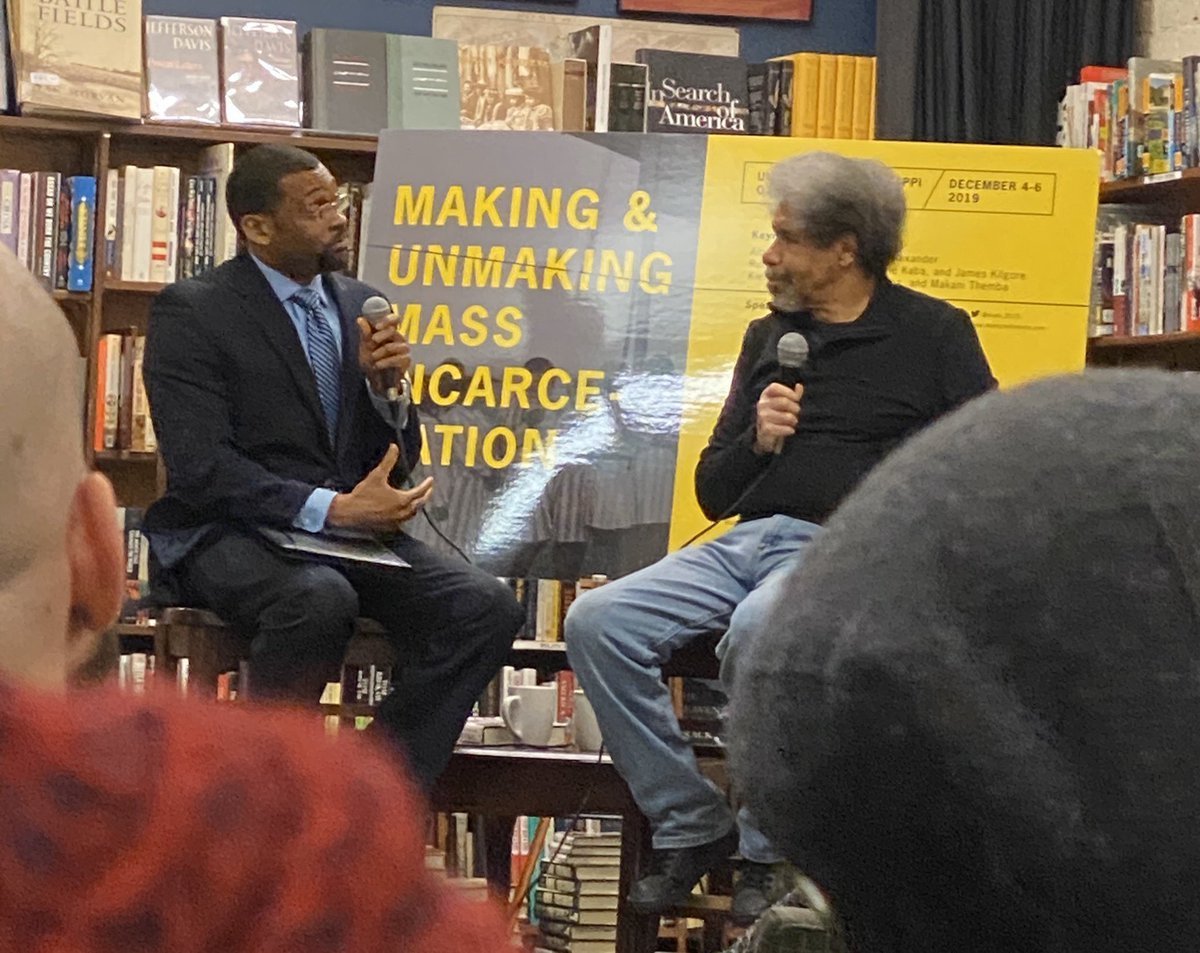
On Dec. 4-6, organizers, activists, students, professors,
reformists and abolitionists from across the spectrum convened at the
University of Mississippi’s Oxford campus to discuss the outcomes of America’s
deadly sin at the Making and Unmaking
Mass Incarceration (MUMI) Conference. With a diverse panel of inspirational
and highly qualified speakers
over a series of agenda packed
days, the event united great minds and aspiring revolutionaries in order to
tackle the plethora of complexities that exist within America’s criminal legal
system.
Overall, the conference highlighted the undeniable role that
many public universities, including Ole Miss, played in building the prison
industrial slave complex and continue to play in maintaining it.
What do universities
owe people who are incarcerated and formally incarcerated?
Historically, access to academia has been viewed as a privilege
that prisoners did not have the right to, simply due to their incarceration
status. In order to combat this, institutions of higher education would need to
seek out students in the prison and be intentional about working with state and
federal departments of corrections to offer their programs to incarcerated
students at an affordable cost.
Institutions with this type of initiative continue to be few
and far between. During the University and the Prison panel, Syrita
Steib-Martin, executive director of Operation
Restoration, explained that for decades the Baptist Theological Seminary,
which targeted lifers as students to become ministers, was the only higher
education opportunity offered to prisoners in Louisiana. Programming that would
inspire critical thinking was not encouraged. This history perfectly
illustrates the intention of the college, in partnership with DOC, to value the
education of prisoners only when that education serves to further sedate the
population, not to empower them.
Thankfully, more recently, colleges and universities have
begun to offer programming in their local penitentiaries. Programs like University Beyond Bars offer
college degrees to incarcerated students at Washington State Reformatory and
Monroe Correctional Complex through Seattle Central College. However, access to
accredited college programming in prison is still an anomaly.
With the passage of the 1994 Crime Bill’s restrictions on Pell
Grant provisions for incarcerated people, access to academia has continued to
dwindle. With limitations on Pell Grant funding for prisoners, the burden of
responsibility falls solely on the student to pay their tuition, making obtaining
an associate or bachelor’s degree while in prison virtually impossible.
Understanding that limited educational opportunities are a chief contributor to
incarceration, it is imperative that we dramatically increase the number of
educational programs offered to people while in prison.
Unfortunately, academia in our state prisons is currently predatory,
as many formerly incarcerated students are unable to complete the degrees that
they began while incarcerated after their release due to restrictions on them
as former felons from the colleges they attended while incarcerated. Michelle
Jones, a third-year doctoral student in the American Studies program at New
York University highlighted this problem, saying that the university owes its
formerly incarcerated students “continuity of a college experience that is
quality … and a clear pathway to completion.”
Jones emphasized that any program marketed as a “college
course” should culminate in the “conferral of a real credential.” Courses that
do not supply credits should be marketed as extracurricular.
Jones also stressed the fact that educators coming into the
prison must embrace their students’ experience of incarceration throughout
their study. As a caution, for educators entering the prison, there must be an understanding
of the false autonomy that many wardens have.
Wardens often choose to limit a student’s access to
education as punishment. Out of a responsibility to their incarcerated
students, educators must be confident in challenging this false autonomy and be
empowered to push back on administration in order to protect the quality of the
education being provided to their students.
Educators should also be open to extending beyond the
divisions enforced by the prison by co-collaborating with students who are
serving life sentences and virtual life sentences, many of whom are deemed
ineligible by DOC to participate in educational programming. Educators coming
into the prison must enforce their natural, true autonomy over their classes in
prison in the same way that they are comfortable doing so at any other
institution of higher education.

Legacies of slavery
During my presentation, I focused on the trends we’ve seen
in politics throughout 2019, mainly in response to the 2018 National Prison
Strike that birthed the ongoing New Suffrage Movement. It was important for me
to illustrate how the increase in outside participation in 2018 amplified the
strength of people’s participation on the inside.
This direct relationship between outside support and inside
action is one that we must continue to strengthen. My goal is to connect
outside organizers, especially student groups, with inside organizers for
guidance and support with upcoming actions.
The need for this was further emphasized during a presentation
by Dan Berger, an author and associate professor of comparative ethnic studies
at my alma mater, the University of Washington. Berger shared a voice recording
from Stevie
Wilson, an organizer incarcerated in Pennsylvania who explained to
attendees that participants in the prison resistance movement are like the “two
wings of a bird” – the inside organizer is one wing and the outside organizer
is the other. “If you’re not connected with someone on the inside right now,
you’re wrong,” Wilson declared.
This metaphor resonated deeply with me, and many others
repeated it throughout the conference. As the days continued, I was approached
by several student groups that were eager to propel forward in their prison
resistance work by connecting with inside organizers. Through the Right2Vote
Report I’m able to quickly locate and identify potential connections between
these groups and my readers, all of which I consider inside activists in their
own right, ready for the opportunity for outside collaboration. This is why I
am eager to expand the Right2Vote Report’s subscription base as well as attend
events like these to assist in making those connections. There are multiple
ways that student groups can support prison resistance with the resources
available on their campuses.
How do we involve the
people of the university as well as the university as an institution in
abolition?
Colleges and universities are seen as sites for movement
building, but this depends on the people within the institution, not the institution
itself. I concur that the university plays an essential role in the abolition
of prisons, but the university is an institution so we have to think about what
roles people within that institution have in the prison resistance movement.
As Right2Vote transitions into a multi-year campaign, we are
focused on helping students identify their role in the prison resistance
movement using the resources available at their college by supporting students
in establishing a variety of prisoner support groups depending on the students
and their institution’s orientation to the Prison Industrial Slave Complex
(PISC). Some institutions may have a deep historical connection, like with the
University of Mississippi’s relationship with Parchman
Prison.
Other universities, like the University of Washington, may
have direct connections to the PISC through state policy. For example,
Washington State has passed legislation that requires the university to
purchase products from Correctional Industries, which employs Washington state
prisoners at slave labor wages.
With these types of relationships still operating between
our prisons and colleges, our universities owe prisoners more than just access
to college credits. In addition to providing accredited college courses to
prisoners, students can support prisoners in a number of ways through forming
student groups with a focus on improving prison conditions.

Prisoner Research Aid
Group
One of the simplest ways for student groups to support
prisoners is through initiating a Prisoner Research Aid Group. This would be
perfect for law, English, sociology or arts majors but is a simple form of
support any type of student can easily get started.
Prisoners are constantly in search of materials that aren’t
readily available in their law library. Students can form a research aid group
to support prisoners in their state by providing reading materials to prisoners
by request. Prisoners need help accessing articles, bills, legislation and
other documents that are imperative to their study, and students have access to
large data basis that usually go underutilized for the majority of their
college career.
These types of groups should exist at colleges to support
prisoners in every state. It can be done by simply creating an email account
for digital correspondence via JPay, CorrLinks or any available system and
having a post office box for snail mail correspondence. As students receive
requests for different types of documents or portions of books, they can simply
fill those requests by printing, scanning, copying and pasting the necessary
material and mailing or emailing those documents to the prisoners who’ve
requested them.
There’s nothing “too” radical about initiating a Prisoner
Research Aid Group for students who may be on the fence afraid to lean too far.
This group guarantees equal access to information, a human right of every
person regardless of their incarceration.
Students involved in this group who are interested in going
deeper may also get involved in a research project to support those
incarcerated in their local prison. Types of projects could include budget
assessments to support reform policies or case studies for individuals who’ve
been over-sentenced or wrongly convicted.
Prison Divestment
Group
As an alternative to the more neutral group described above,
students who’ve identified connections between their university and prison
slavery have formed prison divestment groups in order to call on their college
to divest from the use of prison labor. This is one of the more popular methods
that students can use to support incarcerated citizens suffering from labor
exploitation in their state. For example, at Harvard students formed the Harvard Prison Divestment Campaign calling
on the university to pull out of their prison contracts so long as imprisoned
employees are paid slave labor wages.
There are hundreds of public institutions that maintain the
use of prison slavery through mandating that these companies employing
prisoners be used to supply furniture, food, construction and other products.
These institutions do so usually through a lack of transparency.
There is a growing movement of students who have identified
these draconian policies and are calling out their campuses. The establishment
of divestment groups propels progress towards paying prisoners fair wages.
Knowing that it is the student’s tuition dollars that pay these costs, it is
the students’ responsibility to oversee the use of those dollars.
Prisoner Program
Support Group
Prisoner Program Support groups are already in full swing. Hundreds
of religious groups as well as arts and book clubs have outside members who go
into the prison regularly for to provide programs.
I would like to see more students take advantage of the
opportunity to participate in prisoner programs that allow outside community
members to go into the prison. I’ve been involved in multiple prisoner programs
that went inside, including a poetry program and the Black Prisoners Caucus, in
both of which I was the youngest outside attendee. Prisoners are fueled by
interacting with young, passionate people.
These types of opportunities to go inside are rare, so we
must take full advantage when they are presented. Some colleges have programs
or events that allow students to go into the prison on a regular basis in
support of an on-campus religious, cultural or arts program.
I encourage students to seek out these types of programs and
events or to create their own. Prisoners meet on the inside regularly for book
clubs, poetry reading, strategizing policy and other types of conversations
that I’m sure they would be more than happy for outside participants to
contribute to.
This may be one of the more difficult types of groups to
organize so it may be helpful to start off with establishing a research group
or divestment group over the months it may take to plan and organize an inside
program. Establishing an inside program would require the most amount of
interaction with DOC staff.
Programs can be regular – weekly, monthly or quarterly – or
can be a one-time event. Regardless of the frequency, maintaining communication
with inside organizers is essential throughout the planning and implementation
of the program or event.

Prison Abolition
Group
Finally, one of the more controversial, yet powerful groups
would be a student Prison Abolition Group. Students involved, like those in the
Research Aid Group, would be guided by the requests of those prisoners they are
supporting.
However, rather than solely fulfilling requests for copies
of documents, students in the Prison Abolition Group would be responsible to
prisoners for supporting legislation proposed by their incarcerated comrades.
This student group could go by a series of other names like prisoner policy
support group, prison condition improvement group, or criminal justice reform
focus group.
Regardless of the name, this student group would be a
prisoner support group that would have an abolitionist focus in the legislation
they advocate for. Student advocacy is powerful in politics so it’s essential
that students’ voices are involved in advocacy for legislation committed to
prisoners’ human rights.
It may be difficult for organizers to decide which proposals
for legislation to support. During the conference, Mariame Kaba, an organizer,
educator and founder of Project NIA, provided attendees with a series of guiding
questions to use in our advocacy of reforms including:
- Does it provide material relief?
- Does it leave out any marginalized people?
- Does it legitimize or expand the system we fight against?
- Does it transfer power?
- Does it divide people into deserving vs. underserving?
- What are the logistics that initiatives enforce?
- Does it liberate? Or oppress?
- Is it punitive?
Kaba used the example of police officer body cams that
activists advocated for in California. These cams, contrary to popular belief
as a “helpful” reform, fail questions 1, 3, 4 and 7 by transferring more power
to the criminal legal system that we fight against and by further oppressing
marginalized people who continue to suffer from police brutality. Prison
Abolition Student Groups, as well as all reformist organizers alike, should
review these questions prior to the initiation of any campaigns so that we do
not misdirect energy on policies that will lead to further harm in our
communities.
When’s the next MUMI?
Garrett Felber and his team at the University of Mississippi
did an incredible job organizing this groundbreaking event. I am honored to
have been invited to speak, to uplift the work of Jailhouse Laywers Speak and
to have connected with inspiring organizers and academics in this field, many of
which I’ve been following on social media since my college graduation a few
years ago.
As a student, I did not recognize my authority on campus to
create movements on behalf of incarcerated people in my state, but with this
conference that realization was solidified for hundreds of current students.
Regardless of one’s status as an activist, ally or academic, everyone should
have a critique of the carceral state.
For students who do consider themselves activists or
abolitionists, this is the next step, to form a group of like-minded
individuals on your campus that can build on the work of prison resistance in
your state. The resources are there, the people – on both sides of the wall – are
ready and I am happy to make a trip to visit any student group that needs help
at any phase in establishing a collaborative prisoner support group.
There is great potential for a national initiative of
students collaborating on campaigns in support of prisoners’ human rights.
These student groups can organize the next MUMI conferences on their campuses
for years to come.
I’m ready to put the next five years of conferences on the
calendar!
Amani Sawari is
currently coordinating the Right2Vote Campaign, the national new suffrage
movement to restore the voting rights of probationers, parolees and prisoners
across the country. Campaign updates can be found in the Right2Vote Report.
Incarcerated supporters can request to be added to the mailing list by simply contacting
Amani Sawari @Sawarimi on social media, by email at [email protected] or by mail at P.O. Box 2278, Detroit, MI
48202.
Related

