


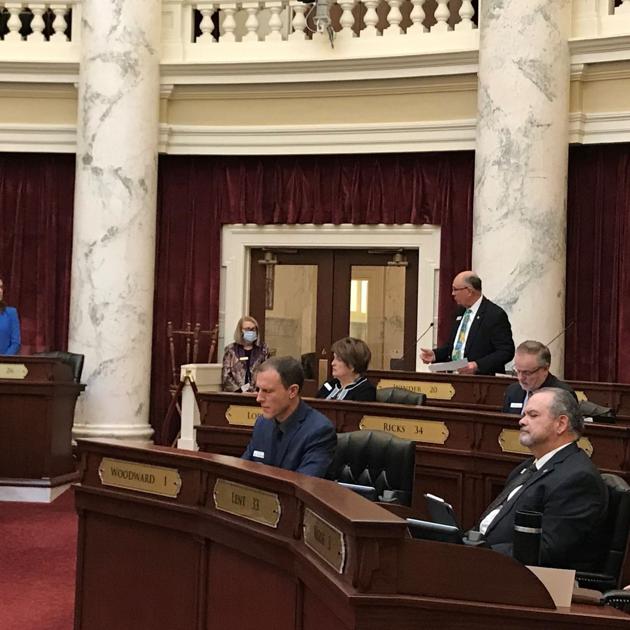
BOISE — Idaho lawmakers advanced two bills Thursday to spend more of the state general fund on their own operations and legal defense.
The Senate voted 27-7 along party lines in support of SB 1022, which would transfer $4 million into the Legislative Legal Defense Fund. And the Senate Finance Committee voted 8-2 to advance SB 1033, which increases annual funding for legislative operations by 26%.
SB 1022 permits the House speaker and Senate president pro tem to spend the money as they see fit on legislative legal defense.
Senate Minority Leader Michelle Stennett, D-Ketchum, objected that at a time when the Legislature is demanding more accountability about spending from the executive branch, there isn’t more scrutiny of that legal defense spending.
“It is the people’s money,” she told the Senate. “There is quite a bit of money. … This has always bothered me a little bit, that individuals can spend that kind of money without a lot of oversight and scrutiny.”
Senate President Pro Tem Chuck Winder, R-Boise, responded, “We didn’t choose to get sued by the treasurer, we didn’t choose to get sued by two members of the House, we didn’t choose to be sued by a group of 30-some disability groups. But we have to defend ourselves.”
Those were references to three current or recent lawsuits; the Idaho Supreme Court just rejected state Treasurer Julie Ellsworth’s appeal in a dispute with the Legislature over Capitol office space, while the other two are lawsuits now pending in federal court over the lack of COVID-19 safety measures during the current legislative session. It was actually the Legislature that sued Ellsworth, not the other way around, after she refused to move her offices out of the state Capitol; when she lost in district court, she appealed to the state Supreme Court.
“Attorney fees are expensive,” Winder said. “But I’ll point out by having outside counsel just in the three most recent cases, we have prevailed, and I think that’s worth something. … So I would urge your support for this.”
The Senate-passed bill now heads to the House side. If it passes there and is signed into law, it would authorize a supplemental appropriation within the current budget year; the bill also has an emergency clause, so the funds would be transferred as soon as the bill becomes law.
Prior to the Senate’s floor session, the Senate Finance Committee, which consists of the Senate portion of the Joint Finance-Appropriations Committee, convened for a hearing on SB 1033, sponsored by the speaker and pro tem and co-sponsored by the two JFAC co-chairs. It would increase the transfer from the general fund for legislative operations each year by an additional $1,756,000 a year, to a new total of $8,511,000, a 26% increase. It’s the first increase since 2008.
The transfers, which occur in four parts each year, cover everything from legislative and staff salaries and benefits to travel, consultants and equipment.
“There are insufficient funds in order to cover all of the expenses of the House and the Senate,” Senate Finance Chairman Steve Bair said, “and the speaker and the pro tem requested we run this bill in order to increase the funds.”
He said, “That’s the number they proposed, so we supported it.”
Two Senate Finance members, Sens. Janie Ward-Engelking, D-Boise, and Jim Woodward, R-Sagle, voted no; both said they wanted to do more research into the need for the funds before they decided on their final votes in the full Senate.
“You are free to vote your conscience,” Bair told the Finance Committee.
The bill authorizes a direct, ongoing appropriation that would occur each year, and it contains an emergency clause making it retroactive to Jan. 1, 2021.
The last increases in the legislative transfer were even larger by percentage. They were a 29% boost in fiscal year 2002; and a 21% increase in fiscal year 2009. Based on agreements between the 35-member Senate and the 70-member House, the Senate receives 37% of the transfers and the House receives 63%.
SB 1033 now moves to the full Senate. To become law, it would need to pass both there and in the House and receive the governor’s signature.
Ironically, both bills won approval shortly after a discussion in the House State Affairs Committee, where, amid a presentation from administration officials about Gov. Brad Little’s proposals to enact a number of his “Building Idaho’s Future” initiatives through supplemental appropriations in the current year, rather than waiting to fund them in next year’s budget, some committee members expressed deep suspicion about the idea of supplemental appropriations.
Bair, after the Senate Finance Committee meeting, said, “We’ve already got reports of what went on down there in committee today. I think people don’t understand the supplemental appropriation process, and why that’s being done. … They think the governor is trying to commit some sort of monetary fraud, and that is not true. I’ve never seen more transparency about a budget.”
Betsy Z. Russell is the Boise bureau chief and state capitol reporter for the Idaho Press and Adams Publishing Group. Follow her on Twitter at @BetsyZRussell.

