


December 11, 2020
2 min read

Women in rheumatology on average see fewer patients, and have fewer patient visits, per year than their male colleagues, resulting in lower earnings, according to data published in The Journal of Rheumatology.
“There has been a substantial shift in the gender distribution of the medical workforce, with increasing representation of female physicians over time,” Jessica Widdifield, PhD, of the Sunnybrook Research Institute and the University of Toronto, told Healio Rheumatology. “This is true for the subspecialty of rheumatology, which has seen a significant increase in the proportion of female rheumatologists.”

“Because female rheumatologists see fewer patients, increased feminization of the rheumatology workforce may lead to longer patient wait-times and reduced clinical capacity of the overall workforce,” Jessica Widdifield, PhD, told Healio Rheumatology.
“In light of the rapidly changing demographics of the rheumatology workforce, it is crucial to understand how feminization is influencing clinical capacity, as previous studies — mostly from primary care — have reported that, on average, female physicians work fewer hours than males, and are more likely to work on a part-time basis and take periods of leave,” she added. “Therefore, the gender shift may have implications for future physician supply and patient access.”
To compare the clinical activity and compensation among women and men in rheumatology, as well as analyze the links between physician gender and practice size and patient volume, Widdifield and colleagues conducted a population-based study of rheumatologists in Ontario, Canada. From 2000 to 2015, the researchers identified all rheumatologists practicing as full-time equivalents or above, and then assessed the differences in practice characteristics and earning between men and women.

Jessica Widdifield
The researchers defined practice size as the number of unique patients, patient volume as the number of patient visits, and earnings as the total fee-for-service billings. They used multivariate linear regression to examine the impact of gender on both practice size and patient volume separately, accounting for age and year.
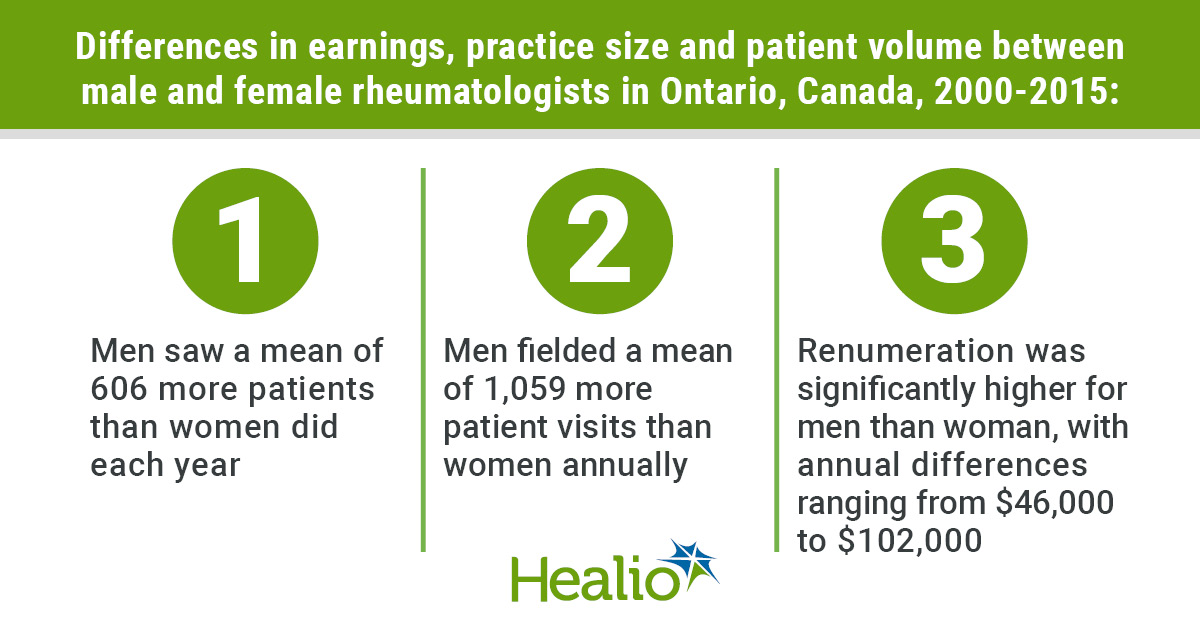
According to the researchers, the number of rheumatologists practicing at or above one full-time equivalent increased from 89 to 120 during the study period, with the percentage of women in the group increasing from 27% to 41.7%. Among the rheumatologists, men had larger practice sizes and practice volumes. In their adjusted analyses, the researchers estimated that, in any given year, men saw a mean of 606 (95% CI, 107-1105) more patients than women did, and fielded 1,059 (95% CI, 345-1,773) more patient visits. Earnings were also consistently, significantly higher for men than women, with annual differences ranging from $46,000 to $102,000.
Among men and women combined, there was a small but statistically significant reduction in mean annual number of patient visits. Meanwhile, middle-aged rheumatologists demonstrated larger practice sizes and volumes than their younger and older colleagues.
“A central concern of these findings is that because female rheumatologists see fewer patients, increased feminization of the rheumatology workforce may lead to longer patient wait-times and reduced clinical capacity of the overall workforce,” Widdifield said. “Rheumatology workforces are already strained by too few physicians in face of the growing burden of rheumatic and musculoskeletal diseases. It is essential to account for the demographic shifts within the workforce when undertaking future rheumatology workforce planning to ensure that populations’ needs are met.”

