


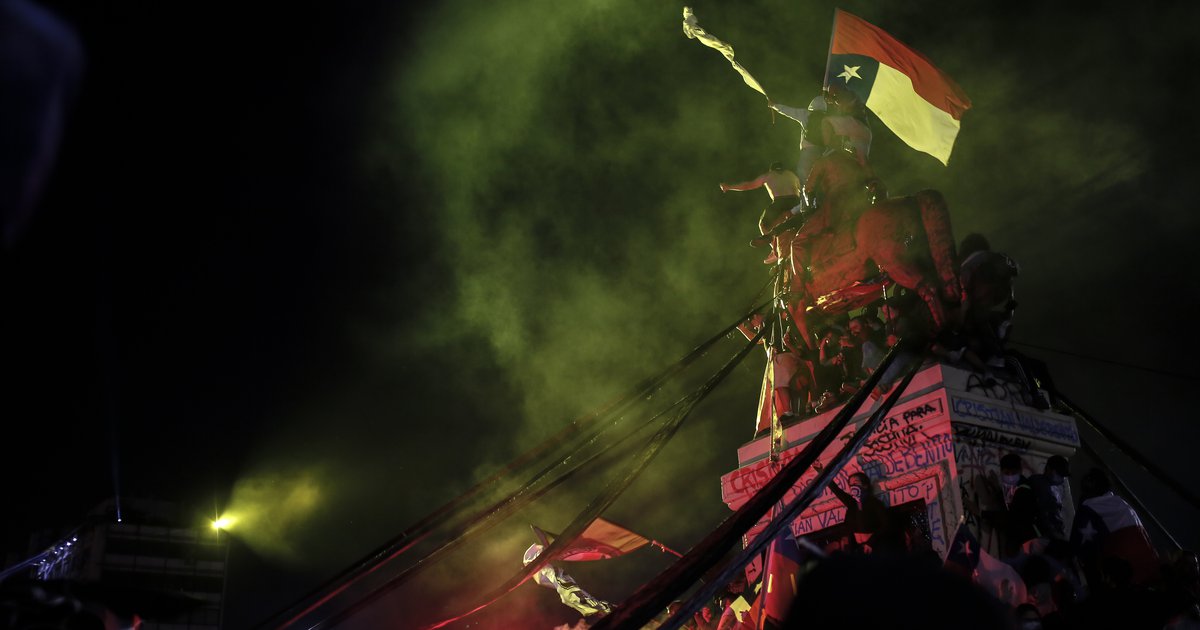
However, claims of belonging to a group like el pueblo re-emerge under a certain set of conditions, such as those created by the social uprising. Since 18/O, the word crops up time and again in our focus groups, charged with positive moral connotations regarding the identity of those to whom the term is applied. Participants from the lower and lower-middle classes indicate that the taxi driver, the mechanic, and indeed anyone on a low wage are members of el pueblo, expressing a sense of collective belonging: “the same pueblo to which we belong; all of us are humble”. In a more general sense, however, the collective comprises the disgruntled, those who support “the cause”, and all those who are united in an effort to achieve “many other things”. As such, participants make reference to a broad group, a “we” or an “us”, a “whole country” who have come out to protest: “rich, poor and flaites” (a term commonly applied to, and indeed often celebrated by, lower-status individuals characterised in part by their ostentatious dress style), those from the upper-class districts of Vitacura and Providencia in Santiago, or simply those who join in the cacerolazos.
Thus, belonging to el pueblo or to a broad social group becomes an emotional and moral issue – a sense of identity that is far from meaningless and which is not limited to those who engage in public demonstrations. Participants reflect that this collective identity has come to include social strata which, prior to the events of 18/O would not have been considered part of el pueblo. This is the case with one of the vignette characters: the owner of a construction firm. Despite his monthly income of over $2,500,000 pesos (US$3,090 or £2,550), which previously would have put him in a higher social category, there is an overriding sentiment that he “supports the cause”, would have a close relationship with his employees, is a “hard-working person” who “came from nothing”, and “doesn’t earn that much” compared to the investor, the personification of the economic elite. However, participants from the upper-medium strata tend to question this character’s support for the protests. There is collective reflection as to the “upper” social limit of those who get behind the movement. An external or “objective” perspective suggests that within those notions of “us”, “we” and el pueblo lies a powerful multi-class identity.
In summary, this focus group-based study found that, thanks to the October uprising in Chile, past fears have been left behind and the people have begun to reflect more freely on the social and economic reality of the country, albeit under the shadow of enduring concern as to what the future will bring. The uprising triggered an emotional liberation of our participants, which has led to more open reflection in general. This suggests that the potential for change in Chilean society will, from now on, depend on learning and listening to the arguments, ideas and sentiments of all, including people from different socio-economic and generational groups, and, in particular, those in a less privileged position.
Notes and references:
Araujo, Kathya (2016). El miedo a los subordinados. Santiago: LOM.
Flam, Helena (2007). Emotions’ map: A research agenda. In Flam, Helena and Debra King. Emotions and social movements. New York, NY: Routledge, 29-50.
Freud, Sigmund (1989 [1923]). The Ego and the Id. TACD Journal, 17:1, 5-22.
Mac-Clure, Oscar; Barozet, Emmanuelle and Valenzuela, Ana María (2020). Naming oneself in the social mirror: A vignette-based survey. Current Sociology. (Forthcoming)
Mac-Clure, Oscar; Barozet, Emmanuelle; Ayala, Constanza; Moya, Cristóbal; Valenzuela, Ana María (2019). Encontrar la posición de uno mismo en la sociedad: una encuesta basada en viñetas. Revista Brasileira de Ciências Sociais. Vol. 34, n° 99, 1-28.
Martuccelli, Danilo (2020). El largo octubre chileno. Bitácora sociológica. In Araujo, Kathya (Ed.). Hilos tensados: para leer el octubre chileno. Santiago: Editorial Usach, 369-476.
Weber, Max (1964 [1922]). Economy and Society. Berkeley, CA: University of California Press.
[1] Further details regarding the research methodology can be found in Mac-Clure, Barozet, Ayala, Moya and Valenzuela (2019).
[2] Quotations from focus group participants have been translated freely while ensuring that the speaker’s original meaning is maintained.
[3] In its survey, the CEP does not distinguish between anger at the destruction and young people’s rage against the status quo, despite the opposing orientations of these two emotions.
[4] H.C. is referring here to the housekeeper’s monthly income of between $200,000 and $300,000 Chilean pesos (US$250–370 or £200–300).
[5] Only five interviewees out of a random sample of 1,982 used the word pueblo or gente de pueblo (the common people).
This work was supported by the Chilean National Research and Development Agency (ANID) through FONDECYT Regular Project 1190436 (National Fund for Scientific and Technological Development) and CONICYT / FONDAP Project 15130009 (National Commission for Scientific and Technological Research / Fund for Research Centres of Excellence in Priority Areas).
This article was originally published in Spanish by CIPER and republished with permission. Read the original here.

