


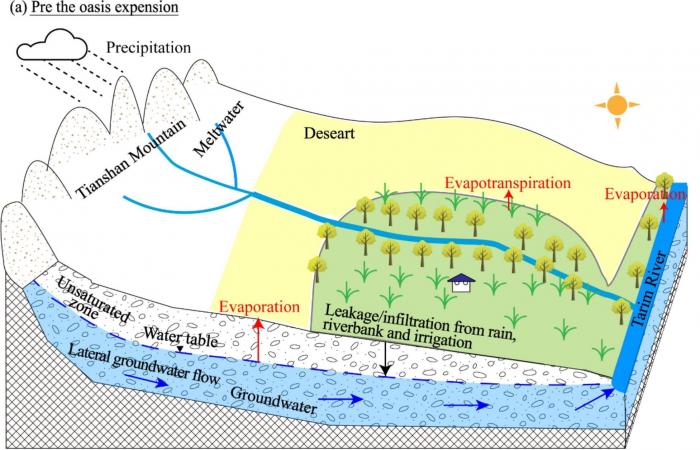
Groundwater is critical to agricultural, ecological and domestic water use, and its depletion under climatic and anthropogenic impacts can pose challenges to regional water resources and ecological security, especially in arid regions.
Space-time variations and drivers of the groundwater are of decisive importance for the understanding of the groundwater cycle and the restoration of the groundwater, while in arid oasis regions they are only insufficiently understood due to the sparse field monitoring.
Researchers at the Xinjiang Institute for Ecology and Geography (XIEG) of the Chinese Academy of Sciences worked out the spatio-temporal variations and control factors of the groundwater level and the degree of mineralization using data collected between 2000 and 2018 at 22 wells in the Wei-Ku oasis of the Tarim Basin.
They used standardized partial regression coefficients and spatial multiple linear regression analyzes to assess the response of groundwater to human activity and climate variability.
The results showed that there were obviously large spatial and temporal differences in both the water table and the degree of mineralization, and that the response to environmental factors was spatially and seasonally different.
The water table was shallowest in spring and deepest in autumn, showing a significant downward trend, largely due to human activity. While the level of mineralization of the groundwater decreased slightly, mainly due to climate change.
A greater variation in groundwater depth / degree of mineralization generally occurred in areas with greater groundwater depth / degree of mineralization. The reduction in leakage on the river bank and the increase in evapotranspiration, groundwater pumping and drainage resulted in a decrease in the water table.
The research results were published in Journal of Hydrologywith the title “Evolutionary properties of groundwater and its response to climate and land cover changes in the oasis of the dried-up river in the Tarim Basin.”
The majority of groundwater reservoirs are resilient to climate change
More information:
Wanrui Wang et al. Evolutionary properties of the groundwater and its response to climate and land cover changes in the oasis of the dried up river in the Tarim Basin, Journal of Hydrology (2020). DOI: 10.1016 / j.jhydrol.2020.125644
Provided by the Chinese Academy of Sciences
Quote: Scientists examine evolutionary features and drivers of groundwater in the oasis of the parched river in the Tarim Basin (2020, October 23), accessed on October 23, 2020 from https://phys.org/news/2020-10-scientists-evolution -features- driver-groundwater.html
This document is subject to copyright. Except for fair trade for the purpose of private study or research, no part may be reproduced without written permission. The content is provided for informational purposes only.
These were the details of the news Scientists examine evolutionary features and drivers of groundwater in the oasis… for this day. We hope that we have succeeded by giving you the full details and information. To follow all our news, you can subscribe to the alerts system or to one of our different systems to provide you with all that is new.
It is also worth noting that the original news has been published and is available at de24.news and the editorial team at AlKhaleej Today has confirmed it and it has been modified, and it may have been completely transferred or quoted from it and you can read and follow this news from its main source.

