


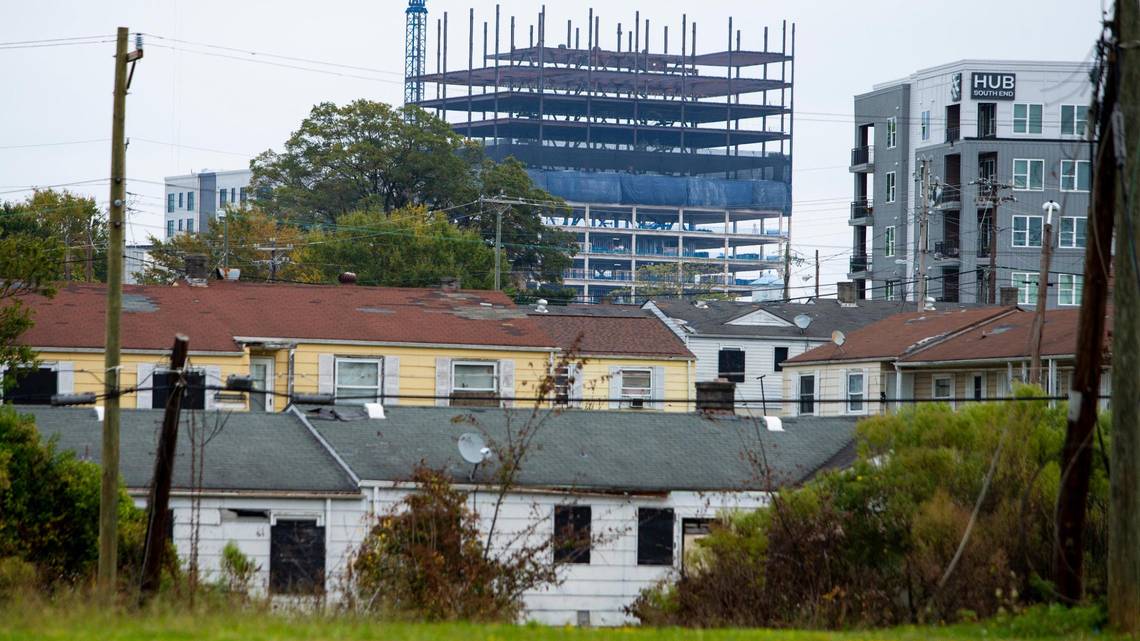
Funding requests to redevelop a historically Black community that has fallen into disrepair have been rejected by city and nonprofit leaders again, putting at risk efforts to preserve affordable housing and potentially displacing its residents.
Brookhill Village, near Charlotte’s rapidly growing South End, is among the last affordable housing options in the area.
But improvement plans for the community that opened in 1951 hit another snag this week as officials in charge of recommending funding for such projects say the developers haven’t met the necessary criteria for approval.
Ralphine Caldwell, executive director of LISC Charlotte, the nonprofit that advises the city on its housing deals, told the Brookhill developer in an email it would not get $13 million from two pots of money: the city’s Housing Trust Fund, which comes from housing bonds, and a fund with money from private companies.
It wasn’t approved for three reasons, officials said: A too-short affordability period when rents would be restricted; lack of long-term financing strategy; and concerns that the property would cease to become affordable at the end of its lease term.
That leaves at least 143 households in limbo, as the developer scrambles to find an alternative way to come up with the money, or move forward with the project with only market rate units.
Developer Lookout Housing Ventures is working with South Tryon Community Development Corp., and its president Ray McKinnon, to help give residents a say in the project.

“People of color in Charlotte have historically been seen as expendable, as collateral damage, and the harder it is, the more we justify just essentially forgetting about them,” said McKinnon. He is a former pastor for the South Tryon Community United Methodist Church and board member of Inlivian, formerly the Charlotte Housing Authority.
“… If we don’t get this done, if we allow these families to be displaced, shame on us.”
An entity affiliated with Raleigh businessman Tom Hendrickson, chairman of Lookout Housing Ventures, purchased the land lease for the Brookhill complex in December for $792,000. The transaction includes the building and improvements, but not the land.
Hendrickson’s firm has plans to build 324 units, 162 of them affordable.
He said he’ll seek funding from private organizations or other city or county sources. But he said he needs to do so in the next few weeks, or he may have to move forward with the development without affordable housing.
“We’re not giving up until we just have absolutely no alternatives,” Hendrickson said. “We have been bending over backwards and doing everything humanly possible to avoid doing that.”
Residents who spoke to the Observer said they hope whatever happens includes a plan for them.
Jerry Pendergrass, 57, was raised in Brookhill, where he now lives with his daughters and grandchild.
He said he believes developers are trying hard to make affordable housing work within redevelopment plans.
“All you can do is pray and keep on going and hopefully it works out,” he said. “I just want somewhere comfortable to lay my head, (for) me and my family.”
Back and forth
Brookhill’s 2019 sale resolved a series of legal conflicts that have complicated any redevelopment efforts.
The transaction kept in place the parameters of a 2016 settlement between the U.S. Attorney’s office and Brookhill’s previous owner after the federal government tried to seize the complex, alleging it had a history of drug violations and violent crime.
The land it sits on is owned by a separate company, affiliated with Charlotte billionaire C.D. Spangler, a former president of the UNC system who died in 2018.
Spangler’s company had sued the previous owner, a firm associated with Charlotte developer Greg Pappanastos, to win back control of the property. The lawsuit accused Pappanastos’ company of defaulting on the lease conditions because the community was in such decay.
The sale of the land lease to Hendrickson’s company dismissed all other legal actions related to the complex. But the agreement with the U.S. Attorney’s office does require tearing down or “substantially” renovating the apartments.
When the city council did not award the Brookhill project funding in April, city staff said at the time they had concerns about the amount requested and Lookout Venture’s ability to secure other funding. But they agreed to keep talking after several council members expressed concern over losing affordable housing in the South End area.
Hendrickson pared his request down to a $3 million loan from the city’s housing trust fund, and a $10 million loan from the private Charlotte Housing Opportunity Investment Fund.
He also secured a loan for $47 million for construction and permanent financing, he said. “The city has never had a developer more willing to cooperate than we are,” he said. “We’re begging them to help us save affordability at Brookhill.”
Request denied again
Pam Wideman, housing and neighborhood services director for the city, said many of the same concerns from April remain regarding funding.
Hendrickson said he provided the city with details on the construction loan he obtained, and presented a plan to repay LISC and the city within 15 and 17 years, respectively.
“We were at least expecting some dialogue regarding our financing plan during the past several months,” his firm wrote in a Friday email to Caldwell and Wideman.
The development would guarantee the units stay affordable for 27 years, which is just under the 30-year period in many of the affordable housing deals the city approves and that receive state tax credits.
But Hendrickson said they couldn’t change that timeframe, because the land lease they purchased for the property expires in 29 years, and the buildings still have to be constructed.
And he said the same situation occurs when the guaranteed period for affordability is up at other affordable housing complexes.
Wideman said the “door isn’t closed” for future conversations about Brookhill.
“I think the city would be willing to work with any developer who could bring a viable proposal to the table,” Wideman said, but added that the city “is not responsible for having affordable housing at a particular site.”
Council member Victoria Watlington, who represents the Brookhill area, said she wants more affordable housing in the district. But, she said, it is the city’s job to spend taxpayer money wisely, and council has been advised the developer’s long term funding isn’t sufficient.
And because LISC has decided not to grant the developer’s request for private funds, Watlington said, it would leave a $10 million gap regardless if the city approved housing trust fund dollars.
Concerns of displacement
Pedergrass said he’s seen the toll that years of neglect has taken on the community during his decades in Brookhill, pointing out several empty units in his cul-de-sac.
But it’s also a place that’s been home to generations of families who have formed close neighborly bonds and a strong community, he said.
Edward Tindal, 74, moved here with his family when the community was new in the 1950s, and returned about 11 years ago. Tindal said he’s seen the designs of what developers want to build and thinks they looks nice.
Tindal and Pendergrass said they hope they can stay in whatever becomes of New Brookhill.
“This is home,” Pendergrass said. “We were raised over here.”
In April, Wideman said the city would work with United Way of Central Carolinas to help people relocate to more stable housing.
United Way CEO Laura Yates Clark said Friday her organization hadn’t been asked by the city to start relocation assistance efforts while discussions with the developer continued over the summer, but said they are willing to do so if called upon.
Last year, United Way staff and other nonprofits helped relocate residents of the Lake Arbor apartments when the owner announced plans to renovate that forced out dozens of families.
McKinnon said he’s working to raise awareness about what’s at stake and plans to reach out to the city council and mayor.
He said it frustrates him that the city is asking voters to support another $50 million in affordable housing bonds this year, but rejected a project that would have helped address the crisis, particularly for those with the lowest incomes.
The developer’s plan calls for 65 of the the 324 units be affordable for households earning less than 30% of the area median income, which is $25,050 for a family of four.
“The mayor and city council are not going to be able to hide behind the bureaucrats in city hall,” McKinnon said. “They all decried Lake Arbor and acted like they wished there was something they could have done, well we are in front of this. And this is going to be much larger than Lake Arbor if this has to happen.”
%20Cropped.jpg)
Support my work with a digital subscription

Danielle Chemtob covers economic growth and development for the Observer. She’s a 2018 graduate of the journalism school at UNC-Chapel Hill and a California transplant.

