


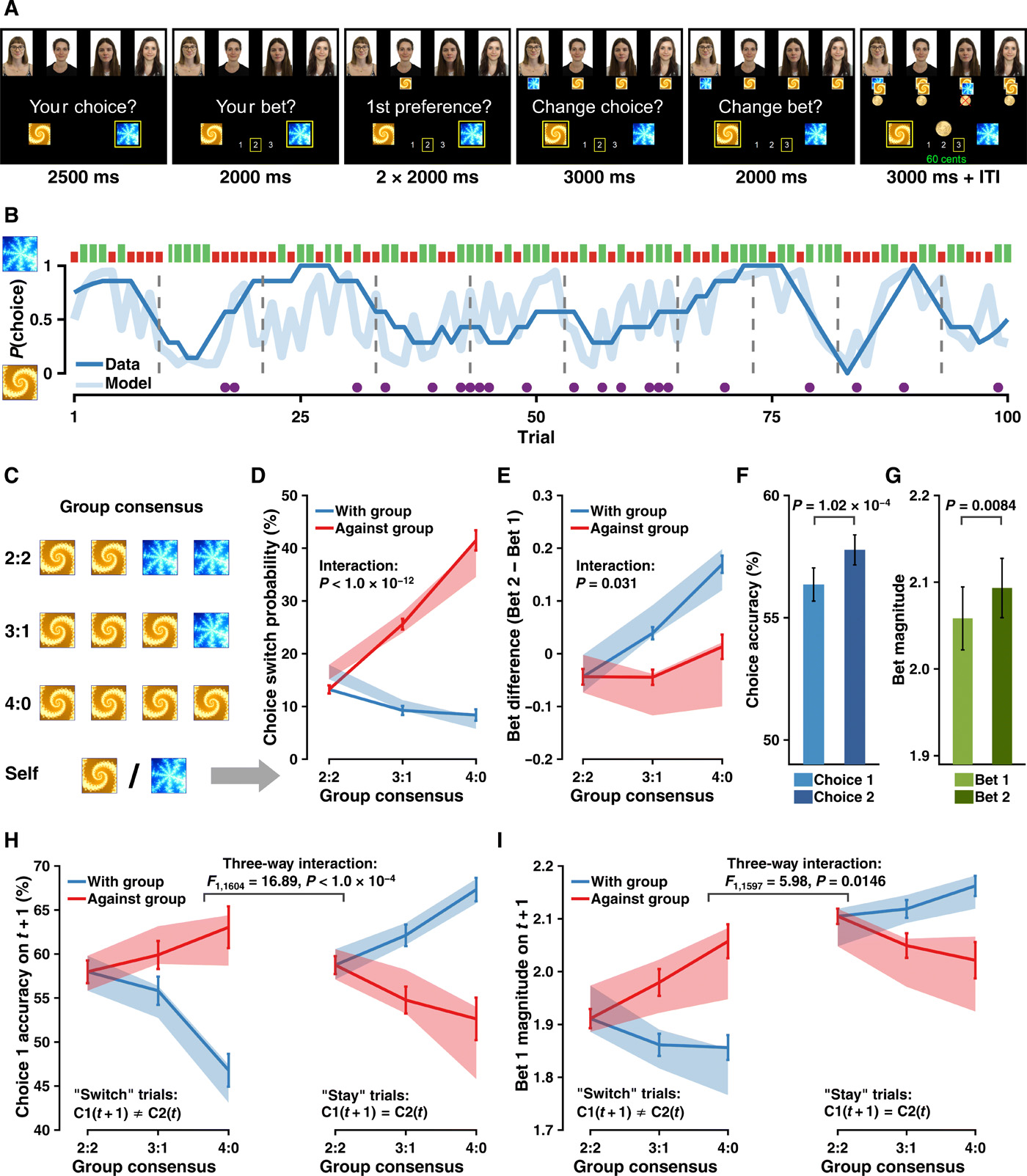
To describe participants’ learning behavior in our social influence task and to uncover latent trial-by-trial measures of decision variables, we developed three categories of computational models and fitted these models to participants’ behavioral data. We based all our computational models on the simple RL model (5) and progressively include components (Table 1).
First, given the structure of the PRL task, we sought to evaluate whether a fictitious update RL model (20) that incorporates the anticorrelation structure (see the “Underlying PRL paradigm” section) outperformed the simple Rescorla-Wagner (21) RL model that only updated the value of the chosen option and the Pearce-Hall (45) model that used a dynamic learning rate to approximate the optimal Bayesian learner. These models served as the baseline and did not consider any social information (category 1: M1a, M1b, and M1c). On top of category 1 models, we then included the instantaneous social influence (i.e., other coplayers’ Choice 1, before outcomes were delivered) to construct social models (category 2: M2a, M2b, and M2c). Last, we considered the component of social learning with competing hypotheses of value update from observing others (category 3: M3, M4, M5, M6a, and M6b). The remainder of this section explains choice-related model specifications and bet-related model specifications (see table S3 for a list of full specifications). All models were estimated and evaluated under the hierarchical Bayesian framework (note S2).
Choice model specifications. In all models, Choice 1 was accounted for by the option values of option A and option B(3)where Vt indicated a two-element vector consisting of option values of A and B on trial t. Values were then converted into action probabilities using a Softmax function (5). On trial t, the action probability of choosing option A (between A and B) was defined as follows(4)
For Choice 2, we modeled it as a “switch” (coded as 1) or a “stay” (coded as 0) using a logistic regression. On trial t, the probability of switching given the switch value was defined as follows(5)where Φ was the inverse logit linking function(6)
Note that, in model specifications of the action probability, we did not include the commonly used inverse Softmax temperature parameter τ. This was because we explicitly constructed the option values of Choice 1 and the switch value of Choice 2 in a design-matrix fashion (e.g., Eq. 8; see the text below). Therefore, including the inverse Softmax temperature parameter would inevitably give rise to a multiplication term, which, as a consequence, would cause unidentifiable parameter estimation (24). For completeness, we also assessed models with the τ parameter, and they performed consistently worse than our models specified here.
The category 1 models (M1a, M1b, and M1c) did not consider any social information. In the simplest model (M1a), a Rescorla-Wagner model was used to model the Choice 1, with only the chosen value being updated via the RPE (δ), and the unchosen value remaining the same as the last trial.(7)where Rt was the outcome on trial t and α (0 < α < 1) denoted the learning rate that accounted for the weight of RPE in value update. A β weight (βV) was then multiplied with the values before being submitted to Eq. 4 with a categorical distribution, as in(8)
Because there was no social information in M1a, the switch value of Choice 2 was composed merely of the value difference of Choice 1 and a switching bias (i.e., intercept)(9)
Choice 2 was then modeled with this switch value following a Bernoulli distribution(10)
In M1b, we tested whether the fictitious update could improve the model performance, as the fictitious update has been successful in PRL tasks in nonsocial contexts (20, 27). In M1b, both the chosen value and the unchosen value were updated, as in(11)
In M1c, we assessed the Pearce-Hall (45) model that entailed a dynamic learning rate(12)where k (0 < k < 1) was the weight of the (dynamic) learning rate and λ (0 < λ < 1) indicated the weight between RPE and the learning rate.
Our category 2 models (M2a, M2b, and M2c) tested the role of instantaneous social influence on Choice 2, namely, whether observing choices from the other coplayers contributed to the choice switching. As compared with M1 (M1a, M1b, and M1c), only the switch value of Choice 2 was modified, as follows(13)where w.Nagainst,t denoted the preference-weighted amount of dissenting social information relative to each participant’s Choice 1 on trial t. It was computed on a trial-by-trial fashion as follows(14)where K indicated the number of opposite choices from the others and ws,t was participants’ trial-by-trial preference weight toward the other four coplayers. Note that these preference weights were fixed parameters based on each participant’s preference toward the others when uncovering their choices: The first favored coplayer received a weight of 0.75, the second favored coplayer received a weight of 0.5, and the remaining two coplayers received a weight of 0.25, respectively. They were not modeled as free parameters because doing so caused unidentifiable model estimate behavior. All other specifications of models in this category (M2a, M2b, and M2c) were identical to models in category 1 (M1a, M1b, and M1c), respectively.
Our category 3 models (M3, M4, M5, M6a, and M6b) assessed whether participants learned from their social partners and whether they updated vicarious option values through social learning. Note that models belonging to category 2 solely considered the instantaneous social influence on Choice 2, whereas models in category 3 tested several competing hypotheses of the vicarious valuation that may contribute to Choice 1 on the following trial, in combination with individuals’ own valuation processes. In all models within this category, the option values of Choice 1 were specified by a weighted combination between Vself updated via direct learning and Vother updated via social learning(15)where(16)
Note that given that M2b was the winning model among category 1 and category 2 models (Table 1), we used M2b’s specification for the value update of Vself (Eq. 11), so that category 3 models only differed on the specification of Vother.
M3 tested whether individuals recruited a similar RL algorithm to their own when learning option values from observing others. Hence, M3 assumed participants to update values “for” the others using the same fictitious update rule for themselves(17)where s denoted the index of the four other coplayers and αo was the learning rate for the others. These option values from the four coplayers were then preference-weighted and summed to formulate Vother, as follows(18)where ws,t was participants’ preference weight. To ensure that the corresponding value-related parameters (βvself and βvother in Eq. 15) were comparable, Vother was further normalized to lie between −1 and 1 with the Φ(x) function defined in Eq. 6(19)
One may argue that having four independent RL agents as in M3 was cognitively demanding: To accomplish so, participants had to track and update each other’s individual learning processes together with their own valuation (together 25 units of information). We, therefore, constructed three additional models that used simpler but distinct pathways to update vicarious values via social learning. In essence, M3 considered both choice and outcome to determine the action value. We then asked whether using either choice or outcome alone may perform well as, or even better than, M3. Following this assumption, we constructed (i) M4 that updated Vother using only the others’ action preference, (ii) M5 that considered the others’ current outcome to resemble the value update via observational learning, and (iii) M6a that tracked the others’ cumulative outcome to resemble the value update via observational learning.
In M4, other players’ action preference (ρ) is derived from the choice history over the last three trials using the cumulative distribution function of the beta distribution at the value of 0.5 (I0.5). That is(20)where s denoted the index of the four other coplayers and t denoted the trial index from T − 2 to T. To illustrate, if one coplayer chose option A twice and option B once in the last three trials, then the action preference of choosing A for him/her was as follows: I0.5(frequency of B + 1, frequency of A + 1) = I0.5(0.5, 1 + 1, 2 + 1) = 0.6875. Vother was computed on the basis of these action preferences(21)where ws,t was participants’ preference weight and s denoted the index of the four other coplayers. Similar to M3, the computation of Vother here was also preference-weighted and summed. The values were similarly normalized using Eq. 19.
By contrast, M5 tested whether participants updated Vother using only each other’s reward on the current trial, which was equivalent to the standard Rescorla-Wagner model with α = 1, indicating no trial-by-trial learning(22)where ws,t was participants’ preference weight, s denoted the index of the four other coplayers, t denoted the trial index from T − 2 to T, and KA denoted the number of coplayers who decided on option A on trial t. Similar to M3, the computation of Vother here was also preference-weighted and summed. These values were then normalized using Eq. 19.
Moreover, M6a assessed whether participants tracked cumulated reward histories over the last few trials instead of monitoring only the most recent outcome of the others. A discounted reward history over the recent past (e.g., the last three trials) has been a relatively common implementation in other RL studies in nonsocial contexts (22, 46). By testing four window sizes of trials (i.e., two, three, four, or five) and using a nested model comparison, we decided on a window of three past trials to accumulate the other coplayers’ performance(23)where γ (0 < γ < 1) denoted the rate of exponential decay and all other notions were as in Eq. 22. Similar to M3, the computation of Vother here was also preference-weighted and summed. The values were then normalized using Eq. 19.
Last, given that M6a was the winning model among all the models above (M1 to M6a) indicated by model comparison (see below model selection; Table 1), we further assessed in M6b whether Bet 1 contributed to the choice switching on Choice 2, as follows(24)
Note that in M6a/M6b, Vother differed from Vself in practice. On trial t, Vself of a punished option might largely decrease given the negative RPE, whereas Vother may not be vastly affected because of the others’ previous successes [e.g., Vother(blue); Fig. 2C; albeit a loss on trial t, the cumulative reward history was still positive, indicating that the cumulative performance was still reliable]. Both Vself and Vother spanned within their range (−1 to 1; Fig. 2D) with a slightly moderate correlation (r = 0.38 ± 0.097 across participants; Fig. 3A), and they jointly contributed to the action probability of Choice 1.
Bet model specifications. In all models, both Bet 1 and Bet 2 were modeled as ordered-logistic regressions that are often used for quantifying ordered discrete variables, such as Likert-scale questionnaire data (24). We applied the ordered-logistic model because the bets in our study indeed inferred an ordinal feature. Namely, betting on three was higher than betting on two, and betting on two was higher than betting on one, but the difference between the bets of three and one (i.e., a difference of two) was not necessarily twice as the difference between the bets of three and two (i.e., a difference of one). Hence, we sought to model the distance (decision boundary) between them. Moreover, we hypothesized a continuous computation process of bet utilities when individuals were placing bets, which satisfied the general assumption of the ordered-logistic regression model.
There were two key components in our bet models, the continuous bet utility Ubet and the set of boundary thresholds θ. Specifically, the bet utility Ubet varied between K − 1 thresholds (θ1,2, …, K−1) thresholds to predict bets. Since there were three bet levels in our task (K = 3), we introduced two decision thresholds, θ1 and θ2 (where θ2 > θ1). Hence, the predicted bets (bêt) on trial t were represented as follows(25)where i indicated either Bet 1 or Bet 2. Because there were only two levels of threshold, for simplicity, we set θ1 = 0 and θ2 = θ (where θ > 0). To model the actual bets, a logistic function (Eq. 6) was used to obtain the action probability of each bet, as follows(26)
The utility Ubet1 was composed of a bet bias and the value difference between the chosen option and the unchosen option(27)
The rationale was that the larger the value difference between the chosen and the unchosen options, the more confident individuals were expected to be, hence placing a higher bet. This utility Ubet1 was kept identical across all models (M1a to M6b), and Bet 1 was modeled as follows(28)
In addition, Bet 2 was modeled as the bet change relative to Bet 1. Therefore, the utility Ubet2 was constructed on the basis of Ubet1. In all nonsocial models (M1a, M1b, and M1c), the bet change term was represented by a bet change bias (i.e., intercept), depending on whether participants had a switch or stay on their Choice 2(29)
In all social models (M2a to M6b), regardless of the observational learning effect, the bet change term was specified by the instantaneous social information together with the bias, depending on whether participants had a switch or stay on their Choice 2(30)with(31)where K indicated the number of opposite choices from the others and ws,t was participants’ trial-by-trial preference weight toward the other four coplayers. Note that, however, despite the high negative correlation between w.Nwith and w.Nagainst, the parameter estimation results showed that the corresponding effects (i.e., βwith and βagainst) did not rely on each other (r = 0.04, P > 0.05). As shown in Fig. 2H, the corresponding parameters showed independent contributions to bet changes during the adjustment. In addition, we constructed two other models using either w.Nwith or w.Nagainst alone, but both models’ performance markedly reduced than including both of them [∆LOOIC (leave-one-out information criterion relative to the winning model) > 1000]. Last, the utility Ubet2 was kept identical across all social models (M2a to M6b), and Bet 2 was modeled as follows(32)

