


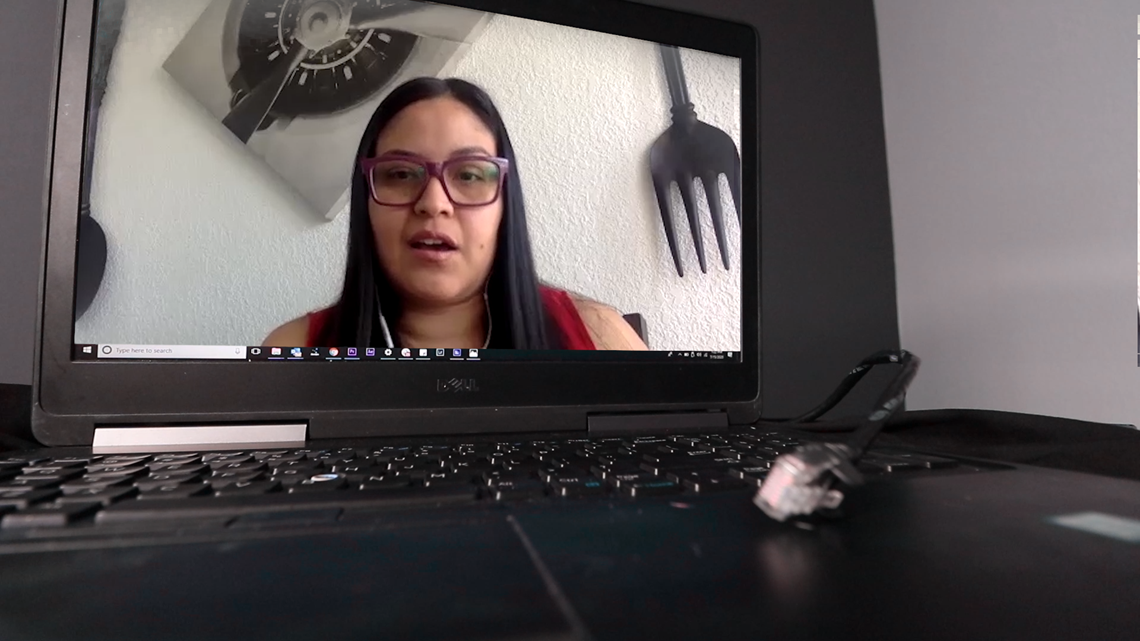
When school starts and classes go virtual again many students may be left behind, again.
AUSTIN, Texas —
“The students in our neighborhood come to school as a refuge,” said Michelle Sandoval Villegas, a teacher at Parkland Pre-Engineering Middle School, Ysleta Independent School District.
She said connections to the students were key.
“I just wanted to let them know I’m still here. I still care about you. I still love you. And that’s not going to change, even through a computer screen,” said Sandoval.
Sandoval teaches 132 students throughout a normal school day. Reaching them all online-only she said is impossible.
“Our campus is very lucky because we’re a one-to-one campus where each child gets a laptop. But they might have a laptop, they might not have the internet. That’s a huge problem because they have the technology. How on earth are they going to utilize the technology without having the proper resources for the technology?” said Sandoval.
Sandoval said some of her students would sit outside closed restaurants and in library parking lots to use the free WiFi.
“I wish I was financially able to just give the internet to everybody,” said Sandoval.
Through a program called “E-Rate,” the Federal Communications Commission has more than $53 million for internet equipment and services earmarked for Texas schools and libraries this year.
“What we’ve seen, schools and libraries were begging the FCC to do things like push their WiFi signal out of the building,” said Dr. Christopher Ali, an associate professor in the Department of Media Studies at the University of Virginia
Ali said money through the E-Rate program doesn’t cover off-campus internet equipment and service, like hotspots.
In addition to the E-Rate program, the FCC and U.S. Department of Agriculture pay millions to Texas internet service providers to build lines to the countryside.
Ali said maps used to determine who gets the funding doesn’t give enough details:
“[Internet service providers] only have to report by the census book, not by the address. A census block can be anywhere between, you know, a neighborhood or a street if you’re in Manhattan or 800 square miles if you’re in Alaska, huge swaths of area. And all the ISP has to do in order to say, ‘We serve an entire census block,’ is serve one building. If one building in an entire census block is considered served, that entire census block is considered served.
“The implication there is that that census block will then no longer be eligible for funding later on because it’s already been served. So that’s the first problem.
“The second problem is that the ISP doesn’t actually have to serve a building. It’s the potential to serve that building within 10 business days. So, an ISP can mark a census block as served even if they’re not there, so long as they’re confident that within 10 business days they can serve that area.”
Getting adequate speed for school children in rural areas is another issue.
Sandoval and many teachers use the platform “Zoom” for classes.
This coverage map from the Texas Comptroller shows 69% of rural Texans can’t meet Zoom’s bandwidth requirement because they don’t have access to high-speed internet.
“The national definition of broadband by speed is 25 megabits per second down, three megabits per second up. The national averages are probably four times or five times that high. If you connect someone at 25mbps/3mbps, then two people would not be able to have a Zoom conversation very well. It’s not enough bandwidth,” said Ali.
Ali said that means government funding doesn’t require providers to give enough internet speed for virtual learning through platforms like Zoom.
“We should be looking much higher, be much more aggressive, which would force these private companies to connect us with future-proof technology, not connect the technologies that they happen to have lying around the basement,” said Ali.
The E-Rate program administrator would not give an interview, and directed us back to their website.
RELATED: Texas Education Agency data shows minorities and low-income families struggle with online learning

