


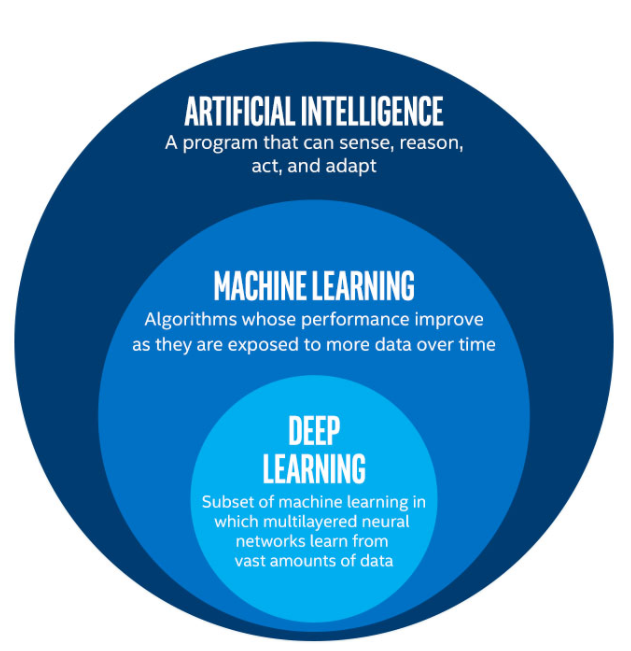

The twenty-first century brought tremendous technological advancement that we could not dream about a couple of decades earlier. Today, it can be found that people benefit from Google’s AI-controlled predictions, Ridesharing apps such as Uber and Lyft, as well as commercial flights with an AI autopilot that uses everyday music recommender systems to involve artificial intelligence, Google maps, and many more apps are powered with AI. However, there is still a misunderstanding between artificial intelligence, machine learning, and deep learning. One of Google’s popular queries reads: “is machine learning and artificial intelligence the same thing?” or “is artificial intelligence a subset of machine learning?”
AI, machine learning, and deep learning are interchangeable and easily confusing, so begin with a brief intro about them.
Artificial Intelligence: Artificial intelligence, also called machine intelligence, can be understood by an intelligence, unlike the natural intelligence shown by humans and animals, which is demonstrated by machines. It looks at ways of designing intelligent devices and systems that can address problems creatively that are often treated as a human prerogative. Thus, AI means that a machine somehow imitates human behavior.
Machine Learning: Machine learning is an AI subset and consists of techniques that enable computers to recognize data and supply AI applications. Different algorithms (e.g., neural networks) contribute to problem resolution in ML.
Deep Learning: Deep learning, often called deep neural learning or deep neural network, is a subset of machine learning that uses neural networks to evaluate various factors with a similar framework to a human neural system. It has networks that can learn from unstructured or unlabeled data without supervision.
Let’s dive into the branches of Artificial Intelligence:
AI systems are categorized by their ability to replicate human characteristics, their technology applications, their applications in the real world, and mind theory, which will be further discussed below.
- Artificial narrow intelligence (ANI), which has a narrow range of abilities.
- Artificial general intelligence (AGI), which is on par with human capabilities.
- Artificial superintelligence (ASI), which is more capable than actual human intelligence.
Narrow/Weak AI
Artificial narrow intelligence (ANI), also referred to as weak AI or narrow AI, is the only type of artificial intelligence we have successfully realized. Narrow AI is aim-oriented to perform different tasks — i.e., face recognition, speech recognition/voice assistants, automobile driving, and internet search — and is smart when carrying out a particular task.
You may have learned of Deep Blue, the first machine in chess to beat a human. Not just any human — in 1996 Garry Kasparov. Deep Blue can produce about 200 million chess positions per second and analyze them. In the whole scenario, some did not readily call it AI in its entirety, while others thought that it was one of the first examples of weak AI.
Strong AI / Deep AI
General Intelligence (AGI) is a concept of a computer that imitates human intelligence and behaviors, with its ability to learn and use its intelligence to solve any problem, which is also referred to as a Strong AI or deep AI. AGI can, in any given situation, think, understand, and behave in a manner that can be no different from that of a human being.
That is where robots can become human-like in the future. They decide themselves and learn without human intervention. They learn. They are not only able to solve intellectual problems but feelings.
When one sees the human brain as the model of the creation of general intelligence, the immense challenge of achieving strong AI is not surprising. Scientists fail to reproduce the essential functions of sight and motion without a solid understanding of the human brain’s features.
Superintelligence
Superintelligence is the conceptual AI that does not merely mimic or recognize human intelligence and behavior; ASI means that computers are self-conscious and outperform human ability and knowledge.
It is the material that everyone wants to learn about AI. Machines, long before humans. Articulate, articulate, imaginative, and outstanding professional competence. Its purpose is to either enhance or kill the lives of human beings.
It may seem enticing to have such powerful tools at our fingertips, but there are many unknown implications for the idea itself. If super-intelligent and self-conscious beings were to be created, they would be able to have concepts like autonomy. It is mere speculation that will impact humanity, our future, and our way of life.
The word AI says nothing about solving these issues. Include rules-based or expert systems; there are many different techniques. In the 1980s, one group of methods became more common: machine learning.

