Research Snappy
  • Market Research Forum
  • Investment Research
  • Consumer Research
  • More
    • Advertising Research
    • Healthcare Research
    • Data Analysis
    • Top Companies
    • Latest News
No Result
View All Result
Research Snappy
No Result
View All Result

Cognitive map–based navigation in wild bats revealed by a new high-throughput tracking system

researchsnappy by researchsnappy
July 10, 2020
in Healthcare Research
0
Cognitive map–based navigation in wild bats revealed by a new high-throughput tracking system
399
SHARES
2.3k
VIEWS
Share on FacebookShare on Twitter

Knowing their way around

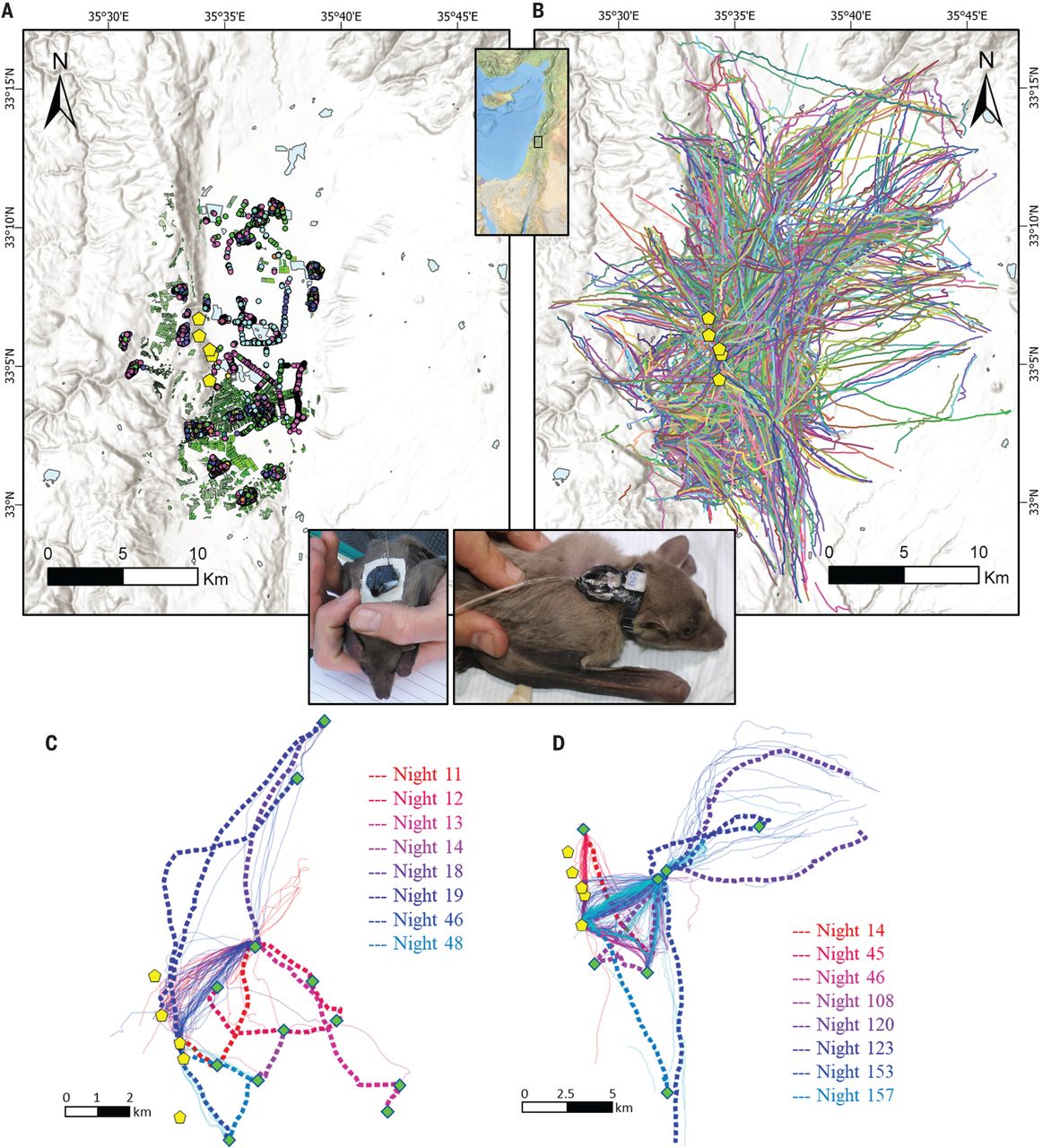
The presence of a cognitive map is essential to our ability to navigate through areas we know because it facilitates the use of spatial knowledge to derive new routes. Whether such maps exist in nonhuman animals has been debated, largely because of the difficulty of demonstrating qualifying components of the map outside of a laboratory. In two studies on Egyptian fruit bats, Harten et al. and Toledo et al. together show that this species’s navigational strategies meet the requirements for the use of a cognitive map of their environment, confirming that this skill occurs outside of humans (see the Perspective by Fenton).

Science, this issue p. 194, p. 188; see also p. 142

Abstract

Seven decades of research on the “cognitive map,” the allocentric representation of space, have yielded key neurobiological insights, yet field evidence from free-ranging wild animals is still lacking. Using a system capable of tracking dozens of animals simultaneously at high accuracy and resolution, we assembled a large dataset of 172 foraging Egyptian fruit bats comprising >18 million localizations collected over 3449 bat-nights across 4 years. Detailed track analysis, combined with translocation experiments and exhaustive mapping of fruit trees, revealed that wild bats seldom exhibit random search but instead repeatedly forage in goal-directed, long, and straight flights that include frequent shortcuts. Alternative, non–map-based strategies were ruled out by simulations, time-lag embedding, and other trajectory analyses. Our results are consistent with expectations from cognitive map–like navigation and support previous neurobiological evidence from captive bats.

Previous Post

The impact of the coronavirus on the Knowledge Process Outsourcing Market Intelligence Report Includes Market Dynamic, Product, Application 2020-2026

Next Post

Leuprolide Acetate Market Production & Demand by 2028

Next Post
Consumer Water and Air Treatment Market to witness astonishing growth with Key Players

Leuprolide Acetate Market Production & Demand by 2028

Research Snappy

Category

  • Advertising Research
  • Consumer Research
  • Data Analysis
  • Healthcare Research
  • Investment Research
  • News
  • Top Company News

HPIN International Financial Platform Becomes a New Benchmark for India’s Digital Economy

Top 10 Market Research Companies in the world

3 Best Market Research Certifications in High Demand

  • Privacy Policy
  • Terms of Use
  • Antispam
  • DMCA
  • Contact Us

© 2025 researchsnappy.com

No Result
View All Result
  • Market Research Forum
  • Investment Research
  • Consumer Research
  • More
    • Advertising Research
    • Healthcare Research
    • Data Analysis
    • Top Companies
    • Latest News

© 2025 researchsnappy.com