


As the pandemic’s economic toll grows around the world, some experts fear it could harm science for decades by putting many thousands of researchers out of work and forcing nations to slash funding as they rebuild societies. Others say the pandemic could highlight the importance of science and spur long-term support, especially for basic research, much as the Second World War did.
In the United States, where the rate of unemployment has risen towards levels last seen during the 1930s, many science leaders are trying to make the case that supporting research and development is crucial. “Without science to help, the country is in jeopardy,” says Harold Varmus, the Nobel-prizewinning cancer scientist who led the US National Institutes of Health (NIH) between 1993 and 1999.
In the wake of the pandemic, the biological sciences might thrive, in the way that the 1957 launch of Sputnik — the beach-ball-sized Soviet satellite that set off the space race — yielded decades of research and discovery in the physical sciences. “Researchers go where the money is,” says Julia Phillips, a member of the US National Science Board and former chief technology officer at Sandia National Laboratories in Albuquerque, New Mexico.

The US Congress has approved about US$3 trillion in emergency spending related to the pandemic.Bill Clark/CQ Roll Call via Getty
The long-term economic consequences for science will vary significantly by country. Australia, for example, has warned that 7,000 university research jobs are at risk this year, whereas science remains largely intact in Germany, which is committed to investing an additional €17 billion (US$18 billion) in science agencies through to 2030, at a steady 3% increase in budgets annually. And although China’s economy and scientific momentum were slammed by the coronavirus, the country is poised to recover relatively quickly. It’s possible there could be a shuffling of priorities, leading the country to invest more in biology and epidemiology, says Cong Cao, a sociologist at the University of Nottingham campus in Ningbo, China.
Some of the most drastic changes could come in the United States, one of the world’s largest funders of scientific research and a country where spending decisions are made annually, unlike some other nations.
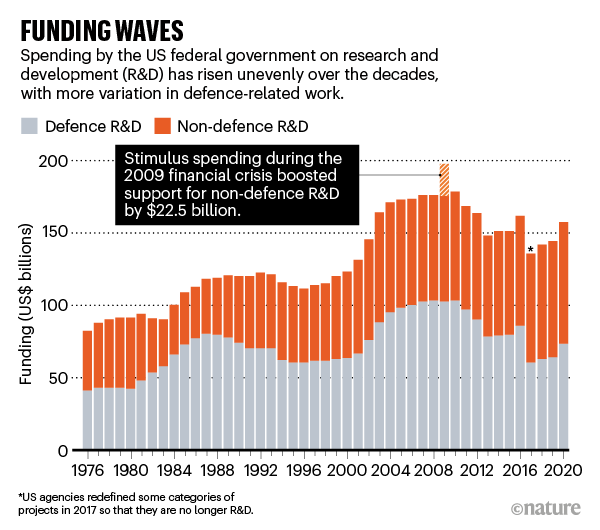
Several science-policy specialists have been looking to the last economic shock, the recession of 2007–09, for clues to the future. After that downturn, the US government doled out extra money to federal science agencies to jump-start programmes as part of the American Recovery and Reinvestment Act (ARRA), a national plan to boost activity across all sectors (see ‘Funding waves’). The NIH, for example, received an extra US$10.8 billion in 2009 on top of the $30-billion annual budget. The ARRA fund was “an enormous amount of money” at the time, says Jennifer Zeitzer, director of legislative relations at the Federation of American Societies for Experimental Biology (FASEB), in Bethesda, Maryland.
Source: AAAS R&D Budget and Policy Program
The need this year is expected to eclipse that episode. In early April, a coalition of groups representing US universities asked Congress to provide $26 billion to science-funding agencies to support the scientific workforce and the reopening of academic labs. The funding could, for example, buffer delayed grants, re-establish colonies of mice that had to be killed and replenish stores of personal protective equipment that were donated to the pandemic effort.
So far, of the roughly $3 trillion in emergency money approved by Congress, nearly $4 billion has been directed at federal science agencies for coronavirus-related work, including developing vaccines and treatments. Groups such as FASEB expect hiring freezes and lab shrinkages to hit early-career faculty members and graduate students particularly hard. “What happens next? Obviously, we’re very worried,” Zeitzer says.
Even in past economic crises, US science has received steady support from the government and industry, with total funding rising more than tenfold since the 1950s, when adjusted for inflation. The business sector accounts for some 70% of spending on basic, applied and translational research. But the US government remains the country’s biggest funder of basic science, making an investment of around $121 billion in 2017.
Although Congress has steadily increased federal dollars spent on science year-on-year, a big economic shock could trip up that trend. “Then you can see a scenario where in fact, the budgets for research agencies will go down,” says Elias Zerhouni, a physician who led the NIH between 2002 and 2008.
Such a blow could tip the balance between basic and applied research. In the past, budget crunches have favoured experimental and applied science over blue-sky research, says Phillips. And if that were to happen now, the United States could lose its competitive edge decades down the road. “The horizon moves in,” she says.
But, at a time when the coronavirus response has the attention of the public and lawmakers, this could also be an opportunity for universities and scientists to ask for more, says Varmus. “I think that the country is in a position now to appreciate what science has the potential to offer when the country is challenged. Moreover, they have the ability to recognize the economic consequences of not being better prepared.”
In fact, several US lawmakers have introduced legislation to dramatically boost funding for the National Science Foundation. They propose giving the agency $100 billion over 5 years, compared to its current annual budget of around $8 billion. The chances of the plan becoming law remain unclear, but Zeitzer expects it would be a smaller amount if it did.
Science in the United Kingdom might fare better than in the United States. In March, the government announced a bold plan to increase research funding from £9 billion (US$11 billion) a year to £22 billion by 2024–25. So far, there are no signs that commitment will change, says James Wilsdon, who studies science and technology policy at the University of Sheffield, UK. “Clearly, if the overall financial outlook is seriously damaged in terms of a prolonged recession or depression, then all bets are off.”

