Research Snappy
  • Market Research Forum
  • Investment Research
  • Consumer Research
  • More
    • Advertising Research
    • Healthcare Research
    • Data Analysis
    • Top Companies
    • Latest News
No Result
View All Result
Research Snappy
No Result
View All Result

Association between the proportion of Plasmodium falciparum and Plasmodium vivax infections detected by passive surveillance and the magnitude of the asymptomatic reservoir in the community: a pooled analysis of paired health facility and community data

researchsnappy by researchsnappy
April 9, 2020
in Healthcare Research
0
Association between the proportion of Plasmodium falciparum and Plasmodium vivax infections detected by passive surveillance and the magnitude of the asymptomatic reservoir in the community: a pooled analysis of paired health facility and community data
400
SHARES
2.4k
VIEWS
Share on FacebookShare on Twitter

Introduction

For diseases such as malaria, infections do not always lead to clinical manifestations and clinical symptoms might not be caused by the parasitic infection. Thus, passive case detection (PCD) data will underestimate the true magnitude of infections.

1

  • Kigozi SP
  • Kigozi RN
  • Sserwanga A
  • et al.
Malaria burden through routine reporting: relationship between incidence and test positivity rates.

, 

2

Measuring malaria endemicity from intense to interrupted transmission.

, 

3

  • Hofmann NE
  • Karl S
  • Wampfler R
  • et al.
The complex relationship of exposure to new Plasmodium infections and incidence of clinical malaria in Papua New Guinea.

Despite efforts to ensure that all confirmed care-seeking malaria infections are captured as part of PCD, little is known about the potential implications of uncounted asymptomatic infections on estimates of malaria infections. This undercounting could help to explain why global estimates of malaria vary substantially depending on how these hidden infections are counted.

4

WHO
World Malaria Report 2018.

Accounting for asymptomatic infections is especially important in malaria elimination settings: targeted interventions might be implemented before transmission is low enough for them to be effective, and any residual infections provide a source for onward transmission.

5

  • Gerardin J
  • Bever CA
  • Bridenbecker D
  • et al.
Effectiveness of reactive case detection for malaria elimination in three archetypical transmission settings: a modelling study.

, 

6

  • Bousema T
  • Stresman G
  • Baidjoe AY
  • et al.
The impact of hotspot targeted interventions on malaria transmission in Rachuonyo South district in the western Kenyan Highlands: a cluster-randomized controlled trial.

Research in context

Evidence before this study

A strong surveillance system is a core intervention in the global strategy for malaria control and elimination. Despite recent progress in strengthening the quality of the data generated in health systems, research suggests that a sizeable population of individuals with asymptomatic infections who do not seek medical care are present in most endemic settings. By not accounting for these infections, malaria burden is underestimated. The probability that an individual becomes symptomatic for Plasmodium falciparum malaria is a function of the protective immunity acquired over repeated exposure to malaria. Therefore, the magnitude of the potential undercounting in estimates of malaria burden that rely on routinely collected data would likely be a function of transmission intensity, whereby the effectiveness of the health system in detecting malaria infections should improve as transmission intensity and population-level immunity to malaria decrease. However, previous studies have not been able to directly assess this issue outside of modelling frameworks. Based on a search of the PubMed and Embase databases in English and French from inception to Dec 31, 2018, using general search terms “malaria”, “epidemiology”, and “polymerase chain reaction [PCR]”, no database of paired community survey and health systems for either Plasmodium falciparum or Plasmodium vivax data covering a range of transmission intensities exists.

Added value of this study

Our work has created a database consisting of 431 and 213 paired PCR prevalence and clinical incidence data covering 13 and seven countries for P falciparum and P vivax, respectively, in three endemic regions. We found that, on average, health systems detect only a small fraction of all infections, with the heath system effectiveness improving at the lowest range of transmission intensity. Factors associated with an improved proportion of infections detected included being in the high transmission season, smaller catchment population sizes, care-seeking behaviours, and a recent change of transmission as a proxy for the expected levels of population-level protective immunity.

Implications of all the available evidence

Our results are the first data estimating the proportion of malaria infections expected to be symptomatic and seek care and the potential magnitude of the undercounting associated with asymptomatic infections in quantifying malaria transmission intensity. The evidence suggests that the health system becomes more effective at detecting malaria infections once transmission intensity is sufficiently low. Where the goal is to eliminate malaria transmission, the notion that the health system becomes more effective at detecting infections when transmission is low is reassuring. Improving access to care for testing and promoting better care-seeking behaviour of infected individuals would lead to more infections being detected. For settings accelerating malaria elimination, this confidence that any infections are likely to be sufficiently symptomatic to seek care becomes especially relevant whereby any residual population-level protective immunity has the potential to mask any lingering or introduced infections and could lead to programmes failing to sustain interruption of transmission.

Asymptomatic malaria infections are common in endemic areas; patients with such infections are not expected to seek care and consequently the infections are not detectable by malaria surveillance activities.

7

  • Slater HC
  • Ross A
  • Ouedraogo AL
  • et al.
Assessing the impact of next-generation rapid diagnostic tests on Plasmodium falciparum malaria elimination strategies.

, 

8

  • Okell LC
  • Bousema T
  • Griffin JT
  • Ouedraogo AL
  • Ghani AC
  • Drakeley CJ
Factors determining the occurrence of submicroscopic malaria infections and their relevance for control.

The presence and persistence of asymptomatic infections is a complex phenomenon related to levels of protective immunity acquired with repeated exposure to malaria and the maturity of the immune system.

9

  • Rodriquez-Barraquer I
  • Arinaitwe E
  • Jagannathan P
  • et al.
Quantification of anti-parasite and anti-disease immunity to malaria as a function of age and exposure.

If an individual is not sufficiently symptomatic to prompt care seeking or if parasite densities are not sufficiently high to be detected using rapid diagnostic tests or microscopy—the routinely used diagnostics for confirming malaria infections in people with clinical symptoms—they cannot be detected within routine aggregation of PCD data as part of malaria surveillance activities.

10

  • Imwong M
  • Stepniewska K
  • Tripura R
  • et al.
Numerical distributions of parasite densities during asymptomatic malaria.

Understanding the magnitude of undercounting, and if or when all infections in a community are expected to become symptomatic and therefore passively detectable, becomes paramount for settings aiming to achieve malaria elimination.

We did a pooled analysis of paired cross-sectional household surveys and routinely collected PCD data for both Plasmodium falciparum and Plasmodium vivax to assess the impact of asymptomatic infections on the interpretation of malaria surveillance data and factors affecting any associations with transmission intensity. The relation between the proportion of all infections detected in health systems—P(Detect)—and the parasite reservoir in the community as estimated by PCR, used here as a proxy for transmission intensity and the expected levels of protective immunity in the population,

9

  • Rodriquez-Barraquer I
  • Arinaitwe E
  • Jagannathan P
  • et al.
Quantification of anti-parasite and anti-disease immunity to malaria as a function of age and exposure.

and any changes over time were examined.

Results

Our search for published and unpublished studies resulted in data from 471 clusters in 13 countries for P falciparum and 213 clusters in seven countries for P vivax (table 1, appendix p 8). The malaria diagnostic used in most clusters was ultrasensitive PCR (in 250/471 for P falciparum and in 194/213 for P vivax), which has a limit of detection that is 50-times more sensitive than that of conventional PCR.

19

  • Imwong M
  • Hanchana S
  • Malleret B
  • et al.
High-throughput ultrasensitive molecular techniques for quantifying low-density malaria parasitemias.

132 clusters from two countries (Zambia [n=111] and Tanzania [n=21]) required adjustment because only rapid diagnostic test data were available.

8

  • Okell LC
  • Bousema T
  • Griffin JT
  • Ouedraogo AL
  • Ghani AC
  • Drakeley CJ
Factors determining the occurrence of submicroscopic malaria infections and their relevance for control.

PCD data representing individuals older than 5 years of age were available for 309 clusters for P falciparum and 201 clusters for P vivax, and data for children aged 5 years and younger in 201 clusters for P falciparum and 23 clusters for P vivax. The discrepancy in the number of clusters is due to clusters for which age adjustment was required being excluded from the age-specific analysis.

Table 1Numbers of paired community survey and health facility clusters available for both the Plasmodium falciparum and Plasmodium vivax analysis in each country

The table shows the clusters for which data from all ages as well as data focusing only on those older than 5 years of age or children 5 years of age and younger were available for analysis. Studies covered the period from 2008 to 2017.

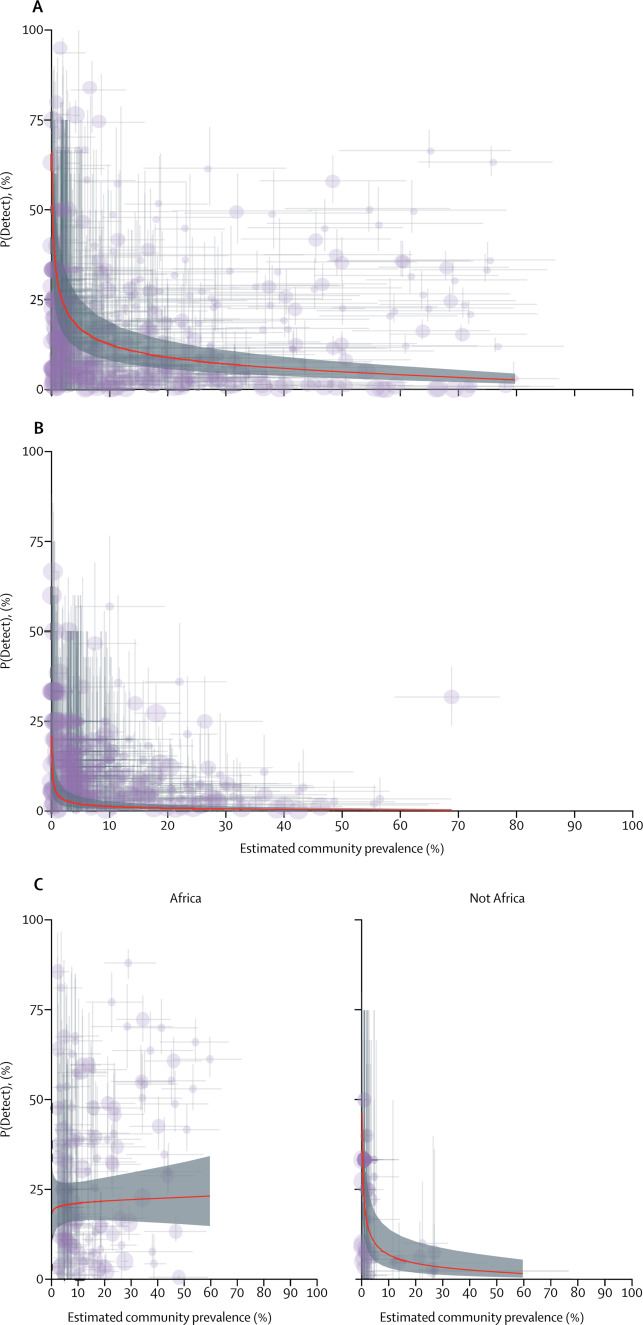
For P falciparum malaria, the cluster-level all-age estimated PCR prevalence was 16·17% (95% CI 14·43–17·91), ranging from 0·04% to 79·74%. The 471 clusters had a median size of 511 people (IQR 148–4724) but ranged from 24 to 100 000 individuals, with the fraction sampled between 0·03% (8/22 988) and 99·2% (392/418) of the population. The median estimated P(Detect) was 12·5% (IQR 5·3–25·0). There was a negative association between P(Detect) and estimated PCR prevalence in the community (adjusted odds ratio [OR] 0·63, 95% CI 0·57–0·69; figure 1A; appendix pp 9–10). Health facilities had lower odds of detecting infections in larger than in smaller communities (adjusted OR 0·23, 95% CI 0·17–0·31), during the low transmission season (0·59, 0·46–0·77), and in non-African compared with African settings (0·37, 0·22–0·62). Settings in which malaria incidence had increased in the year before the survey were more likely to have infections detected (adjusted OR 431·82, 95% CI 2·07–89859·3; table 2).

Figure thumbnail gr1

Figure 1Estimated proportion of Plasmodium falciparum infections in populations detected within health systems (P[Detect]) compared with the corresponding prevalence of infection in the community

Show full caption

(A) All age groups. (B) Individuals older than 5 years of age. (C) Children aged 5 years and younger, with the significant interaction in non-African and African populations shown in the separate panels. The average fitted linear mixed model trend is shown by the red line and corresponding 95% CI band is shaded in grey. Each dot represents a paired community and health facility cluster, with their size representing the sample size of the community survey as small (<50 people), medium (50–100 people), or large (>150 people). The 95% credible intervals around each metric are shown by the horizontal and vertical grey lines around each cluster.

Table 2Fixed-effects results of the mixed-effects log-linear regression for the proportion of Plasmodium falciparum infections detected in the health system according to community-level transmission intensity

Detection of infection in the full all-age population, in the populations aged older than 5 years, and in children aged 5 years and younger is shown. Some cells are empty because the factor was not retained in the adjusted analysis because they did not contribute to the explanatory power of the model. OR=odds ratio. RDT=rapid diagnostic test.

Within the 309 clusters with data on infections in those older than 5 years of age, a similar but more extreme trend was observed as that for the all-age population, whereby most infections remained unrepresented at the facility level until reaching the lowest levels of estimated PCR prevalence (figure 1B). In the population older than 5 years of age, health facilities had an increased odds of detecting infections in non-African settings compared with African settings (adjusted OR 4·45, 95% CI 2·00–9·89), and where there was a higher reported use of insecticide-treated bednets in the population (2·29, 1·16–2·37). There were lower odds of infections detected within health facilities during the low transmission season than in the high transmission season (adjusted OR 0·65, 95% CI 0·53–0·80; table 2).
The odds of detecting infections in health facilities in children aged 5 years and younger also showed a negative association with estimated community PCR prevalence, but there was a significant interaction by region (figure 1C). The relation in African settings showed a slight positive association with transmission intensity. By contrast, the relation in non-African settings was similar to that observed in the population older than 5 years of age, with an increase in P(Detect) once estimated prevalence was sufficiently low (figure 1C; appendix pp 9–10). Similar factors to the other models were associated with P(Detect) and the odds of detecting infections were lower during the low transmission season (adjusted OR 0·62, 95% CI 0·44–0·87; table 2).
The seasonal pattern in P(Detect) was specifically assessed using a longitudinal dataset with 12 villages in The Gambia with paired PCD and community data spanning 2 years. Annual village-level estimated PCR prevalence ranged from 2·29% to 24·18% (figure 2). Overall, monthly estimates of P(Detect) ranged from 0·57% to 82·05%, with the largest within-village variation observed in village L (ranging from 3·33% to 82·05%; figure 2A). A seasonal pattern whereby P(Detect) increases during the high transmission season (usually September–December) was evident (figure 2B). When stratified by villages with high (n=4) and low (n=8) transmission intensity, a similar seasonal pattern emerged (figure 2C).

Figure thumbnail gr2

Figure 2Estimated proportion of Plasmodium falciparum infections in populations detected within health systems (P[Detect]) in 12 communities sampled at 13 monthly intervals over 2 years in The Gambia

Show full caption

(A) The annual variation within each study village (A to M) is shown as a boxplot, with low transmission villages represented in orange and high transmission villages in blue. (B) The locally estimated scatterplot smoothing (LOESS) trends for all villages combined with the different colours representing the 12 individual villages. (C) The LOESS trends for villages stratified according to high transmission intensity (blue line) or low transmission intensity (orange line). The 95% CIs from the LOESS estimate are shown as the shaded grey area. The 95% credible intervals around P(Detect) are shown by the vertical grey lines around each, with the point size representing the estimated community prevalence for that sample month. The dashed vertical red line identifies the period where a mass drug administration of dihydroartemisinin–piperaquine was deployed in all study villages.

18

  • Mwesigwa J
  • Achan J
  • Affara M
  • et al.
Mass drug administration with dihydroartemisinin-piperaquine and malaria transmission dynamics in The Gambia—a prospective cohort study.

For P vivax malaria, mean cluster-level all-age estimated PCR prevalence was 14·47% (95% CI 12·5–16·37) but ranged from 0·05% to 93·75%. The 213 clusters of paired data ranged in size from 24 to 20 841 individuals with the fraction sampled between 0·02% (82/4168) and 94·44% (51/54) of the population. The median estimated P(Detect) was 10·1% (IQR 5·0–18·3). Again, there was evidence of a negative association between P(Detect) and estimated PCR prevalence in the community (adjusted OR 0·52, 95% CI 0·47–0·57; figure 3A, appendix pp 9–10). There were lower odds of detecting infections in Asian than in non-Asian settings (adjusted OR 0·05, 95% CI 0·02–0·12) and lower odds of detecting infections in larger than in smaller populations (0·23, 0·17–0·32). P(Detect) was also likely to increase in communities in which ultrasensitive PCR was used as the diagnostic tool when compared with communities where malaria was assessed using other PCR methods (adjusted OR 4·09, 95% CI 2·12–7·90; table 3).

Figure thumbnail gr3

Figure 3Estimated proportion of Plasmodium vivax infections detected in health facilities compared with the corresponding prevalence of infection in the community

Show full caption

(A) All age groups. (B) Individuals older than 5 years of age. The average fitted linear mixed model trend is shown by the red line and corresponding 95% CI band is shaded in grey. Each dot represents a paired community and health facility cluster, with their size representing the sample size of the community survey as small (<50 people), medium (50–100 people), or large (>150 people). The 95% credible intervals around each metric are shown by the horizontal and vertical grey lines around each cluster.

Table 3Fixed-effects results of the mixed-effects log-linear regression for the proportion of Plasmodium vivax infections detected in the health system according to community-level transmission intensity

Detection of infection in both the full all-age population and detection of infections in the population older than 5 years of age. Some cells are empty because the factor was not retained in the adjusted analysis because they did not contribute to the explanatory power of the model. OR=odds ratio. usPCR=ultra-sensitive PCR.

When examining the 201 clusters with data about P vivax infections in the population aged older than 5 years, a similar trend was observed to that in the all-age population, with most infections remaining undetected until the lowest estimates of estimated PCR prevalence (adjusted OR 0·51, 95% CI 0·47–0·56; figure 3B, appendix pp 9–10). Infections in those aged older than 5 years were more likely to be detected at health facilities where a recent intervention (mass drug administrations targeting P falciparum with or without concurrent long-lasting insecticidal net distribution) took place than in those without a recent intervention (adjusted OR 1·56, 95% CI 1·01–2·41), and where the probability of individuals seeking care if febrile was higher (1·95, 1·46–2·60). There were lower odds of infections being detected in larger than in smaller communities (adjusted OR 0·22, 95% CI 0·16–0·31; table 3). In the 23 clusters with data available for P vivax infections in children aged 5 years and younger, a similar trend to that seen in all ages as well as individuals older than 5 years was observed; however, the number of clusters was insufficient for further analysis (appendix p 11). Results of the validation tests for all models suggest a good predictive capacity (appendix pp 12–14).

Discussion

The presence of asymptomatic infections across the malaria transmission spectrum has been well established but not adequately quantified.

8

  • Okell LC
  • Bousema T
  • Griffin JT
  • Ouedraogo AL
  • Ghani AC
  • Drakeley CJ
Factors determining the occurrence of submicroscopic malaria infections and their relevance for control.

Irrespective of issues related to health system capacity, such infections are not typically captured as part of routine passive surveillance. Using paired health facility and cross-sectional survey data, we have described the extent to which malaria is underestimated due to the prevalence of asymptomatic infections for both P falciparum and P vivax malaria when relying solely on malaria surveillance data, providing a proxy measure for the proportion of infections that are symptomatic enough for infected individuals to seek care. Crucially, we have shown how this association changes as transmission intensity decreases. Although for malaria control programmes to know the true transmission intensity will be difficult, as will ascertaining whether or not the clinical symptoms driving care-seeking are attributable to malaria, the observation that more infections are identified within the health facility once transmission is sufficiently low (eg, a higher estimated P[Detect]) is reassuring.

20

  • Adhikari B
  • Phommasone K
  • Pongvongsa T
  • et al.
Treatment-seeking behaviour for febrile illnesses and its implications for malaria control and elimination in Savannakhet Province, Lao PDR (Laos): a mixed method study.

The observed pattern for P falciparum is consistent with the expected levels of population-level immunity.

9

  • Rodriquez-Barraquer I
  • Arinaitwe E
  • Jagannathan P
  • et al.
Quantification of anti-parasite and anti-disease immunity to malaria as a function of age and exposure.

Proxy measures for immunity were consistently found to be important factors associated with P(Detect). First, an increase in transmission during the past year was positively associated with the proportion of infections detected. In such settings, a higher proportion of susceptible individuals would be expected given the current estimated levels of transmission and these individuals therefore have an increased likelihood of becoming symptomatic.

3

  • Hofmann NE
  • Karl S
  • Wampfler R
  • et al.
The complex relationship of exposure to new Plasmodium infections and incidence of clinical malaria in Papua New Guinea.

, 

21

  • McCallum FJ
  • Persson KEM
  • Fowkes FJI
  • et al.
Differing rates of antibody acquision to merozoite antigens in malaria: implications for immunity and surveillance.

Second, compared with non-African sites, African settings tended to have a lower P(Detect). Different global regions have had very different malaria histories, with malaria transmission in Africa being much higher for longer than in America or Asia, meaning that different levels of population immunity are expected.

4

WHO
World Malaria Report 2018.

Third, the interaction between prevalence and region in children further supports this notion, with the estimated P(Detect) in children generally being higher than in adults and remaining relatively constant across the range of estimated PCR prevalence. Children are less likely than adults to have acquired sufficient immunity to protect against symptoms and are therefore more likely to become sufficiently symptomatic to prompt care-seeking.

9

  • Rodriquez-Barraquer I
  • Arinaitwe E
  • Jagannathan P
  • et al.
Quantification of anti-parasite and anti-disease immunity to malaria as a function of age and exposure.

This theory is further reinforced by the slight increase in P(Detect) in African children as transmission intensity increases. This trend could represent opportunistically detected malaria infections in children acquiring sufficient levels of protective immunity earlier in life, meaning that the fever prompting care-seeking might not be causally related to their malaria infection.

The observed association is less straightforward when considering P vivax. The factors probably contributing to the negative association between P(Detect) and transmission intensity might be affected by several, non-mutually exclusive factors. First, P vivax infections typically have lower parasite densities than P falciparum infections.

22

  • Ding XC
  • Ade MP
  • Baird JK
  • et al.
Defining the next generation of Plasmodium vivax diagnostic tests for control and elimination: target product profiles.

Such lower parasite densities might be related to fewer infections being sufficiently symptomatic to prompt care-seeking and fewer infections that are expected to be infectious.

23

  • Tadesse FG
  • Slater HC
  • Chali W
  • et al.
The relative contribution of symptomatic and asymptomatic Plasmodium vivax and Plasmodium falciparum infections to the infectious reservoir in a low-endemic setting in Ethiopia.

Furthermore, even if someone does seek care, the routine diagnostic tests for P vivax are currently less sensitive than those for P falciparum: thus, infections might not be confirmed even if infected individuals are presenting to a health-care facility and tested.

22

  • Ding XC
  • Ade MP
  • Baird JK
  • et al.
Defining the next generation of Plasmodium vivax diagnostic tests for control and elimination: target product profiles.

Next, although natural acquired immunity to P vivax is likely, the degree of the protection obtained and effect of hypnozoites on the probability that an infected individual will become symptomatic is not well understood. In areas with co-circulating parasite strains, efforts might also be biased towards P falciparum, which is traditionally the focus of malaria control and elimination programmes. The perception of risk for P vivax might differ to that for P falciparum infections, which alters care-seeking and diagnostic behaviours. Moreover, there might be sufficient cross-protection between the species, modifying the likelihood that an infection from either species would elicit symptoms.

24

  • Commons RJ
  • Simpson JA
  • Thriemer K
  • et al.
Risk of Plasmodium vivax parasitaemia after Plasmodium falciparum infection: a systematic review and meta-analysis.

Across the settings examined, P(Detect) varied substantially, with health facilities in 27 clusters across six countries detecting at least half of all P falciparum infections and health facilities in nine clusters across three countries detecting at least half of all P vivax infections. Two factors that were consistently associated with a reduced probability that an infection will be detected within the health facility were the facility catchment population size and the transmission season. Intuitively, detecting one infection will be easier in 20 people than in 2000 people. Similarly, seasonality was defined according to the specific setting and parasite species. In the low transmission season, when vector densities are low, a malaria parasite might be more geared towards surviving until the next transmission season than causing clinical symptoms that could lead to treatment. The protective immunity acquired during the previous transmission season might also have not yet sufficiently waned for symptoms to develop, suggesting a lower probability of becoming symptomatic and therefore a lower estimated P(Detect).

25

  • Carneiro I
  • Roca-Feltrer A
  • Griffin JT
  • et al.
Age-patterns of malaria vary with severity, transmission intensity and seasonality in sub-Saharan Africa: a systematic review and pooled analysis.

It is also plausible that clinicians would be less likely to test for malaria or patients less likely to seek care for a fever when malaria is not perceived to be a problem.

26

  • Worges M
  • Celone M
  • Finn T
  • et al.
Malaria case management in Zambia: a cross-sectional health facility survey.

These findings reinforce the view that good access to testing and treatment practices improves detection of malaria infections and a better understanding of malaria-attributable fevers could improve clinical algorithms that account for any seasonal changes in malaria presentation.

5

  • Gerardin J
  • Bever CA
  • Bridenbecker D
  • et al.
Effectiveness of reactive case detection for malaria elimination in three archetypical transmission settings: a modelling study.

, 

27

  • Dalrymple U
  • Cameron E
  • Bhatt S
  • Weiss DJ
  • Gupta S
  • Gething PW
Quantifying the contribution of Plasmodium falciparum malaria to febrile illness amongst African children.

, 

28

  • Eisele TP
  • Bennett A
  • Silumbe K
  • et al.
Short-term impact of mass drug administration with dihydroartemisinin plus piperaquine on malaria in southern province Zambia: a cluster-randomized controlled trial.

In settings where blood-stage malaria vaccines or other interventions reduce the likelihood of an individual becoming sufficiently symptomatic to seek care, the proportion of infections detected within the health system will probably decrease.

Passive surveillance data for malaria are generally used for two purposes: resource allocation and monitoring trends in malaria.

29

  • Nankabirwa JI
  • Briggs J
  • Rek J
  • et al.
Persistent parasitemia despite dramatic reduction in malaria incidence after 3 rounds of indoor residual spraying in Tororo, Uganda.

, 

30

WHO
Malaria surveillance, monitoring & evaluation: a reference manual.

From the resource allocation perspective, the magnitude of undercounting might not matter. The number of tests or malaria drugs to send to a health facility will not be affected unless additional people start to seek care or testing rates increase. Conversely, the effect on estimating current or changes in malaria burden could be substantial. It has long been assumed that, although within-catchment heterogeneity of transmission is not routinely represented, incident infections detected at the health facility are a good representation of transmission intensity in the community.

2

Measuring malaria endemicity from intense to interrupted transmission.

, 

15

  • Cameron E
  • Battle KE
  • Bhatt S
  • et al.
Defining the relationship between infection prevalence and clinical incidence of Plasmodium falciparum malaria.

However, what is identified in the health system does not account for non-opportunistically detected new infections in the immune population or when an already infected person receives multiple inoculations with different strains of parasites.

31

  • Mueller I
  • Schoepflin S
  • Smith TA
  • et al.
Force of infection is key to understanding the epidemiology of Plasmodium falciparum malaria in Papua New Guinean children.

Similarly, reductions in transmission intensity are not immediately detectable based on clinical incidence data. Once transmission declines, the first expected trend is a shift in the underlying age distribution of clinically detected cases, with older individuals presenting with clinical symptoms as immunity wanes in the population.

32

  • O’Meara WP
  • Bejon P
  • Mwangi TW
  • et al.
Effect of a fall in malaria transmission on morbidity and mortality in Kilifi, Kenya.

, 

33

  • Bejon P
  • Williams TN
  • Liljander A
  • et al.
Stable and unstable malaria hotspots in longitudinal cohort studies in Kenya.

The prevalence of infected individuals, such as that assessed using easy access group surveys, and any change in the size of the parasite reservoir is arguably a more direct measure of progress in the short term, especially in a population with a large proportion of immune individuals.

The presence of undetected infections becomes especially critical in settings striving for and maintaining malaria elimination. A key factor initiating a shift to elimination strategies is routinely collected malaria data.

30

WHO
Malaria surveillance, monitoring & evaluation: a reference manual.

Allowing for the time for transmission to taper off naturally with corresponding decreases in population-level protective immunity, and improvements in health systems could be an option whereby relying on clinical data alone to detect all infections during the elimination phase might be sufficient. However, in settings accelerating elimination, the potential for any residual population immunity masking any asymptomatic or introduced infections must be acknowledged.

34

  • Goncalves BP
  • Kapulu MC
  • Sawa P
  • et al.
Examining the human infectious reservoir for Plasmodium falciparum malaria in areas of differing transmission intensity.

A better understanding of the probability that an infection becomes symptomatic and potentially detected by the health system will inform the critical point at which programmes could scale back control activities and rely on the health system to identify all infections (eg, P[Detect] of 100%). Until that point, maintaining diligent levels of control is essential.

35

  • DePina AJ
  • Andrade AJB
  • Dia AK
  • et al.
Spatiotemporal characterisation and risk factor analysis of malaria outbreak in Cabo Verde in 2017.

This study has some important limitations. It was a pooled analysis driven by a large number of clusters in a few countries and therefore was not powered to detect the specific change point whereby the majority of infections can be detected or the exact proportion of infections detected. The general trends observed are consistent with existing knowledge, and model fits were good despite the substantial variation in the data. The conclusions are nevertheless informative. Second, this was not a full systematic review and relied on secondary data analysis. We were unable to include all eligible community surveys because the ability to obtain matched PCD data was logistically unfeasible because of research sites being closed or the timeframe required to obtain local approvals was prohibitive. Some bias might have been introduced by the exclusion of some sites but the effect of this bias is expected to be non-differential and thus we believe our inferences are still valid. Similarly, because of the nature of this pooled analysis, not all variables of interest were available in all datasets, leading to derivation of the primary outcome variable and reliance on modelled or estimated covariates in some settings, potentially introducing some bias. However, the credible intervals were calculated accounting for this introduced uncertainty and the final model fits are consistent with known factors related to malaria transmission. Third, the more granular epidemiological considerations and differences between settings were not accounted for—for example, in southeast Asian settings, forest goers are known to be at increased risk of malaria infection due to the vectors’ preferred ecological niche, leading to a different risk profile in this setting.

36

  • Rossi G
  • Vernaeve L
  • Van den Bergh R
  • et al.
Closing in on the reservoir: proactive case detection in high-risk groups as a strategy to detect Plasmodium falciparum asymptomatic carriers in Cambodia.

Accounting for the differential risk profiles can help make health systems more effective at detecting infections by adapting activities to where they are more likely to find them. Moreover, cases might not report to their nearest health facility, might seek care at private facilities, or be misclassified as imported or local. However, people from other catchments might also prefer to attend the included facility, resulting in non-differential misclassification of infections or cases. Similarly, travel history is used to define an infection as imported. Classification is generally improving, especially in low transmission settings where this is more relevant, but variation exists at both the facility and country level in how imported was classified. The data generated at the facility level are what is available for decision making so, although the data used here might not be perfect, we expect the resulting inferences to be valid. Some care-seeking malaria infections might have been misclassified because of the low diagnostic sensitivity of rapid diagnostic tests or routine microscopy, which is again lower than that of molecular methods used to define the extent of the infected population in the community. The aim here was to show the degree of bias when relying on routinely collected data to estimate the magnitude of malaria burden and not a direct comparison of two populations using different diagnostic tools. Finally, the P vivax data available were cross-sectional. Infections detected might be due to relapse instead of being an incident infection. However, in terms of P(Detect), this is expected to be a non-differential bias and unlikely to affect the observed trends.

This study has confirmed that health facilities detect a small proportion of the malaria parasite reservoir, with routine data underestimating transmission intensity and the magnitude of malaria-infected populations. When transmission is very low, health facilities become more effective at detecting infections, and this finding is observed for both P falciparum and P vivax. Promoting better health-seeking behaviour of infected individuals and investing in better access to care for testing would lead to more infections being detected and, along with the iterative approach of surveillance as an intervention as outlined by the WHO, might ultimately contribute to accelerating malaria elimination.

GS conceived and designed the study. GS, KF, LG, JuM, JA, JoM, DJB, TPE, JaM, PJL, MLM, FEE, FT, JCS, AMQ, AS, ML, SY, SS, EP, JG, KEH, AY, JFL, MAC, KP, MM, JL, DMP, LVS, FN, GD, AD, TB, UD’A, and CD were involved in the primary data collection in the different study sites and facilitated access to the health systems malaria data where needed. EC, KB, and PG provided access to the covariables from the Malaria Atlas Project data. GS and NS had access to and analysed the data. All authors participated in the development and provided a critical review of the reported research. All authors approved the final report for the publication and are accountable for the accuracy and integrity of the work.

We declare no competing interests.

Previous Post

Investors gain Rs 4 lakh crore on hopes of second stimulus package to fight Covid-19

Next Post

Insulated Cable and Wire Market Global Share, Regional Growth Analysis, Upcoming Trends, Manufacturers, Technology Updates and Development Analysis Research Report 2025

Next Post
Insulated Cable and Wire Market Global Share, Regional Growth Analysis, Upcoming Trends, Manufacturers, Technology Updates and Development Analysis Research Report 2025

Insulated Cable and Wire Market Global Share, Regional Growth Analysis, Upcoming Trends, Manufacturers, Technology Updates and Development Analysis Research Report 2025

Research Snappy

Category

  • Advertising Research
  • Consumer Research
  • Data Analysis
  • Healthcare Research
  • Investment Research
  • News
  • Top Company News

HPIN International Financial Platform Becomes a New Benchmark for India’s Digital Economy

Top 10 Market Research Companies in the world

3 Best Market Research Certifications in High Demand

  • Privacy Policy
  • Terms of Use
  • Antispam
  • DMCA
  • Contact Us

© 2025 researchsnappy.com

No Result
View All Result
  • Market Research Forum
  • Investment Research
  • Consumer Research
  • More
    • Advertising Research
    • Healthcare Research
    • Data Analysis
    • Top Companies
    • Latest News

© 2025 researchsnappy.com