


SINGAPORE (Reuters) – The dollar slipped for a third consecutive session on Wednesday, as a deal to backstop the U.S. economy with a huge fiscal stimulus package promised to further ease some of the pandemic-driven skyrocketing demand for hard cash.
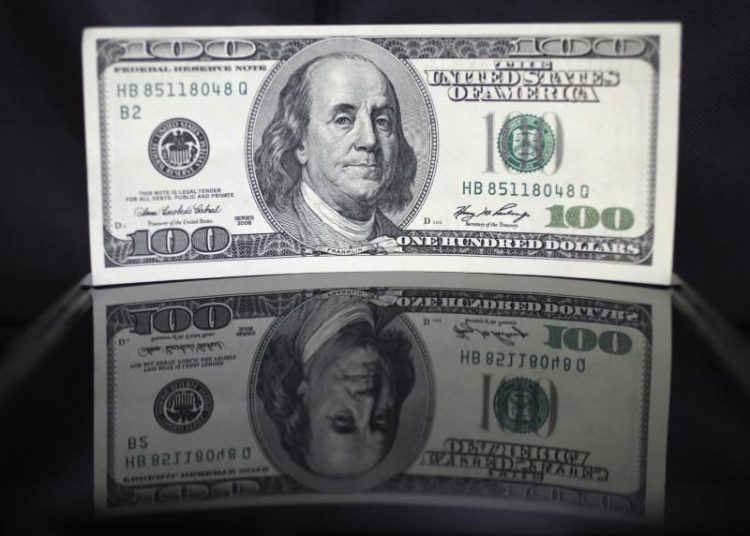
A picture illustration shows U.S. 100 dollar bank note and its reflection taken in Tokyo August 2, 2011. REUTERS/Yuriko Nakao
U.S. Senate majority leader Mitch McConnell said the package, expected to be worth $2 trillion (1.70 trillion pounds), had been agreed and would be put to a vote later on Wednesday.
The risk-sensitive Australian dollar jumped over the 60-cent mark for the first time in a week as news of the agreement trickled out, and then extended gains to $0.6047.
The British pound rose 0.6% to a session high of $1.1834 and the New Zealand dollar was 1% ahead at $0.5894. The euro lifted 0.3% to $1.0819.
“Now we are seeing the fiscal bazooka in action, and that should help further ease the dollar funding stress,” said Moh Siong Sim, currency analyst at the Bank of Singapore.
“There has been a need for cash to ride through this period where there is a revenue shortfall,” he said, adding the deficit could be alleviated should help find its way quickly to affected businesses, especially in the travel and hospitality sectors.
Against a basket of currencies the dollar eased 0.2% to 101.43. The U.S. currency was broadly steady against the Japanese yen at 111.17 yen per dollar.
The precise details of the U.S. rescue bill are not clear, but Senate Democrat leader Chuck Schumer said it included $150 billion to aid hospitals and the same amount again to support state and local governments.
Three sources briefed on the matter had also told Reuters that U.S. lawmakers are nearing agreement on a $61 billion rescue package for the aviation sector.
The fiscal deal also follows enormous moves from the U.S. Federal Reserve to restore market confidence with limitless bond purchases and a flood of discount dollars.
Yet, despite the burst of rescue measures, signs of dollar funding stress do remain, and so does the dollar’s broad strength.
While the Australian dollar is up 1.5% for the session, both it and the pound have lost more than 7% for the month as nearly everything has been clobbered by the rush for U.S. dollars.
Few analysts expect any lasting turnaround until there are signs that the virus is in retreat, though there is none of that happening beyond China and South Korea.
Spain reported its sharpest increase in cases on Tuesday while India announced a 21-day lockdown of its 1.3 billion population.
The World Health Organization said that New York could become the next epicentre of the pandemic.
And within funding markets, signs of stress remain as businesses and investors drive enormous demand for dollars to cover liabilities.
Cross-currency basis swap spreads, which reflect the cost of borrowing dollars abroad, have relaxed for the euro.
But they remain elevated for the yen and Australian dollar, even as the Bank of Japan and Reserve Bank of Australia tap the Fed’s funding lines for billions of short-term dollars.
“There’s a lot of reasons to believe that we’re not out of the woods yet,” said Chris Weston, head of research at Melbourne brokerage Pepperstone.
“People still feel that the downside risk is far more prevalent.”
Reporting by Tom Westbrook; Editing by Sam Holmes & Shri Navaratnam
