


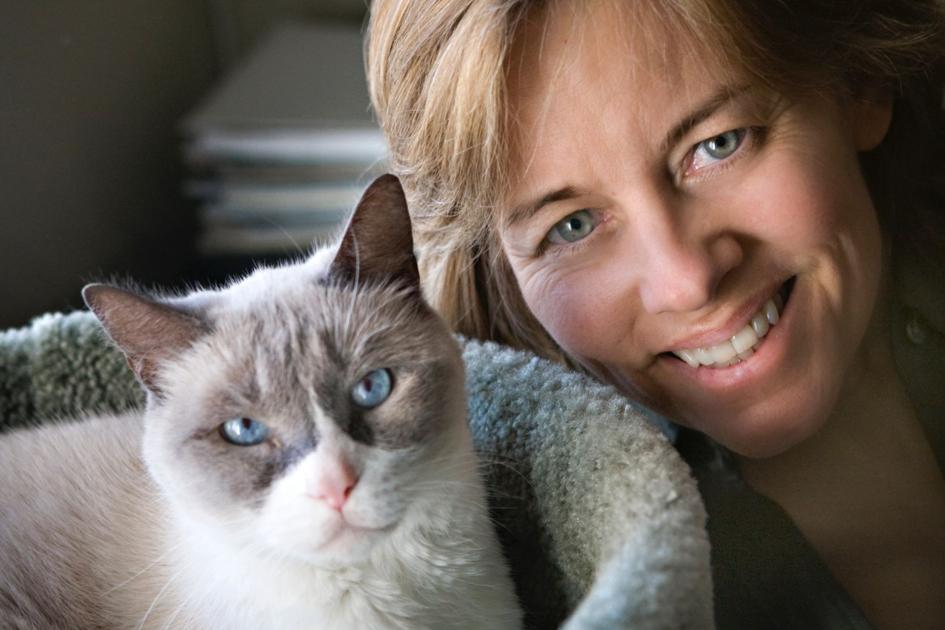
Dr. Julius “Jukie” Leary Jr. of Greenwood says the fund his family established in memory of his late sister, Dianne, through the Greenwood Genetic Center could “give more hope” for others navigating Charcot-Marie-Tooth, a rare progressive inherited nerve disease.
This disease, named for physicians who discovered it in 1886, affects peripheral nerves and is usually slowly progressive, causing loss of function in feet and legs and hands and arms. It is sometimes called hereditary motor and sensory neuropathy.
Dianne Patricia Leary, 60, died April 13, 2020 at her home in Greenwood. She was a retired computer analyst for Duke Energy in Charlotte and a graduate of the University of South Carolina and Greenwood High School.
“Dianne was born and appeared normal and healthy,” said Jukie, a retired OB-GYN. “She developed normally until about 2 years old. She started stumbling and doctors couldn’t figure out what was going on. … CMT was the closest to it, but her case was not typical.”
Visits to renowned medical facilities followed, including Duke University Hospital and National Institutes of Health. There were muscle and nerve biopsies.
“What was finally concluded was that her disorder was an atrophy of the nerves that caused atrophy of the muscles and it starts in the ankles and goes all the way up,” Leary said, noting Dianne’s rate of progression with CMT slowed greatly when she was about 15 years old.
“What finally took her in her last few months of her life was that her respiratory system was affected,” Jukie said.
For decades, research on CMT has yielded little progress, Jukie said, but genetic markers for the disease have been established.
“Dianne lived an amazing life and influenced so many people,” Jukie said. “If this fund could give one person with CMT more comfort it will have fulfilled its purpose.”
Bill Tiller, executive director for the Greenwood Genetic Center Foundation said the fund might help inform new ideas for therapeutic interventions for CMT.
“This gift will encourage a meaningful focus on CMT at the GGC in years ahead, allowing us to shorten the diagnostic journey for these patients and foster consequential research to improve their outcomes,” Tiller said. “It’s an honor and a pleasure to work with the Learys to create this significant legacy of love. Relationships like this are the very best part of my work.”
The Dianne Patricia Leary Fund for Charcot-Marie-Tooth Neuromuscular Disorders at the Greenwood Genetic Center has been established by a financial gift to the GGC Foundation in memory of Dianne. The fund is established by Dr. and Mrs. Julius L. Leary Jr., Dianne’s brother and sister-in-law, Cindy, of Greenwood, Lynne Leary Lovette, a sister, of Summerville and Kathie Leary Marsh, sister, of Columbia.
A portrait of Dianne, taken by close friend and photographer, Caroline Jones Jenkins of Greenwood, will hang in clinic space at GGC and the portrait also is displayed in a building at the Medical University of South Carolina.
For the portrait, Jenkins asked Dianne to pose for her for the South Carolina Portrait Project, a four-year endeavor including the work of 24 photographers.
Jenkins asked Dianne to pose without her wheelchair or mobility aids.
“You just see the grit and the strength and also the beauty and the softness,” Jenkins said. “It hung it the State Museum and the portrait made it into a book on the project.”
“Dianne always focused on abilities,” Jukie said. “I never saw our mother get angry until Dianne started high school at the new Greenwood High building. Classes were on three different levels in the building. She argued that classes should be made accessible and that sort of thing had just become law.”
Jukie said Dianne was told she would never graduate from high school, but she did, in 1977, and graduated from the University of South Carolina in 1981, with a degree in computer science.
Jukie said his parents had reservations about Dianne going off to college, but their concerns, and some of Dianne’s, were relieved when Dianne learned one of her computer professors used a motorized wheelchair for mobility.
“That totally changed her mind about abilities and she and other students started an organization on campus for accessibility,” Jukie said. “Dianne went through the entire campus at Carolina and mapped, sidewalks, steps and elevators. It was used for making accessibility improvements and for showing students with disabilities how to get from building to building. From that point on, she really waged war, and was an advocate for accessibility.”
When Dianne graduated from the University of South Carolina, her parents bought her an accessible van that Dianne named Freedom.
“It gave her the ability to go and do what she wanted to do,” Jukie said. “I’ve got pictures of her riding a mechanical bull in Texas and snow skiing in Colorado. … She did not let her condition get in the way of living a full life.”
Jenkins recalls Dianne aspired to major in engineering initially, instead of computer science, but the CMT affected hand dexterity.
“At the time, engineering was all hand-drawn, but, later in life, she designed a lot of things to help her in daily life,” Jenkins said. You wouldn’t be surprised, because she was an engineer up here (Jenkins points to her head). Computer science was a brand new major when she went to college, but it had a lot of math and she was good at math.”
For well more than a decade, Dianne’s friends from Charlotte and her days with Duke Energy, would travel to Greenwood for Dianne’s birthday, to share a homemade lasagna meal, Jenkins said.
As the CMT progressed, Dianne retired from her job with Duke Energy and moved back to Greenwood in the early 2000s. She and Jenkins reconnected and spoke nearly daily on the phone.
“One of Dianne’s caregivers raised money for CMT recently,” Jenkins said. “And, Dianne was an inspiration to her. They would enjoy popcorn and movie nights and banana split runs.”
That caregiver, Lauryn LeBlanc, wrote a post in May of 2020 on her personal Facebook page, asking people to donate to the CMT Association.
“But most of all I miss being there for her when it felt like no one else was,” LeBlanc wrote. “I miss her listening to my rants about how hard college was. I miss talking with her for hours when it only felt like minutes. Going through countless emails in one night. Seeing how many episodes of marvelous Mrs maisel we could get into one night. I miss having her here.”
Jukie said Dianne often referenced the wizard from “The Wizard of Oz.”
“She would say that the wizard had the straw man, the tin man and the lion recognize what they had and how to use it,” Jukie said. “If everybody could harness the abilities they have, this would be an incredible society.”
Contact St. Claire Donaghy at 864-992-8934.

